Lead segmentation for inventory
airSlate SignNow regularly wins awards for ease of use and setup




See airSlate SignNow eSignatures in action
Our user reviews speak for themselves











Why choose airSlate SignNow
-
Free 7-day trial. Choose the plan you need and try it risk-free.
-
Honest pricing for full-featured plans. airSlate SignNow offers subscription plans with no overages or hidden fees at renewal.
-
Enterprise-grade security. airSlate SignNow helps you comply with global security standards.
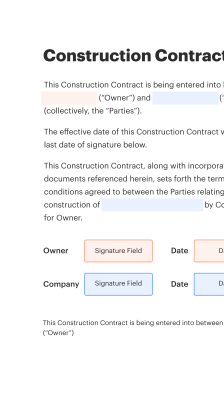
Lead Segmentation for Inventory
lead segmentation for Inventory
Experience the benefits of airSlate SignNow's lead segmentation feature for inventory today and witness the difference it can make in your business operations. Take advantage of this powerful tool to effectively manage your leads and streamline your workflow.
Streamline your inventory management with airSlate SignNow's lead segmentation feature now!
airSlate SignNow features that users love





Get legally-binding signatures now!
FAQs online signature
-
What are the four 4 types of inventory classifications?
The four types of inventory are raw materials, work-in-progress (WIP), finished goods, and maintenance, repair, and overhaul (MRO) inventory. Knowing which items belong to which category allows you to optimize your operations and account for each step of the production process more efficiently.
-
What are the 4 target segments?
Market segmentation is the process of dividing the market into subsets of customers who share common characteristics. The four pillars of segmentation marketers use to define their ideal customer profile (ICP) are demographic, psychographic, geographic and behavioral.
-
What is the ABC of inventory segmentation?
The most important stock keeping units (SKUs), based on either sales volume or profitability, are “Class A” items, the next-most important are Class B and the least important are Class C. Some companies may choose a classification system that breaks products into more than just those three groups (A-F, for example).
-
How do you segment your leads?
How do you segment leads for better targeting? Define your goals and metrics. Identify your segmentation criteria. Collect and analyze your data. Create and test your segments. Optimize and refine your segments. Here's what else to consider.
-
What is an example of lead segmentation?
Lead segmentation is like organizing a bunch of different toys into separate groups based on what they do or what they look like. For example, you might group all the toys that are for babies together and all the toys that are for older kids in another group.
-
What is 4 segmentation?
The 4 main types of segmentation variables include demographic, geographic, psychographic, and behavioral traits. For example, if you were to segment your audience based on their zip code, you would be using the geographic variable.
-
What is inventory segmentation?
Inventory segmentation is the apportion of inventory into segments. When inventory is apportioned for a segment, it indicates that the inventory is not to be consumed for demands other than the demands with matching segments segment types, or both.
-
What is stock segmentation?
Stock segments are used for logical distribution of existing and planned stock. Therefore, stock segments are assigned to both the physical stock and procurement proposals such as planned orders, production orders, purchase requisitions, and purchase orders.
Trusted e-signature solution — what our customers are saying


How to create outlook signature
today we're going to be talking about inventory segmentation and how we use inventory segmentation to improve our performance as a business first let's talk about what inventory segmentation is the model that we will be using today is a three by three matrix the ABC classification is a classification by usage value and the LMH classification is a variability of demand that creates nine boxes for us to look at and to segment the inventory now the first question is why do we need to segment inventory well demand patterns are different and values are different so the strategies that we have to hold inventory in those based on those classifications is different we may need to hold more of a product that we use frequently or based on the manufacturing environment we're working in holding less of it and replenishing it more frequently may be the better strategy or with a very high variability product something that we don't use often maybe we need to work more closely with the supplier to reduce lead times and to increase flexibility so that we're able to move that material in more quickly or potentially we need to talk to our customer about some of those products and say the lead time is going to be longer if you order something that not all of our customers order so there are all kinds of different strategies that may be associated based on the inventory segmentation that we're looking at let's start by talking about ABC classification most of us are familiar with this kind of classification but the key to understand when we're looking at inventory segmentation is that this is not on hand inventory that we're looking at if you've talked about ABC in inventory a lot of times it gets used for inventory management when we're going out and doing cycle counting will use the ABC classification to go out and do cycle counting that classification is usually done based on the inventory on hand because the more value of inventory have on hand the more we want to make sure that it's accurate it helps us to be accurate on our financial statements but when we're looking at inventory management we're still looking at the same kind of ABC classification as far as 80% of the usage value being a 15% being a B and the last 5% being a C but rather than looking at the on-hand value we're looking at the usage value because when it comes to inventory management we need to know how much inventory is flowing through not only how much is sitting in the building and so it's very important that when we do our ABC classification in inventory management that we look at usage not on-hand inventory now some ERP systems are good at doing this and looking at this but they remember that the numbers in the system are only as good as the inputs so oftentimes the ABC classification built into the system is incorrect Z items are their own classification because they have no usage at all over the period that we've been looking at inventory so our inventory analysis always has some kind of a time period we may pull the data monthly for 24 months or weekly for 36 months then our data set is on a fixed time period so whatever time period we choose if we have no usage at all then those are Z items items that are in inventory but have not been used in the period that we are using for our analysis let's talk a little bit about demand variability before we go any further demand variability simply means how predictable the product is that we are buying how it predictable is the demand do we know we're going to sell some every week or is it something that we're not sure how many we're going to sell or if we're going to sell any or is it a special order that we're only going to do once and then we'll never sell it again or maybe there's just a huge spike in demand and we don't know when or why that's going to happen so it's very very difficult to predict so that's what we mean when we're talking about demand variability now that might be different if we're talking about finished goods finished goods demand we're talking about the customer demand is what's changing that variability but in raw materials it's our own manufacturing demand that may be increasing or decreasing that demand variability so we have to look at the kind of inventory that we're working with and understand what the factors are that are impacting that demand now when we're doing the statistical analysis associated with segmentation we don't get into that quite yet but it is important to keep in mind what it is we're analyzing and what kind of inventory we're talking about in order to make rational decisions around the inventory segmentation when we're talking about segmenting by variability and a low medium and high segments of variability the low variability is between zero and one standard deviations from the mean what does that mean that means we look at our usage values over time say we have 24 months of monthly usage so we've rolled up the usage by month and we have 24 numbers now all we do is take the average of those 24 numbers divide them by the standard deviation of the 24 numbers and see what number we get that's what we call it a normalized standard deviation now that standard deviation will help us to understand how predictable that demand is the lower the number is the more steady the demand is the higher the number is the higher the variability so if that number is between 0 & 1 then that demand is relatively predictable in a business environment that's something we can forecast that's something we know we're going to be able to use and if it's medium variability if that numbers between 1 & 2 then it's harder to predict we we may know that we're going to use it but not know how much I was working in a company that made milk their product that was kind of in that medium variability range was chocolate milk because this was in the Netherlands and they use chocolate milk a lot to make hot cocoa in the winter so the sales of chocolate milk was directly correlated to the weather and the weather can be kind of that medium variability if you track it over time you know it's going to get cold but you don't know how cold or for how long and so the demand for chocolate male milk was not consistent whereas the demand for white milk was relatively steady and consistent and they always hold the regular milk every week they sold a predictable amount but the chocolate milk demand would spike when the weather got cold so it's that kind of thing that we know we're going to sell it but we don't know how much for exactly when now the high variability product high variability is something that we have a very difficult time predicting because it's associated with a special project or it's something that a customer custom orders we just don't know when we're going to need it or how much that high variability product is much less predictable and we have to work a lot harder with our customer to know when we're going to need it in order to forecast that kind of product then we're going to take a quick look at the inventory analysis matrix overall we talked about the variability of demand and the ABC classification and we're putting those two things together in order to think about what our strategies should be now we could try to come up with 10 different strategies based on the classification and many people frankly do that in my opinion that's a mistake because an implementation 10 strategies is too many to choose from you need to look at the project you're working with or the product you're working with and classify it in the least reasonable number of classifications here we have 5 a and B low low variability our strategy is going to be very similar if not the same for those products it might be different for the medium variability and different again for the high variability C items we're suggesting that we handle all of them the same regardless of of what kind of demand pattern they and Z items those those obsoletes are something completely different why would I say that 10 is too many because in in practice when you're working in a factory the difference between strategies six and number seven gets lost and what you'll find is that you end up using only four or five of the strategies anyway so why put a bunch of work into developing strategies for all ten of these boxes when the truth is you're only going to use five and so you might as well set up your your system and your your processes to work in the way that you're actually going to manage things I strongly recommend simplicity for implementation when it comes to inventory segmentation is the key to it actually being implemented at any system that is too complex will never be used when it's brought out onto the factory floor now our strategies around see items I said that maybe we should handle those all the same well our strategy there is to hold inventory the see items are by definition low value there are things that we don't use a lot that the usage value is very low so if we hold a little more inventory it's not going to hurt our cash flow when we think about inventory it's one of the three elements working capital and it takes cash to hold inventory and so when you say we're going to hold more inventory it rings all the alarm bells for the finance folks well it's not a lot of money when we're talking about see items and the cost of holding the additional inventory is much much smaller than the cost of running out and so if we've got rivets and screws and some tape and small items that we have that are low value we want to make sure we have enough stock on hand that we never run out we should never stop a production line based on a shortage in see items we should also never expedite see items I often see in businesses that they are expediting bringing in a box of screws in order to make sure the production line doesn't go down the shipping cost of expediting overnight that box of screws was higher than the value of the screws themselves now that is not a good use of our cash we should have had that bat in stock we should never run out of C items and so our our service levels should be extremely high on C items in this classification we're talking about all of them the same we might do in something a little bit differently with Cee Lo's than than the rest of the C items but these are a perfect opportunity for our vendors to manage the inventory for us for our suppliers our suppliers can manage this inventory better than we can because it's their core business these are items that that we should have an area that our suppliers make sure that our inventory is kept up and they are managing a forest so they're not drawing our attention away from the things that are core for our business these are sometimes held in supermarkets or in some kind of when I say supermarkets that's the that's the lean term with a Kanban with a supermarket it might be held in a supermarket they might be held in a vending machine there are all kinds of different tools that we can use to manage this inventory but the key is to make to make it so that we don't have to touch it a lot we don't have to focus on it a lot and that we never run out so our strategy on the C items is to make it automated as automated as possible and to make it consistent so that we never run out of the product now the Z items are a whole nother animal because these are obsolete they're sitting in inventory they're tying up our cash because any time you see your inventory sitting on a shelf that's cash sitting on a shelf so what are we going to do with it are we going to get rid of it are we going to use it can we turn it into something we can use all of those questions need to be asked and if there's not a systematic way of dealing with this kind of inventory it will just continue to grow over time and eventually become a real problem for the best there are different reasons it might be a problem I mean what's the problem if we've already paid for it and it's sitting on the shelf well it's taking up shelf space it has to be inventoried there are all kinds of costs associated with holding obsolete inventory this process of getting rid of Z items is a standard way of figuring out how to free up some cash in the business and sometimes these items can just be you know if there are finished goods all we need to do is tell sales that we have them in the warehouse and they can go out and find somebody to buy them it's sometimes that simple other times we need to bite the bullet and go ahead and scrap this stuff and get rid of it so that it's not taking up warehouse space and not taking up our time now let's talk about inventory drivers first is customer requirements their requirements as far as service level and on-time delivery their requirements for price are concerned and poor quality of concerned all are going to be a primary driver of how much inventory we hold next we we think about our supply base we have our customers and our suppliers what is their flexibility are they able to deliver in and change based on our orders what are their minimum order quantities the way they set up their plant may require us to buy a certain amount of product and it may not not be the optimal amount of product for us and what is the cost of dealing with those suppliers and and of buying from them if it's low value we already talked about the importance of the value of inventory a B and C the the other thing is the demand pattern which we've already talked about the variability quite a lot but it's also frequency of demand how often is this product called for and how critical is it will impact how much inventory we hold there are products that we have to have and so we will always use the cash to hold that in retort in order to make sure that it's available when our customer needs it now all of these things are tied together by lead time how long does it take to get the inventory I'm sure you've heard of one-piece flow ideally if we didn't have lead time we could get each piece exactly when we need it and use it and never have to hold inventory because we have one piece flow now that's an ideal that is impossible in most circumstances and so because of lead time we have to hold inventory but to the amount that we can control the time we can actually reduce the value of inventory that we need to hold here is a practical example of how to use these concepts in a real company so here we have a data set that was from a real company where we have the ABC Z classification and the low medium and high variability of demand classification we can see that the low variability column adds up to only about 3500 parts out of the 23,000 850 so 15% of our parts are low variability whereas the high variability column that's 14,000 part numbers out of the 2300 so MRP is going to have a little bit of difficulty managing these parts because of the lack of predictability and the difficulty of forecasting accurately the other thing that we can tell by looking at this data set is that only 6% of the parts 1358 parts make up 80% of the value that tells us that we have some very high-value parts and it's not that many we have to manage in order to manage that 80% of spend or of our usage over time and so we can focus on that 1,300 parts and get the value the the efficiencies associated with 80% of our inventory and it also shows us that we have 2,000 parts that are obsolete out of that 2300 and so we have over 7 percent of our inventory on hand is obsolete parts that we should get rid of in order to make room for things that we actually use now how do we do this in practice there are a couple of steps here to talk about when we want to think about how to do inventory segmentation first we have to collect the data now we have to get that straight out of the systems and it's crucial that we understand where that data come from comes from and that it's not already filtered for other reporting because if we use data that's already being used for something else there are going to be filters applied that we don't know about and that we don't necessarily want on our data set so make sure we get a good clean data pull then we clean that in other words we look for outliers we pull those out we ask questions to make sure that we understand what the data set looks like and should look like and get rid of things that we shouldn't be looking at and then we validate that data do simple things like summing it by month and and validating it with finance to make sure that we're looking at the data correctly before we ever do anything else because the most common mistake people make with data analysis is not really understanding and cleaning their data correctly in the first place and so all of the work that they do afterwards is then suspect because they didn't really understand their data set then we can go into the inventory coverage analysis aging the inventory profile and segmentation and those are in order of importance those should be validated all the way along with our stakeholders in order to make sure they understand what we're doing that's it for today if you have any questions you can contact me thank you stay safe
Show more