Streamline Your Sales Audit Procedures for Sales with airSlate SignNow
airSlate SignNow regularly wins awards for ease of use and setup




See airSlate SignNow eSignatures in action
Our user reviews speak for themselves











Why choose airSlate SignNow
-
Free 7-day trial. Choose the plan you need and try it risk-free.
-
Honest pricing for full-featured plans. airSlate SignNow offers subscription plans with no overages or hidden fees at renewal.
-
Enterprise-grade security. airSlate SignNow helps you comply with global security standards.
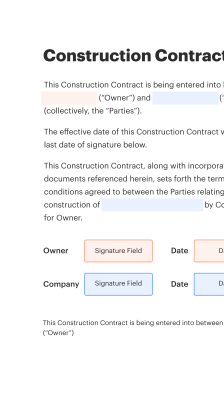
Sales audit procedures for Sales
sales audit procedures for Sales How-To Guide
By following these simple steps, you can ensure that your sales audit procedures for Sales are conducted smoothly and efficiently. Take advantage of airSlate SignNow's features to simplify your document signing process today.
Streamline your sales audit procedures for Sales with airSlate SignNow and experience the convenience of secure eSignatures.
airSlate SignNow features that users love





Get legally-binding signatures now!
FAQs online signature
-
How to do a sales process audit?
1 Define your audit scope and objectives. ... 2 Collect and analyze your sales data. ... 3 Evaluate your sales strategy and alignment. ... 4 Identify your sales process gaps and opportunities. ... 5 Develop your action plan and recommendations. ... 6 Implement and monitor your action plan. ... 7 Here's what else to consider. How to Conduct a Sales Process Audit in 6 Steps - LinkedIn LinkedIn https://.linkedin.com › All › Sales Consulting LinkedIn https://.linkedin.com › All › Sales Consulting
-
How do auditors verify sales?
The types of tests that can be performed will vary by company, but the audit team will generally send confirmations to customers, examine invoices, or vouch customer payments to the bank statement. How to verify that revenue or sales transactions occurred or ... Universal CPA Review https://.universalcpareview.com › Questions Universal CPA Review https://.universalcpareview.com › Questions
-
What is a sales audit in retail?
Retail audits help brands measure and monitor retail success by analyzing the shopper's experience with your products in-store. Using a retail audit, your brand can identify the time it takes to find your products on shelf, the helpfulness of store employees, the scarcity or abundance of stock and more.
-
What is sales process audit?
A sales audit is an analysis of a company's sales tactics and history. Sales audits help companies consider their current state so they can make better sales and business strategies. This process includes both sales and marketing teams and can help professionals understand the company's strengths and weaknesses.
-
What is the sales audit process in retail?
In retail, the sales audit function describes the process of reviewing the Point-of-Sale (POS) and Order Management System (OMS) transaction data for accuracy. ReSA provides a simplified sales audit process while ensuring the integrity of audited data and smooth integration with other retail applications. 1 Sales Audit Overview - Oracle Help Center Oracle Help Center https://docs.oracle.com › doc.160030 › overview Oracle Help Center https://docs.oracle.com › doc.160030 › overview
-
What to check in sales while auditing?
However, the following steps should be included in every sales audit: Evaluating your existing sales process. ... Reviewing your sales stack. ... Examining your sales collateral. ... Rating your lead quality. ... Generating customer feedback.
-
What is an internal sales audit?
Internal audits of the sales process are conducted to assess the effectiveness of an organization's sales practices. These audits typically involve reviewing the organization's sales procedures, including how leads are generated, how sales are negotiated, and how contracts are executed. What is a sales audit? 5 Steps to conduct a ... - TeleCRM TeleCRM https://telecrm.in › Home › Sales & Marketing › Sales TeleCRM https://telecrm.in › Home › Sales & Marketing › Sales
-
What is the process of retail audit?
A retail audit is a formal, systematic inspection of the various aspects of a retail business. This includes analyzing store operations, ensuring product displays are cohesive, managing inventory supplies, providing quality customer service, and sustaining overall compliance with company standards.
Trusted e-signature solution — what our customers are saying


How to create outlook signature
hello and welcome to the session this is Professor Farhad in this session we're going to look at analytical procedures as a substantive test of details when it comes to sales and the collection cycles no beer in mind we are still working within the sales and the collection cycle and we look at six different prior recordings so this is gonna be the seventh recording within this session so the first thing is we need to know what our analytical procedures do you know what analytical procedures or yes we did cover them in a prior session but I'm gonna do it do a quick review here analytical procedures is the study of relationship data between various fingers now the assumptions here is what the assumption is there is a stable relationship in that industry or in that company or in the figures so an initial itical procedures we have to assume that we have some sort of a base that we are basing things upon so we could look at ratios we could look and a horizontal analysis vertical analysis so on and so forth this is what analytical procedures are now I do have one whole session about analytical procedures in the other thing and the other thing playlists but this is just a reminder it's not only we're looking for those relationship we're also looking for any unusual fluctuation so this is what looking for why would why would you use it why we are looking for unusual fluctuation simple to look for further investigation so why do we do so we look something unusual like what if we say an increase in receivable okay and an increase of receivable of 10% and an increase in sales of 2% so a or is increasing by 10% and sales is only increasing by 2% well we need to look into this this is this is a common one okay or account receivable is increasing or sales is decreasing so your sales is going down but your accounts receivable is going up so we're looking for unusual relationship what we can find one we also look at things like large receivable unusual amounts long overdue receivable a receivable from affiliate companies officers related party and so on and so forth so we don't we don't only look at relationship if there's any figures that's kind of that stands out that doesn't make any sense if an if a balance is way overdue and this is kind of in a sense part of the analytical procedures now political procedures it gets done at three stages and the audit we do illogical procedures at three stages stage one is at the beginning of the audit and this is part of the risks risk assessment procedures which we cover in another session part two is during the audit and again this is what we're doing today this is an optional step as a substantive test so the auditor decides if they're going to do substantive procedures or not once again what are they what do they what factors do they take into account is there any proper relationship is the company stable from year to year is the industry stable because some industries they might be growing very fast then going down growing up fast then going the up and down so there's a lot of fluctuations in the activities of the company then then there is a then analytical procedures may not make a lot of sense it depends on the stability of the figures okay and we do analytical procedures at the end of the audit which is you have to do this you have to do one and you have to do three in this is part of the finance the financial and analytical procedures at the end of the audit which is this is we have to do this we have to do this we haven't done this as of yet we haven't done this as of yet bear in mind that substance of analytical procedures performed during the detail the detailed testing phase are done after the balance sheet date but before the tests of details what we do is we wait till all the numbers are in so we don't start the elliptical procedures before the balance sheet date the malechie date means all the numbers are in we reported all the receivable we reported all the sales we recorded the allowance we recorded the bed that we recorded all the returns this is when we perform the analytical procedures after all the numbers are in okay now bear in mind and when the auditor to perform both planning which is in the stage one and substantive procedures in stage two we do the alyttle procedures for the entire sales and collection cycle not just receivable we're gonna look at relationship in sales we're gonna look at relationship sales and bad debt allowance and receivable we may we might look at returns in relationship to sales so we look not only at account receivable we look at many different all all the accounts involved and this is necessary because the close relationship between these income statement and the balance sheet accounts so we don't only look at you know account receivable changes and receivable we look at all the all the different figures any of some examples of some analytical procedures for example we could compare gross margin with previous years so this is gross margin so it has so it has nothing to do with the account receivable directly but it may give us something some information so it may give us overstate with your understatement of sales or receivable so it's assumed in the friary of the gross margin for a product line we could also look for a product line or for the company overall so if we have many product line we could look at gross margin for each product line so let's assume the gross the gross margin was 20% and this year the gross margin is 25% well that's a huge increase of 5% why are we overstating sales that could be the case or it may not be the case but could be that our sales went up in our cost of goods sold did not go up but doors eree there's a risk that we overstated our sales or the opposite could be true gross margin went from 50 20 to 15 we might be understating sales and account receivable another finger we can look at this compare sales by month over time so we can look at Jenny where he last year January this year February last year February this year if sales last year was 200,000 and this year around 210 this could be a normal you know normal comparison but if sales was 200,000 and January and sales this year as 300,000 then assuming there should be a stable relationship then we need to find out why sales went up that much and we'll do the same thing for February March April so we do it month by month this way we can see if there's any overstatement and sales and account receivable obviously when we say sales we're assuming we're also comparing the account receivable here because both accounts are related we could compare sales returns and allowances as a percentage of gross sales with prior year such as soon last year sales returns and allowances were 3% or let's say 5% in this year sale three returns and allowances are 1% hold on a second are we hiding any sales returns and allowances or there were five years and now they are that they were 5% and now they are 8% well what's happening are we are we having a lot of sales returns and allowances okay so or is there any changes and sales maybe sales returns and allowances are stable but sales is fluctuating more than normal more than what we expected so this is we could look at overstatement and understatement of sales returns and allowances and account receivable as well we can look at individual customer balances over a stated amount with a previous period for example ABC customer ingenuity first court order balance was 250 thousand last year this year ABC account balance is 500 thousand just to make it extreme life Wow why is this a huge increase why did their account receivable double why aren't they paying doorbell are we selling them more and they're not paying doorbell what's going on this is what we are looking for we're looking for now we're drilling into a specific customer here we're looking for misstatement of receivable and related income statement we could compare bad debt expense as percentage of gross sales so we look at will get bad that bad that last year was an 8% of sales this year it is 6% or 5% of sales what's happening why are we having less bad that in terms of sales okay especially when we see that our sales going up and specifically sales on credit so we need to know why or it could go from 8 to 15 percent why did our bet that expense went out again those are the thing we're looking for we're looking for in collectable account receivable that has not been provided for so are we missing something here okay so again we could also look at compare the number of days of days that receivable are outstanding with prior year and related turnover let's assume last year we would collect our receivable every 30 days and this year we are collecting our receivable every 40 days Wow why is it taking us longer to collect receivable okay days days in collection or the turnover was lettuce soup the turnover was twelve now the turnover is only eleven okay so we're looking at those type of relationship what are we looking for overstatement or understatement of allowance and bed that expense and specifically fictitious receivable fictitious receivable could be an issue here that's why we have more receivable that's taken us longer to to collect compare the aging of receivable as a percentage of account receivable and compare that to the prior year okay here we're looking for overstatement and understatement of net that expense we could also compare the allowance as a percentage of receivable what was our allowance for example our allowance was 3% of receivable this year it's 5% why that's what we're looking for we're looking for either overstatement or understatement of allowance again if last year was 3% if everything is normal it should be 3 percent this year unless there's a reason why it should fluctuate so we're looking for unusual fluctuation compared write-offs often collectible as a percentage of account receivable and comparison to the priority at how much did we how many accounts that we write off last year in comparison to account receivable and what's the number this year what we're looking for overstatement or understatement of allowance and bad debt expense so those are the different figures we're looking for now right again I'm not using specific numbers but what I'm gonna do in the prior session we're going to look at this example so we're gonna work with some data to see how this actually works so you could look at this example try to work it on your own in the next session we will cover it as a practice of how do we how do we deploy analytical procedures to help us to help guide us and in the audit if you have any questions any comments by all means email me or see me in class and if you're studying for your CPA exam study hard
Show more