Transform Your Spanco Sales Process with airSlate SignNow
airSlate SignNow regularly wins awards for ease of use and setup




See airSlate SignNow eSignatures in action
Our user reviews speak for themselves











Why choose airSlate SignNow
-
Free 7-day trial. Choose the plan you need and try it risk-free.
-
Honest pricing for full-featured plans. airSlate SignNow offers subscription plans with no overages or hidden fees at renewal.
-
Enterprise-grade security. airSlate SignNow helps you comply with global security standards.
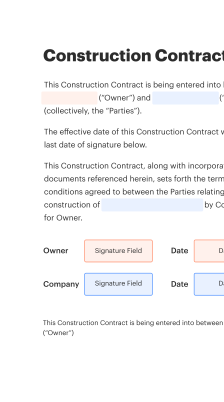
Spanco Sales Process
How to Utilize the Spanco Sales Process effectively:
In conclusion, by leveraging the power of the Spanco Sales Process, you can take your sales operations to the next level and achieve greater success. Start optimizing your sales workflow today with Spanco and see the difference it can make in driving your business forward.
Take the first step towards improving your sales process with Spanco today!
airSlate SignNow features that users love





Get legally-binding signatures now!
FAQs online signature
-
What is the 4 step selling method?
The purpose of money is to be exchanged for goods or services therefore based on the above definition, Sales run this world. There are four Steps in the sales process: 1) Greet, 2) Qualify, 3) Present, 4) Close.
-
What is the difference between a suspect and a prospect in Spanco sales funnel?
I Feedback: A suspect is a customer with whom you have not interacted, but they have shown some interest in the product. A prospect is a suspected customer with whom you have interacted.
-
What is the first step to do in Spanco?
SPANCO - Suspect, Prospect, Approach, Negotiations, Close, & Order. Read it till the end to understand better.
-
What are the 4 stages of the selling process?
Stage One: Lead Generation and Qualification. Stage Two: Lead Conversion. Stage Three: Sales Management and Deal Closing. Stage Four: Post-Sale Actions.
-
What is the Spanco model of selling?
Mr Ajit Jain briefed the class about SPANCO model i.e. Suspect, Prospect, Approach, Negotiation, Close, Order. Suspect:- A suspect is the person who will spend for a certain amount of time in the sales conversation or sales process without any intention to buy the products.
-
What are the 7 steps of sales process?
The 7-step sales process Prospecting. Preparation. Approach. Presentation. Handling objections. Closing. Follow-up.
-
What are the 5 steps of the sales process?
How the 5-step sales process simplifies sales Approach the client. Discover client needs. Provide a solution. Close the sale. Complete the sale and follow up.
-
What is the Spanco method of selling?
Mr Ajit Jain briefed the class about SPANCO model i.e. Suspect, Prospect, Approach, Negotiation, Close, Order. Suspect:- A suspect is the person who will spend for a certain amount of time in the sales conversation or sales process without any intention to buy the products.
Trusted e-signature solution — what our customers are saying


How to create outlook signature
Do you ever find yourself in a selling situation where things just start to fall apart and you're not sure why? You know what, that happens to salespeople all day long. And the problem is that the salesperson did not have the right sales process. When you're not using the right sales process, problems come up, things start to fall apart. In this video, I'm going to show you the absolute best sales process ever, check it out. (light music) What we're going to be focusing on here all comes from the Sales Insights Method, which is our proprietary sales process that we have developed from the best data on what is working in sales. Without further ado, let's dive right in. Number One- Insight opens the door. As you can see in the sales process, the first step is insight. And what insight really means is, are you demonstrating that you know what's going on in the prospect's world? Can you bring some value to the table to get them to lower their doors and ultimately start the conversation? Because what we see nowadays are two approaches. One is where the salesperson just goes in and starts pitching and selling their product or service, which is disastrous. The other is where salespeople go in and immediately start with the probing questions. And the prospect is like, "Whoa, whoa, whoa, whoa, I don't know who you are. I have no idea, why should I answer these questions?" What insight does it solves both of these. Because it allows us to really come into the conversation with real value, real insight. Because as a salesperson, you actually have one of the ultimate bird's-eye views of what's going on in your prospects' lives because you talk to so many people who are just like them in similar situations. Bringing that insight early on into the conversation, that's what gets the prospect to ultimately open up and start the conversation with you. Number Two- Disqualification makes more sales. The next step in the Sales Insights Method is disqualification. Now, chances are, if you've been in sales for a little while, you've probably been taught that you need to persuade or convince prospects to do business with you. Or maybe if you're a little savvier and you've been in this and you learned from some sales trainers, maybe they taught you that you actually want to qualify prospects. We take all of that and we throw it out the door. And what we say you actually want to be doing is be disqualifying prospects. This means using a doctor's mindset. Once you've demonstrated insight to engage them in a conversation, to ask a systematic set of questions to really determine whether they're a fit. And by the way, if they're not a fit, that's cool too. That's what disqualification is all about. It's not coming into the conversation trying to lead to a specific place, but instead, really taking them through a process to determine, is this someone that I should be spending my time with? Because what we see is that top-performing salespeople are spending the highest percentage of their time with qualified prospects. And the only way we're in front of qualified prospects is if we disqualify the people that are not a fit. That's the most important piece of this is that being comfortable with the idea that you know what, I'm not a fit for everyone and not everyone is a fit for us. Once we're there and we can follow that process, we start to free up our time and focus all of our energy on the right people, and they're going to see so much more value in what we do because of the process we've taken them through. Number Three- Solve their challenges. We started with demonstrating insight, and then we disqualify, and now, once we've determined that someone's a fit, we want to solve. You'll notice that we don't say that you're going to present, but instead, you want to be solving. And what solving really means is, you want to demonstrate that you can provide the solution to the challenges that they have talked about. It's not presenting features and benefits or really trying to take them into a benefits conversation, but instead, connecting the dots between where they are and where they want to go and demonstrating that you can provide that bridge to help get them there. When you can solve their challenges and demonstrate that you can do it, that's when powerful things happen. It's not some fancy smooth talking pitch, but instead, just a conversation demonstrating that you are the solution to the challenges that they've discussed that are important to them, that are important that they solve. Number Four- Be next-step-obsessed. You'll notice that throughout this entire process, there are the little word next throughout. And one of the things that we see is that sales fall apart when next steps are not established. What we have found is that top-performing reps are completely obsessed with establishing next steps at every stage of the sale. There are very few selling situations that are truly one-call closes. They do exist, but for the most part, there are multiple steps to most sales. And that's okay. What we want to do is make sure that every time we're near the end of a conversation, we are establishing the next step. This is a place where we've got to be really strong and really firm because we are next-step-obsessed. That's what matters. You're not going to close the sale, you're going to establish that next step that is clear, that is in the calendar, and that is ready to go so that way, you're constantly holding the sale on track and things don't slip through the cracks. Number Five- Rinse, wash, repeat. We've taken you through the process and now what we want to be doing is constantly rinse, wash, repeat. That's the power of having a sales process in the first place. Is that, we know what we're going to be doing at every stage of the sale. And we do it over and over and over again. You know what, sales is redundant. Good selling is doing the same thing over and over and over again. Obviously, there are different things that happen, and so it's fun and we can enjoy what we do, but following that process is what we need to do because it works. I find even myself, as soon as I start to let go of the process and start to just kind of wing it, things start to fall apart. Rinse, wash, repeat. There is the absolute best sales process ever. If you enjoyed this video, then I have an amazing free training on the step-by-step formula to closing more deals. Just click right here to get registered instantly. Seriously, just click right here. This is an in-depth training that will help you close more deals at higher prices, all while generating more meetings. Also, if you got some value, please like this video below on YouTube and be sure to subscribe to my YouTube channel by clicking my face that should be right about here to get access to a new video just like this one each week.
Show more