Role-based controls
Assign different access rights to users and groups so only authorized roles can open, edit, or extract content from password-protected PDFs.




Password-protecting PDFs prevents unauthorized access, complements eSignature audit trails, and helps meet confidentiality obligations. It is a low-friction control that strengthens document confidentiality during distribution and storage without changing the signing workflow.

IT administrators design and enforce password policies for document workflows, implement encryption settings on platforms, and integrate document controls with identity systems. They manage key rotation, storage encryption, and centralized configuration so that password protection aligns with broader security standards and auditing.
Legal counsel defines acceptable access controls for contracts and confidential documents, specifies retention and redaction requirements, and advises on compliance implications. They coordinate with security and record teams to ensure password rules meet legal and regulatory obligations.
Organizations that handle sensitive or regulated records typically require password-protected PDFs as part of routine document workflows.
Applying passwords as part of a consistent process reduces risk and supports compliance with record-handling policies across departments.
Assign different access rights to users and groups so only authorized roles can open, edit, or extract content from password-protected PDFs.
Apply passwords and consistent policies to many documents at once, with reporting to confirm which files were protected and when.
Programmatic endpoints to add encryption, set passwords, and integrate document protection into automated workflows and platforms.
Prebuilt integrations with cloud storage and CRM systems so protected PDFs flow into existing document repositories and business processes.
Centralized control of cryptographic keys and rotation policies to meet organizational security standards and reduce key compromise risk.
Detailed reporting on who attempted to open protected files, successful unlocks, and failed access attempts for operational oversight.
Strong symmetric encryption for document confidentiality, with configurable algorithms and key lengths to meet organizational security requirements and regulatory expectations.
Control whether a PDF can be opened, printed, copied, or edited after unlocking, enabling role-based access and minimizing unnecessary exposure of document content.
Options to deliver passwords securely, such as separate SMS, phone, or an authenticated portal, so credentials are not transmitted in the same channel as the protected PDF.
Comprehensive logs that record when a password-protected PDF was created, who accessed it, and how access attempts were handled for compliance and forensic review. signNow supports integrated audit trail records.

| Setting Name | Configuration |
|---|---|
| Encryption Algorithm | AES-256 |
| Password Policy | Minimum 12 characters |
| Auto-lock Time | Immediate on save |
| Reminder Frequency | 48 hours |
| Storage Location | Encrypted cloud storage |
Verify platform compatibility across desktop, mobile, and common PDF viewers before enforcing password-protected distribution.
Ensure recipients use supported viewers or provide instructions for compatible apps; test encryption behavior across platforms to avoid access failures and to confirm that audit logging remains intact regardless of device.
A clinic encrypts patient discharge summaries before email distribution to external providers to preserve PHI
Resulting in reduced exposure and clearer access records for HIPAA compliance.
A title company applies passwords to closing packages before sharing with buyers and lenders to protect financial details
Leading to fewer post-closing disputes about document confidentiality and chain of custody.
| Criteria for vendor feature comparison table | signNow (Recommended) | DocuSign | Adobe Sign |
|---|---|---|---|
| Password protection option for exported PDF files | |||
| Ability to set a custom password per document | |||
| Use AES-256 encryption for stored documents | |||
| Support bulk application of passwords to many files |
| Plan / Pricing Comparison | signNow (Recommended) | DocuSign | Adobe Sign | HelloSign | PandaDoc |
|---|---|---|---|---|---|
| Entry-level plan pricing and billing model | Per-user plans starting under $10 monthly | Tiered per-user pricing from about $10 monthly | Per-user plans from around $15 monthly | Per-user plans from roughly $15 monthly | Per-user and document credits available |
| Mid-tier business plan details and users | Team plans include admin controls and integrations | Business plans with advanced workflows and integrations | Business plans with Adobe Document Cloud features | Team plans with audit trail and templates | Business plans focused on sales workflows |
| Enterprise pricing and contract flexibility | Custom enterprise contracts and volume discounts available | Enterprise contracts and global compliance options | Enterprise agreements with Adobe Licensing | Enterprise agreements available | Enterprise contracts with custom workflows |
| Password protection included in plan | Included in paid plans and configurable by admins | Included; may require admin configuration | Included in paid tiers | Included in paid tiers | Included with paid subscriptions |
| Free trial and free tier availability | Free trial available and limited free tier features | Trial available, limited free individual use | Trial available with Acrobat subscriptions | Free trial available for new accounts | Free trial and free plan available |
| Billing granularity and per-signature fees | Per-user licensing without per-signature fees | Per-user or envelope pricing options | Per-user and subscription licensing | Per-user pricing with some per-signature options | Per-user plus per-document options possible |
To add an extra layer of protection to your eSignature transaction and ensure that only you and your recipient can access a document, use two-factor authentication. Secure your file with a password.
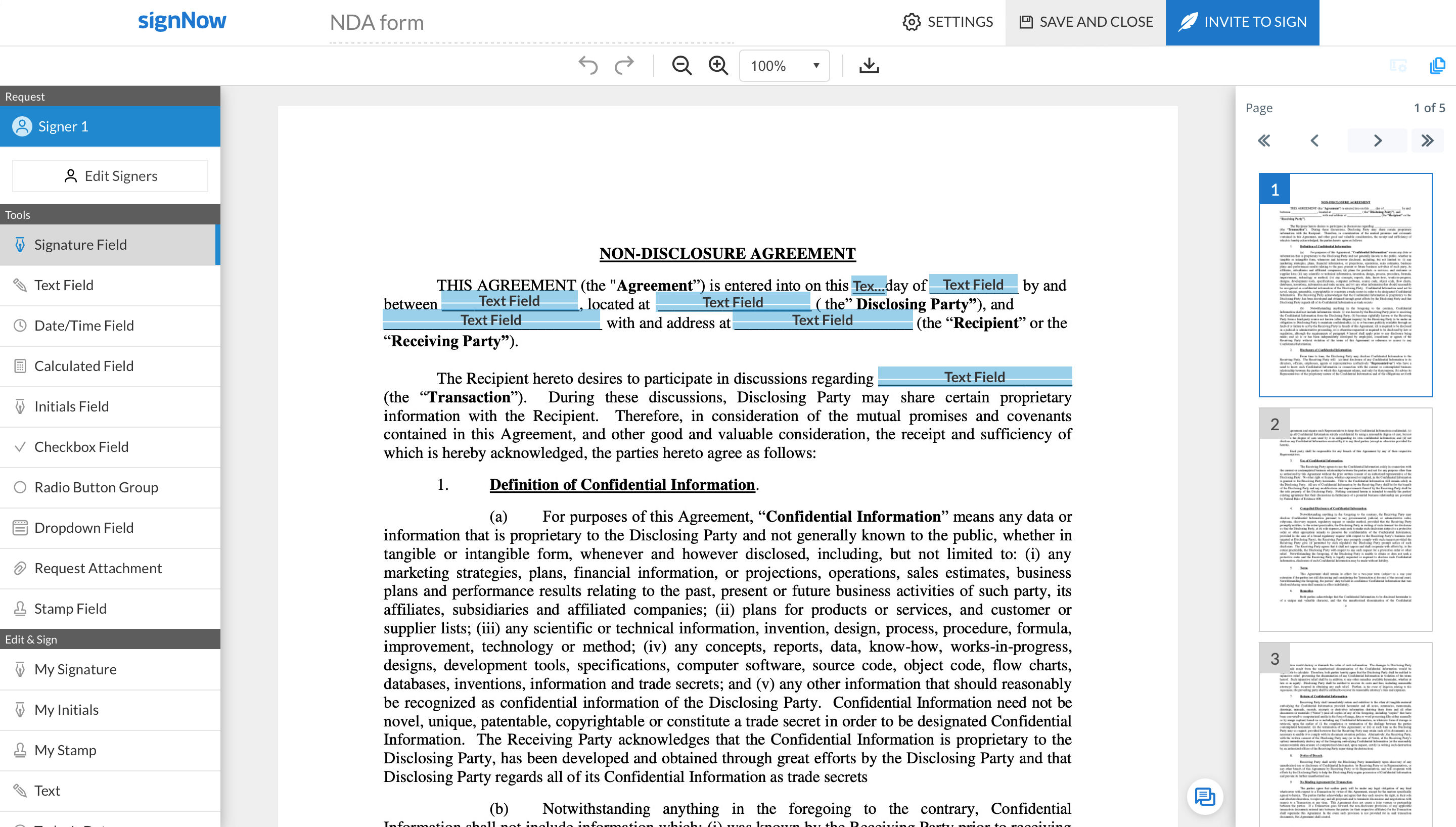
Once you have added fillable fields to a document and assigned signing roles, click Invite to Sign.
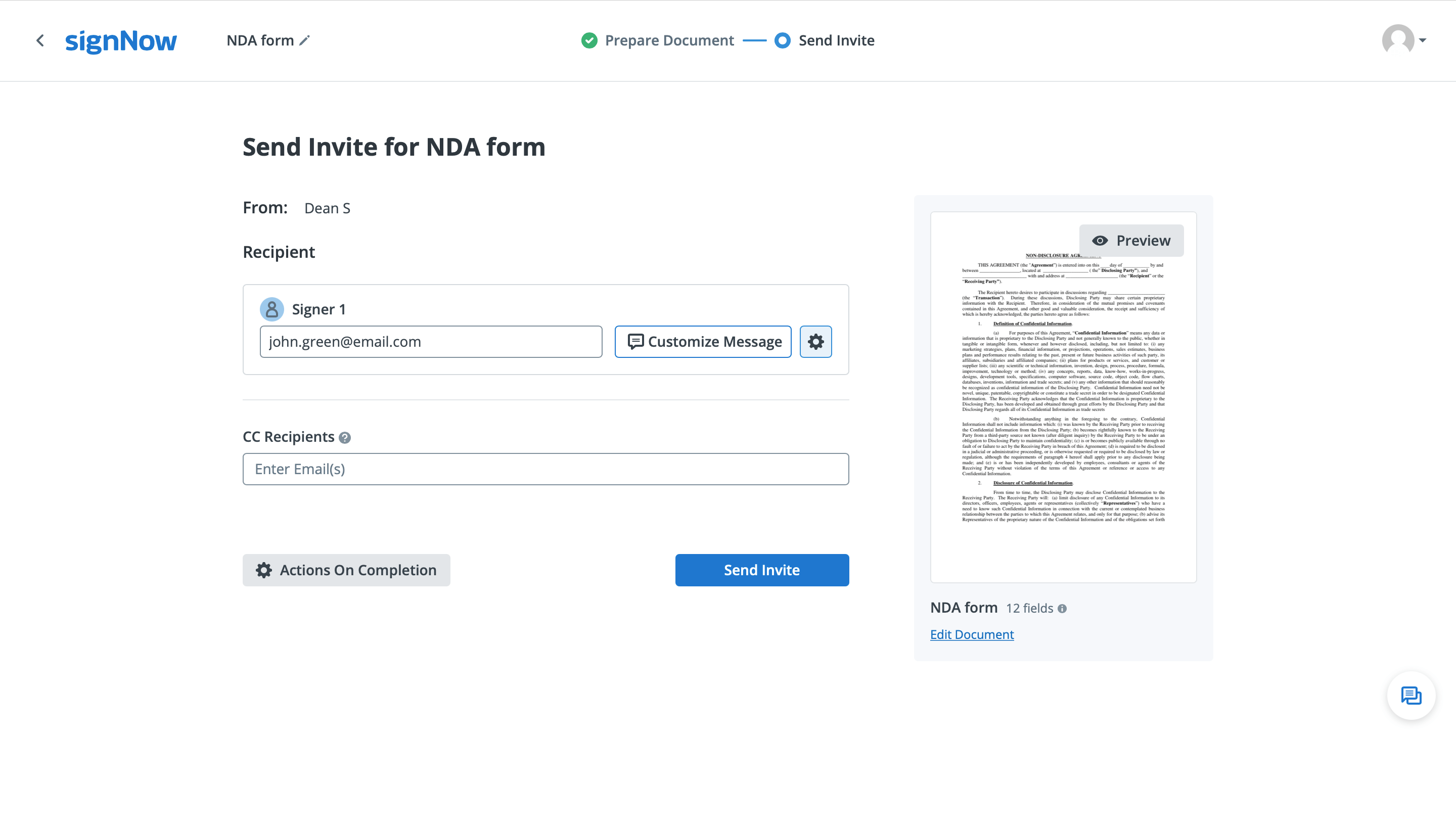
When finalizing your eSignature invite, click the gear icon next to your signer’s email address to view the advanced settings.
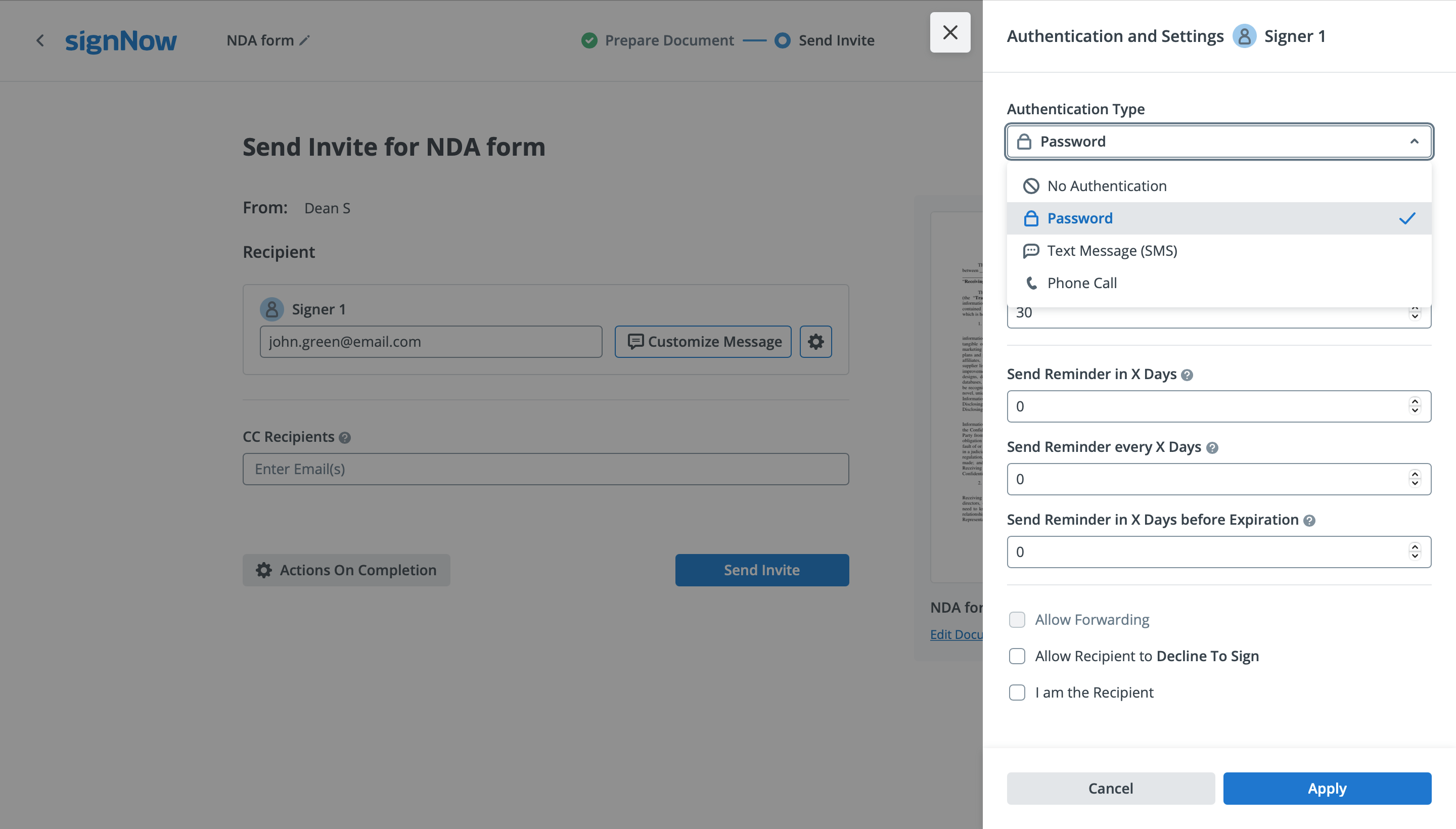
Select Password from the Authentication Type dropdown. Then, enter your password in the box below and hit the Apply button.
When finished, send your signature invite. Now, your recipient will have to enter the password you have created to access your document. Don’t forget to communicate this password to your signer (via email, phone, in person, etc.). Otherwise, they won’t be able to sign your document.











