Best Invoice Design for Mortgage Solutions

Streamline your invoicing process with airSlate SignNow's easy-to-use and cost-effective eSignature solution. Enhance your business efficiency while ensuring secure document management.

Award-winning eSignature solution

What best invoice design for mortgage means in practice

A best invoice design for mortgage refers to a standardized invoice template and process tailored to mortgage lending workflows that clarifies fees, escrow items, interest calculations, and closing costs while supporting required disclosures. It combines clear line-item presentation, required regulatory fields, payer and loan identifiers, and consistent numbering to reduce disputes and accelerate reconciliation. When paired with secure electronic signing and reliable audit trails, a mortgage-specific invoice design helps servicers, brokers, and vendors exchange billable items efficiently, maintain compliance records, and integrate with loan servicing platforms and accounting systems.

Why use a mortgage-focused invoice template

A tailored mortgage invoice reduces errors, supports regulatory transparency, and speeds reconciliation across lenders, brokers, and settlement agents while standardizing required disclosures for audit readiness.

Why use a mortgage-focused invoice template

Common challenges when designing mortgage invoices

  • Inconsistent line items across vendors create reconciliation delays and frequent clarification requests.
  • Missing loan identifiers or borrower details increase risk of misapplied charges and accounting errors.
  • Poorly formatted escrow and prorated fields cause confusion during closing and audit reviews.
  • Manual distribution and signature collection lengthen billing cycles and raise document control issues.

Typical user roles and responsibilities

Loan Officer

Loan officers prepare client-facing estimates and ensure charges align with underwriting and rate locks; they need clear, borrower-facing invoice sections and quick signoff workflows to finalize disclosures.

Title Agent

Title agents assemble closing statements and coordinate disbursements; they require precise line-item templates, escrow breakdowns, and document-level signatures to close transactions on schedule.

Who benefits from a best invoice design for mortgage

Mortgage lenders, title companies, loan servicers, and third-party vendors use standardized invoices to simplify billing and compliance.

  • Mortgage lenders and originators managing closing cost schedules and fee disclosures.
  • Title and settlement agents producing itemized closing invoices and disbursement statements.
  • Loan servicers and accounting teams reconciling escrow and payment adjustments.

Consistent invoice design reduces back-and-forth communication and supports faster funding, reporting, and audit readiness across teams.

Essential features for mortgage invoice workflows

These features support accuracy, compliance, and efficient processing of mortgage invoices across teams and systems.

Template Library

A centralized template library stores approved invoice formats with required disclosures and standardized field mappings so teams use consistent templates and reduce manual formatting errors.


Auto-fill Fields

Pre-populate borrower, loan number, and fee codes from LOS or CRM to eliminate rekeying, speed invoice creation, and reduce mismatched charges or missing identifiers.

Sequential Approvals

Configure workflows that require designated approvals in order, ensuring compliance checks occur before invoices are sent to payers or external vendors for signature.

Audit Trail

Maintain immutable records of every transaction event, including timestamps and IP addresses, to support audits and dispute resolution with clear provenance.

Custom Line Items

Allow granular line-item descriptions and codes for escrow, third-party, and service fees so accounting systems can map charges to correct GL accounts.

Secure Archival

Automatic, encrypted archival with retention rules preserves signed invoices for required regulatory periods and simplifies retrieval for compliance reviews.

be ready to get more

Choose a better solution

Integrations that matter for mortgage invoices

Integrating invoice templates with core systems reduces manual entry and improves accuracy across mortgage operations.

Loan Origination Systems

Bi-directional integration with LOS platforms pulls loan identifiers, borrower details, and fee schedules into invoice templates to ensure line items match underwriting records and to reduce reconciliation errors.

Accounting Software

Syncing invoice totals and GL codes with accounting systems prevents duplicate entry, supports period-end close, and ensures vendor payments align with ledger accounts and audit trails.

Cloud Storage

Automatic archival to secure cloud repositories retains signed invoices alongside closing documents, enforces retention policies, and simplifies retrieval for audits and compliance reviews.

CRM and Payment Portals

Linking invoices to CRM records and online payment gateways provides borrower visibility, enables online payments, and centralizes communication about charges and due dates.
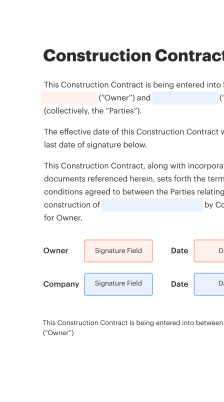
How to create and send invoices online

Online invoice workflows streamline preparation, delivery, and signature capture for mortgage transactions.

  • Create: Upload template or start from a mortgage-specific form.
  • Populate: Auto-fill borrower, loan, and fee data from LOS.
  • Route: Define signers, reviewers, and approval order.
  • Track: Monitor status and collect audit logs.
Collect signatures
24x
faster
Reduce costs by
$30
per document
Save up to
40h
per employee / month

Quick setup: create a mortgage invoice template

Follow these four steps to build a clear, compliant mortgage invoice template that supports electronic signing and document tracking.

  • 01
    Identify fields: List loan ID, borrower, fee types, totals.
  • 02
    Structure sections: Group charges: origination, escrow, third-party.
  • 03
    Add disclosures: Include required lender notices and timing.
  • 04
    Enable signing: Assign signature and date fields for parties.

Audit trail and recordkeeping: step-by-step

Maintain a defensible audit trail by following these recordkeeping steps for each invoice transaction.

01

Capture event:

Log creation timestamp
02

Record changes:

Track edits with user ID
03

Store signatures:

Save signed PDF
04

Preserve metadata:

Include IP and device info
05

Archive copies:

Move to retention store
06

Provide access:

Grant read-only retrieval
be ready to get more

Why choose airSlate SignNow

  • Free 7-day trial. Choose the plan you need and try it risk-free.
  • Honest pricing for full-featured plans. airSlate SignNow offers subscription plans with no overages or hidden fees at renewal.
  • Enterprise-grade security. airSlate SignNow helps you comply with global security standards.
illustrations signature

Recommended workflow settings for mortgage invoice automation

Configure these workflow settings to automate reminders, approvals, and archival for mortgage invoice processing.

Setting Name Configuration
Reminder Frequency 48 hours
Approval Chain Two-step
Auto-archive Delay 7 days
Retention Policy 7 years
Signature Order Sequential

Device and software requirements for invoice workflows

Ensure users have compatible devices and modern browsers to access and sign mortgage invoices reliably.

  • Desktop browsers: Chrome, Edge, Safari
  • Mobile platforms: iOS, Android
  • PDF support: Viewer enabled

For integrated workflows, confirm LOS and accounting systems expose APIs or connectors and that mobile users enable push notifications to avoid signature delays and missed alerts.

Security controls to protect mortgage invoices

Encryption in transit: TLS 1.2+
Encryption at rest: AES-256
Two-factor authentication: Optional MFA
Role-based access: Granular
Document audit logs: Immutable
Permissioned sharing: Restricted links

Real-world mortgage invoice examples

Two concise scenarios show how invoice design reduces friction for lenders and closing agents.

Lender reconciliation

A mid-sized lender standardized invoice fields for origination and appraisal fees to match loan numbers and escrow IDs

  • Template included loan ID, borrower contact, and fee codes
  • Resulted in fewer mismatches and two-day faster reconciliations

Leading to reduced accounting backlog and clearer vendor accountability.

Title company closing

A regional title firm implemented a template separating escrow, third-party, and settlement fees into named sections

  • The invoice included signature fields for payer and authorized representative
  • This clarity reduced post-closing inquiries and reissued statements

Resulting in faster fund releases and fewer courier exchanges.

Best practices for accurate mortgage invoices

Adopt consistent structure and automation to minimize disputes and keep records audit-ready across mortgage billing workflows.

Standardize field names and order
Use consistent labels for loan number, borrower name, escrow details, and fee codes across templates to ensure downstream systems and reviewers interpret charges identically and reduce reconciliation work.
Validate data before sending
Implement automated checks to verify loan ID, escrow balances, and payment due dates; flag discrepancies for review to prevent incorrect billing and post-close corrections.
Include regulatory disclosures
Embed required federal and state mortgage disclosures in the invoice as appropriate, and timestamp sign-offs to demonstrate compliance during audits or regulatory inquiries.
Keep an immutable audit trail
Ensure every sent invoice records sender, recipients, timestamps, and each signature event to maintain a defensible record of approvals and exchanges for compliance and dispute resolution.

FAQs and troubleshooting for mortgage invoices

Answers to common questions and fixes for frequent issues when preparing, sending, or signing mortgage invoices.

Feature availability across popular eSignature vendors

This comparison highlights common capabilities relevant to mortgage invoice signing and verification.

Criteria signNow (Featured) DocuSign Adobe Acrobat Sign
Bulk Send
API Access REST API REST API REST API
HIPAA Support
Mobile App
be ready to get more

Get legally-binding signatures now!

Typical timing considerations for mortgage invoices

Key dates help ensure invoices are processed and signed within loan closing and servicing timelines.

Invoice issuance window:

Within 3 business days post-closing

Payment due date:

Per vendor terms, typically 30 days

Retention start date:

Document signature date

Audit access period:

7 years minimum

Dispute resolution window:

30 to 60 days

Regulatory and operational risks

Noncompliance fines: Significant
Data breach exposure: Severe
Payment delays: Costly
Audit failures: Damaging
Reputational harm: Long-term
Contract disputes: Litigation

Pricing and plan contrasts for eSignature services

Plan features and entry pricing differ; below are representative public plan characteristics for commonly used providers in mortgage workflows.

Plan / Vendor signNow (Featured) DocuSign Adobe Acrobat Sign Dropbox Sign PandaDoc
Starting Price (monthly) $8 per user $10 per user $14 per user $12 per user $19 per user
Free Trial Yes Yes Yes Yes Yes
API Included Available Available Available Available Available
HIPAA Compliance Option Available Available Available Available Available
Enterprise Features SAML, SCIM, Dedicated suporte Advanced admin Enterprise admin SSO, Admin roles Advanced workflows
walmart logo
exonMobil logo
apple logo
comcast logo
facebook logo
FedEx logo
be ready to get more

Get legally-binding signatures now!