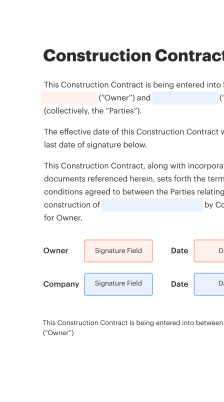
Federal Contract Management for Management

Experience seamless document sending and eSigning with our user-friendly, cost-effective solution designed for your business needs.

Award-winning eSignature solution

What federal contract management for management entails

Federal contract management for management refers to the processes and controls organizations use to create, route, sign, store, and audit contract documents in compliance with U.S. federal procurement rules. It covers bid submissions, award documentation, contract modifications, performance records, and closeout files while ensuring records meet agency retention and audit standards. Electronic signature tools can reduce paper handling and accelerate approvals but must align with ESIGN and UETA requirements, preserve an immutable audit trail, and support authentication and access controls required by federal programs and regulated data handling policies.

Why streamlined federal contract management matters

Efficient federal contract management for management reduces administrative delays, improves audit readiness, and helps teams maintain consistent compliance with federal acquisition standards while lowering operational cost and manual error rates.

Why streamlined federal contract management matters

Common challenges in federal contract management

  • Coordinating multi-party approvals across agencies and contractors with varying security requirements and timelines.
  • Ensuring electronic records meet ESIGN, UETA, and agency-specific retention and audit requirements.
  • Protecting sensitive contract data while granting appropriate access for review and audits.
  • Maintaining version control and defensible chain-of-custody for contract amendments and modifications.

Representative user profiles for federal contract workflows

Contracting Officer

A Contracting Officer prepares solicitations, awards contracts, and signs on behalf of the agency. They need auditable signature records, role-based access controls, and retention capabilities to satisfy federal procurement regulations and to respond to post-award audits and oversight inquiries.

Program Manager

A Program Manager tracks deliverables, approves invoices and modifications, and coordinates with contractors. They require clear version control, automated reminders for milestones, and secure document sharing to manage performance and closeout activities effectively.

Teams that commonly manage federal contracts

Procurement, legal, compliance, and program managers typically collaborate to administer federal contracts and maintain contract documentation.

  • Contracting officers and procurement specialists responsible for solicitations and award documentation.
  • Legal and compliance teams that verify regulatory clauses and manage audit responses.
  • Program managers and subcontract administrators overseeing performance and deliverables.

These groups rely on structured workflows, auditable signatures, and controlled access to meet federal oversight and reporting obligations.

Key tools and capabilities for effective contract management

A secure, compliant electronic contract environment combines signature, automation, security, and records features to meet federal needs.

Template Library

Centralized templates ensure consistent inclusion of federal clauses, streamline document preparation, and reduce the risk of omitted or inconsistent contract language across solicitations and awards.

Bulk Send

Bulk Send enables distribution of identical documents or acknowledgement forms to multiple recipients, maintaining individualized audit trails and accelerating mass compliance or notification tasks.

Role-Based Access

Fine-grained access controls restrict who can view, edit, or sign documents, supporting least-privilege practices required in federal systems and audits.

Advanced Authentication

Support for multi-factor, knowledge-based, and certificate-based authentication allows agencies to match signer verification to contract sensitivity and agency policy.

Audit Trail

Immutable event logs capture timestamps, IP addresses, and action histories to provide defensible evidence for audits and dispute resolution.

Retention Controls

Automated retention and disposition settings help organizations comply with agency recordkeeping rules and reduce manual archive management.

be ready to get more

Choose a better solution

Integrations that support federal contract workflows

Integrations reduce manual transfer of records and keep contract data synchronized across commonly used systems.

Google Docs

Two-way integration lets teams prepare draft contracts in Google Docs, send them for signatures without reuploading, and sync final signed PDFs back to Drive for centralized storage and team access with preserved metadata.

Customer Relationship Management

CRM integrations link contract execution to account records so contract status, signed documents, and expiration dates appear in client profiles, improving renewal and compliance workflows across procurement and program teams.

Dropbox

Direct Dropbox connectivity stores signed contracts in designated folders, applies retention labels, and simplifies sharing with auditors or agency stakeholders while keeping a single source of truth for executed agreements.

Document Management

Integration with document management systems automates indexing, applies metadata and retention rules, and ensures signed contracts are accessible for audits and reporting without manual reconciliation.

How electronic federal contract processes operate

A typical electronic contract process moves a document through preparation, review, signing, and archival stages while preserving evidence of each action.

  • Prepare: Assemble clauses and attach exhibits.
  • Review: Internal stakeholders add comments and approvals.
  • Sign: Signers authenticate and apply signatures.
  • Archive: Store signed files with audit metadata.
Collect signatures
24x
faster
Reduce costs by
$30
per document
Save up to
40h
per employee / month

Quick setup steps for federal contract management

Follow these core steps to configure an electronic contract workflow that supports federal requirements and predictable audits.

  • 01
    Define roles: Map signing and approval responsibilities.
  • 02
    Select templates: Create standard contract and clause templates.
  • 03
    Configure authentication: Choose appropriate signer verification methods.
  • 04
    Enable audit logs: Activate immutable event tracking.

Audit trail management: step-by-step checklist

Use these steps to ensure signed contract records are audit-ready and defensible.

01

Capture metadata:

Record timestamps and signer identifiers.
02

Log events:

Store actions such as views and signatures.
03

Preserve versions:

Keep prior drafts and change history.
04

Secure storage:

Use encrypted, access-controlled repositories.
05

Export capability:

Enable full-report exports for audits.
06

Retention policy:

Apply agency-aligned retention schedules.
be ready to get more

Why choose airSlate SignNow

  • Free 7-day trial. Choose the plan you need and try it risk-free.
  • Honest pricing for full-featured plans. airSlate SignNow offers subscription plans with no overages or hidden fees at renewal.
  • Enterprise-grade security. airSlate SignNow helps you comply with global security standards.
illustrations signature

Recommended workflow settings for federal contracts

Configure these settings to align eSignature workflows with federal procurement controls and audit needs.

Setting Name Configuration
Reminder Frequency 48 hours
Signature Order Sequential
Authentication Method Multi-factor
Document Retention Period 7 years
Audit Trail Enabled On

Supported platforms and system requirements

Federal contract workflows typically run on standard desktop and mobile platforms and require modern browsers plus secure network settings.

  • Desktop browsers: Chrome, Edge, Safari, Firefox
  • Mobile support: iOS and Android apps available
  • Network needs: TLS 1.2+ and outbound HTTPS

Ensure browser and OS versions meet your agency security baseline, enforce enterprise network controls such as VPN or secure gateways as required, and maintain device management policies for mobile signing to preserve confidentiality and integrity of contract records.

Security features to look for

Encryption: AES-256 at rest and TLS in transit
Access control: Role-based permissions and groups
Multi-factor auth: SMS, email, or authenticator app
Audit logging: Immutable event records for every action
Document watermarking: Dynamic visible or invisible watermarks
Data residency: U.S. region hosting options

Industry examples: federal contract scenarios

Practical examples show how structured electronic workflows support common federal contract activities while preserving compliance and auditability.

Bid Submission Workflow

A federal contractor digitizes bid packages to centralize approvals and signature collection

  • Automated sequential approvals reduce coordination time
  • Signed, time-stamped packages include an immutable audit trail that supports compliance

Resulting in clearer submission records and accelerated evaluation timelines for agency review.

Subcontractor Compliance Tracking

An agency prime uses electronic forms to collect subcontractor certifications and clauses

  • Standardized templates capture required federal clauses and attestations
  • Each submission stores signer identity, timestamp, and document history for oversight

Leading to more reliable subcontract records and simplified responses to compliance audits and inquiries.

Best practices for secure, accurate federal contract management

Adopt consistent processes and controls to reduce risk and improve audit readiness across contract lifecycles.

Standardize templates and clause libraries
Maintain a single, controlled repository of approved contract templates and mandatory federal clauses. Use version control and administrative review workflows to ensure any changes are reviewed by legal and compliance before being published for use.
Use role-based access and least privilege
Assign permissions based on job function, limit administrative access, and review access lists periodically. Restrict editing and signature capabilities to authorized personnel to reduce exposure and maintain accountability.
Preserve complete audit trails and metadata
Capture signer identity, timestamps, IP addresses, and document versions for every transaction. Store metadata alongside signed documents to support audits, FOIA requests, and internal reviews without manual reconstruction.
Align retention and disposition with agency rules
Configure automated retention schedules to match federal and agency-specific requirements, document retention policies in an easily auditable manner, and ensure timely disposition when records reach end-of-life.

FAQs about federal contract management for management

Answers to frequent questions about using electronic signatures and workflows for federal contracting, focused on compliance, validity, and operational concerns.

Feature comparison: electronic versus traditional signatures and vendor support

A concise feature matrix comparing signature capabilities among common providers and how they address federal contract requirements.

Criteria signNow (Recommended) DocuSign Adobe Sign
Legal validity (U.S.)
Bulk Send capability
HIPAA-focused option
Native template management
be ready to get more

Get legally-binding signatures now!

Record retention and typical federal timelines

Typical retention ranges and considerations for federal contract documents and related records.

Contract files retention (typical):

Commonly retained for three to seven years depending on agency rules.

Audit and financial records:

Often retained for six years or per agency audit requirements.

HIPAA-related records:

Maintain for six years to comply with federal privacy rule baseline.

Subcontractor documentation:

Retain through contract closeout and agency-specified period.

Disposition review schedule:

Conduct periodic reviews to confirm records meet retention and legal hold obligations.

Risks and potential penalties for poor management

Noncompliance fines: Monetary penalties or disallowances
Contract disputes: Costly litigation or remediation
Audit findings: Corrective actions and scrutiny
Loss of funding: Grants or contract termination
Data breaches: Regulatory reporting and fines
Reputational harm: Impaired future awards

Plan and capability snapshot for common eSignature providers

An at-a-glance view of entry-level plans and core enterprise capabilities across providers commonly used in federal contract workflows.

Plan / Feature signNow (Recommended) DocuSign Adobe Sign OneSpan Sign Dropbox Sign
Entry-level plan Business Personal Individual Cloud Essentials Standard
Free trial Yes Yes Yes Yes Yes
API access availability Included Paid tier Paid tier Enterprise Paid tier
SSO support Available Available Available Available Available
HIPAA compliance option Available Available Available Available Available
walmart logo
exonMobil logo
apple logo
comcast logo
facebook logo
FedEx logo
be ready to get more

Get legally-binding signatures now!