Caiq Compliant SignNow's CRM Vs Creatio

Check out the reviews of the airSlate SignNow CRM vs. Creatio to compare the benefits, features, tools, and pricing of each solution.

Award-winning eSignature solution

Why choose a CAIQ-compliant eSignature path

A CAIQ-compliant approach aligns third-party security assessment expectations with practical eSignature controls. For U.S. organizations evaluating signNow and Creatio, CAIQ alignment helps surface security architecture, data handling, and control maturity relevant to ESIGN, UETA, HIPAA, and FERPA obligations.

Why choose a CAIQ-compliant eSignature path

Typical user roles for a CAIQ-focused deployment

Security Administrator

Responsible for configuring access controls, encryption settings, and retention policies across signNow and Creatio. This role maintains CAIQ evidence, coordinates control assessments, and approves integration credentials and audit settings to ensure ongoing compliance.

Business Process Owner

Manages document templates, signer workflows, and authentication levels for business units. This role documents business justification for workflow choices, reviews audit reports, and liaises with security teams during CAIQ or vendor assessments.

Core features to evaluate for CAIQ alignment

Examine functionality that maps to CAIQ control families: identity, authentication, logging, encryption, access control, and change management to compare signNow and Creatio integrations.

eSignature

Robust eSignature capture with field types, signer sequencing, and completed-document locking to preserve integrity and support non-repudiation requirements under ESIGN and UETA.


Authentication

Multiple signer verification options including email OTP, SMS OTP, and advanced certificate-based methods to meet varying assurance levels required by regulated workflows.

Audit logging

Comprehensive, tamper-evident audit trail capturing events, timestamps, IP addresses, and user agents for each transaction to support forensic review and compliance audits.

Encryption

At-rest and in-transit encryption using industry-standard protocols with key management practices that align to common CAIQ expectations for data protection.

Access controls

Role-based permissions, granular document sharing, and session management to limit exposure and demonstrate least-privilege access during a CAIQ assessment.

Integrations

Prebuilt connectors and APIs for CRM, storage, and identity providers enabling secure data flows and centralized control that CAIQ reviewers expect to see documented.

be ready to get more

Choose a better solution

Integrations and template controls for CAIQ alignment

Focus on integrations and templating that reduce manual handling and preserve control evidence for assessments.

Google Workspace

Native document import and templating from Google Docs allow organizations to maintain original document provenance, automate field placement, and reduce copy workflows that introduce risk while preserving metadata for CAIQ-related evidence.

CRM connectivity

Bi-directional integration with Creatio ensures signed documents and status updates are recorded in the CRM record, enabling centralized access controls, lifecycle tracking, and simplified evidence assembly for security questionnaires.

Cloud storage

Direct links to Dropbox or other compliant storage reduce duplication, enforce retention policies centrally, and keep signed PDF artifacts with consistent metadata for audits.

Template management

Team templates and reusable form fields promote consistency across documents, reduce configuration drift, and allow administrators to enforce required fields important for regulatory and CAIQ control checks.
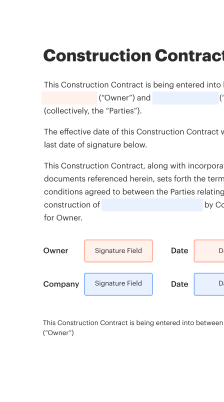
Creating and using CAIQ-compliant signing flows online

A compliant online signing flow integrates document preparation, signer authentication, and audit capture so that each step aligns with control objectives from CAIQ assessments.

  • Prepare document: Upload and apply fields in signNow.
  • Authenticate signer: Choose email, SMS, or certificate methods.
  • Execute signing: Signers complete fields and finalize.
  • Record audit: System stores signature events and metadata.
Collect signatures
24x
faster
Reduce costs by
$30
per document
Save up to
40h
per employee / month

Quick setup: CAIQ-compliant signNow's CRM vs Creatio workflow

This concise setup guide covers initial configuration steps to prepare signNow with Creatio for CAIQ-focused reviews and routine signing operations.

  • 01
    Assess requirements: Map regulatory needs like ESIGN, UETA, HIPAA.
  • 02
    Provision accounts: Create signNow and Creatio service accounts.
  • 03
    Integrate endpoints: Connect via secure API keys and webhooks.
  • 04
    Validate controls: Run a checklist against CAIQ controls.

Audit trail and evidence capture checklist

Use this checklist to confirm the essential data points are captured for each signed transaction.

01

Signer identity:

Method recorded
02

Timestamps:

UTC recorded
03

IP address:

Logged
04

Document hash:

Verified
05

Event sequence:

Immutable
06

Retention tag:

Applied
be ready to get more

Why choose airSlate SignNow

  • Free 7-day trial. Choose the plan you need and try it risk-free.
  • Honest pricing for full-featured plans. airSlate SignNow offers subscription plans with no overages or hidden fees at renewal.
  • Enterprise-grade security. airSlate SignNow helps you comply with global security standards.
illustrations signature

Typical automation settings for compliant signing workflows

Recommended workflow settings help ensure consistent evidence capture and retention across signing events when using signNow with Creatio.

Feature Configuration
Reminder Frequency 48 hours
Signature Order Enforcement Sequential
Audit Log Retention 7 years
Webhook Event Types Completed, Declined
Document Expiration 90 days

Supported devices and system requirements

signNow and Creatio both support modern browsers and mobile platforms; confirming minimum OS, browser versions, and connectivity helps ensure consistent signing experiences.

  • Web browsers: Chrome, Edge, Safari, Firefox
  • Mobile platforms: iOS and Android supported
  • Connectivity: HTTPS required; stable network

For CAIQ review, document the exact browser versions, mobile OS builds, and any proxy or firewall configurations used in production to confirm compatibility and control enforcement across devices.

Security controls mapped to CAIQ considerations

Data encryption: AES-256 at rest
Transport security: TLS 1.2+ enforced
Authentication options: OTP, certificates
Audit records: Immutable logs
Access management: Role-based controls
Data residency: US-based storage

Industry scenarios showing CAIQ-focused workflows

These examples illustrate how signNow integrated with a CRM like Creatio can satisfy typical control and operational needs in regulated sectors.

Healthcare consent workflow

A hospital digitizes patient consent forms using signNow integrated with Creatio to automate pre-visit paperwork and capture authentication methods

  • Field-level validation and secure storage ensure PHI is handled correctly
  • Reduced waiting room time and stronger auditability for release requests

Resulting in improved compliance posture and faster patient throughput.

Higher education FERPA forms

A university uses signNow with Creatio to collect parental authorizations and transcript release forms while recording signer authentication and timestamps

  • Integration centralizes student records and applies role-based access
  • Administrators gain clearer retention and access controls for FERPA compliance

Leading to streamlined recordkeeping and defensible disclosure practices.

Operational best practices for CAIQ readiness

Establish procedures that demonstrate ongoing control operation, documentation, and periodic validation for CAIQ responses.

Document a control owner and schedule reviews
Assign a named owner for eSignature and integration controls who is responsible for maintaining documentation, scheduling periodic reviews, and ensuring any configuration changes are logged and approved to show continuous compliance activity.
Standardize authentication levels by workflow type
Define required authentication methods (email OTP, SMS, certificate) for each workflow based on transaction sensitivity, and document decision criteria so CAIQ reviewers can map authentication strength to business risk.
Centralize logs and evidence
Aggregate audit logs, webhook records, and signed artifacts into a single retention store with controlled access and versioning to simplify evidence collection during assessments and incident investigations.
Test and validate incident response procedures
Run tabletop exercises for signature or integration incidents to confirm detection, containment, and communication steps; record outcomes and improvements to demonstrate operational readiness.

Common issues and FAQs for CAIQ-compliant signNow + Creatio setups

This FAQ-style block addresses frequent configuration and operational questions when aligning signNow and Creatio to CAIQ controls.

Feature availability: signNow (Recommended) versus Creatio

Compare core eSignature and compliance-relevant capabilities that commonly appear in CAIQ evaluations for signing and CRM-integrated workflows.

Feature and Vendor Availability Comparison signNow (Recommended) Creatio
Legal validity under US laws
Built-in eSignature capability
Prebuilt CRM integration
Dedicated audit trail for signatures Limited
be ready to get more

Get legally-binding signatures now!

Retention and backup timelines for signed records

Document retention and backup schedules should reflect regulatory obligations and internal policies; maintain clear retention boundaries and recovery points for signed artifacts and logs.

Minimum retention period:

7 years for many regulated records

Backup frequency:

Daily incremental backups

Audit log retention:

7 years or per policy

Disaster recovery RTO:

Target under 24 hours

Periodic review cadence:

Annual control review

Risks and compliance penalties to consider

Regulatory fines: Monetary penalties
Legal invalidation: Contract disputes
Data breach impact: Notification costs
Operational downtime: Service disruption
Reputation damage: Trust loss
Contractual liability: Indemnity exposure

Pricing and plan differences across eSignature vendors

High-level pricing and plan characteristics can affect total cost of ownership and procurement decisions; this table highlights common plan attributes rather than precise account quotes.

Plan name and entry option signNow (Recommended) Business plan monthly Creatio Contact sales for quote DocuSign Standard per user Adobe Sign Small Business plan PandaDoc Business plan
Included signatures per month Unlimited documents, user-based limits may apply Varies by package and license Limited per plan tier Unlimited with subscription Per-user limits on some tiers
API access availability Available on Business and API plans Available via platform licensing Available on paid tiers Available with enterprise plans Available with integration plans
Enterprise contract option Yes, enterprise agreements available Yes, enterprise agreements available Yes, enterprise agreements available Yes, enterprise agreements available Yes, enterprise agreements available
Free trial or demo Free trial available Trial/demo typically provided Free trial available Trial available with Adobe ID Demo or trial on request
Typical procurement model Subscription with per-user billing Subscription or perpetual for Creatio CRM Subscription per user Subscription per user or enterprise Subscription per user
walmart logo
exonMobil logo
apple logo
comcast logo
facebook logo
FedEx logo
be ready to get more

Get legally-binding signatures now!