



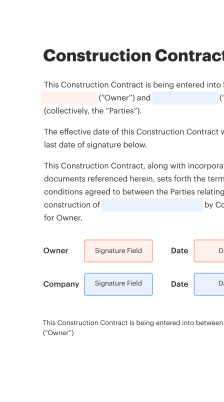
Consignment Invoice Template for Businesses
What a consignment invoice template for businesses is and why it matters
When a business should use a consignment invoice template
Using a consignment invoice template reduces administrative errors, clarifies payment responsibilities, and speeds reconciliation between consignor and consignee in consignment arrangements while supporting legal recordkeeping and audit trails.
Common operational challenges with consignment invoicing
- Unclear terms lead to disputes over ownership, returns, and commission calculations, delaying payments and reconciliation.
- Manual entry errors in quantities or item codes cause inventory mismatches and incorrect revenue recognition.
- Multiple versions of the invoice create confusion about which terms were agreed and complicate audits.
- Slow approval cycles and paper signatures extend the cash conversion cycle and increase administrative costs.
Typical user profiles for a consignment invoice template
Consignment Manager
A Consignment Manager oversees inventory placed with retailers, tracks sales and commissions, and reconciles monthly statements. They require templates that provide clear itemization, commission formulas, and signature fields to confirm acceptance and terms.
Retail Seller
A Retail Seller receives consigned goods and needs concise invoices that clarify return windows, pricing guidelines, and payment schedules. Templates help them accept deliveries and provide a signed record for the consignor.
Who typically uses consignment invoice templates
Small manufacturers, wholesalers, and retailers frequently rely on consignment invoice templates to standardize transactions and protect both parties.
- Independent retailers selling items on consignment from local artisans.
- Manufacturers supplying products to multi-location consignment dealers.
- Wholesale distributors managing inventory placements with third-party sellers.
In larger operations, finance, inventory, and legal teams use templates to enforce consistent terms, enable automated workflows, and support audit readiness across channels.
Choose a better solution
Essential features for effective consignment invoice templates
Prebuilt Fields
Itemized SKU fields, quantity and price line-items, commission calculations, and delivery acceptance fields reduce manual entry and standardize data for downstream systems.
Conditional Logic
Show or hide sections such as return instructions or VAT fields based on consignee location and agreement terms to keep invoices concise and compliant.
Signature Blocks
Clear, auditable signature sections for consignor and consignee capture acceptance, date, and role metadata to support legal enforceability and audit trails.
Integration Hooks
Prebuilt connectors to accounting, CRM, and inventory systems allow automatic posting of sold items, commission calculations, and reconciliation records.
How digital consignment invoices work in practice
-
Generate: Create invoice from template with item data
-
Send: Deliver electronically to consignee for review
-
Sign: Collect eSignatures and acceptance confirmations
-
Record: Store signed invoice in secure, auditable archive
Step-by-step: create and deploy a consignment invoice template
-
01Draft fields: List consignor, consignee, items, quantities, prices
-
02Define terms: Specify commissions, payment timing, and returns
-
03Review legally: Have counsel check liability and tax language
-
04Publish template: Distribute template and integrate with workflows
Why choose airSlate SignNow
-
Free 7-day trial. Choose the plan you need and try it risk-free.
-
Honest pricing for full-featured plans. airSlate SignNow offers subscription plans with no overages or hidden fees at renewal.
-
Enterprise-grade security. airSlate SignNow helps you comply with global security standards.
Recommended workflow settings for consignment invoice automation
| Workflow Setting Name and Configuration | Configuration Value |
|---|---|
| Reminder Frequency | 48 hours |
| Signature Order Enforcement | Sequential only |
| Auto-archive Destination | Secure cloud folder |
| Notification Recipients | Finance, inventory leads |
| API Sync Interval | 15 minutes |
Supported platforms and basic technical requirements
The consignment invoice template works on modern web browsers and mobile apps to support signing, editing, and storage across devices.
- Desktop Browsers: Chrome, Edge, Safari
- Mobile Platforms: iOS and Android apps
- Minimum Bandwidth: Broadband recommended
For reliable operation, ensure devices run supported OS versions, that browsers are up to date, and that network security policies permit TLS traffic to your eSignature provider; consult your IT team for enterprise firewall and SSO configuration.
Real-world consignment invoice examples
Retail Consignment Example
A regional apparel consignor ships seasonal inventory to boutique stores with a standardized consignment invoice that lists SKU, size, and suggested retail price.
- The invoice includes a fixed 30 percent commission field.
- The store records sales and reports weekly for automated commission calculations.
Resulting in faster reconciliations, fewer disputes over sold items, and consistent commission payouts that preserve consignor-retailer relationships and accounting accuracy.
Wholesale Consignment Example
A manufacturer places displays of accessories at national retailers and issues a consignment invoice that defines return terms and restocking procedures.
- The template captures batch numbers and delivery acceptance signatures.
- Retail stores scan barcodes and report sell-through to the manufacturer.
Leading to automated inventory adjustments, clear ownership records during the consignment period, and predictable revenue recognition for both parties when items are sold.
Best practices when using a consignment invoice template
FAQs about consignment invoice template for businesses
- How do I customize fields for specific consignments?
Build a base template that includes all common fields and use conditional logic to show or hide sections per consignee. Maintain a small set of role-specific templates for frequent partners to reduce repetitive customization while ensuring consistent legal language across documents.
- Can I collect signatures on mobile for delivery acceptance?
Yes. Modern eSignature solutions support mobile signing with touch or typed signatures and can record geolocation and timestamp metadata. Ensure your provider supports the required mobile platforms and that acceptance fields capture role and date for audit purposes.
- What should be included to make the invoice legally enforceable?
Include clear identification of consignor and consignee, detailed item descriptions, explicit commission and payment terms, signature blocks with dates, and reference to the governing law. Retain signed copies and audit trails to demonstrate consent under ESIGN and UETA rules.
- How do I integrate invoice data with accounting systems?
Use the provider's API or native integrations to push signed invoice data into accounting software. Map fields consistently, test with sample transactions, and set up automatic posting rules for sold items and commission calculations to avoid manual reconciliation.
- What retention policies apply to signed consignment invoices?
Follow your business and regulatory retention schedules; commonly invoices are retained for seven years for tax and audit purposes. Ensure the platform supports secure archiving, exportability, and retention controls to meet internal and external requirements.
- How do I handle disputes or corrections after signing?
Create an addendum or corrected invoice and route it through the same signature workflow with change highlights and versioning. Preserve both original and corrected documents with their audit trails and document the reason for changes for legal and accounting records.
Feature availability: signNow (Recommended) versus DocuSign
| Feature or Capability for Comparison | signNow (Recommended) | DocuSign |
|---|---|---|
| Legal Compliance | ESIGN/UETA compliant | ESIGN/UETA compliant |
| Bulk Send | Bulk Send available | Bulk Send available |
| API Access | REST API available | REST API available |
| HIPAA Support | Business associate agreement | BAA available |
Get legally-binding signatures now!
Legal and financial risks to consider
Pricing and plan characteristics across major eSignature providers
| Pricing Metric and Descriptor | signNow (Recommended) | DocuSign | Adobe Sign | PandaDoc | Dropbox Sign |
|---|---|---|---|---|---|
| Entry-level plan availability | Affordable entry plans with monthly billing options | Individual and business plans | Included with Acrobat subscriptions | Small business plans available | Simple plans for teams |
| Enterprise features and add-ons | Enterprise controls, SSO, and advanced admin | Comprehensive enterprise suite | Enterprise integrations and management | Advanced templates and analytics | SSO and enterprise APIs |
| Trial and onboarding options | Free trial and guided onboarding available | Free trial and documentation | Free trial with tutorials | Free trial and templates | Free trial and quick start guides |
| Compliance and certifications | ESIGN, UETA compliance and SOC reports | ESIGN, UETA, SOC reports | ESIGN and ISO-compliant controls | ESIGN compliant and SOC reports | ESIGN compliant with enterprise controls |
| Support and SLAs | Email and priority support on paid tiers | Extensive support options and SLAs | Enterprise support with Acrobat | Dedicated support for higher tiers | Business support and documentation |
Explore Advanced Features
- Quotation Generator for Staffing
- Quotation Generator for Entertainment
- Quotation Management Software for Legal Services
- Quotation Management Software for Manufacturing
- Software de Gestión de Cotizaciones para Recursos Humanos
- Quotation Management Software for Entertainment
- Quotation Management System for Hospitality
- Quotation Management System for Travel Industry