Software De Gestión De Contratos Para Inventario

Transform your inventory management with airSlate SignNow, providing an easy-to-use platform for sending and signing documents. Experience cost-effective solutions that streamline your workflow.

Award-winning eSignature solution

What contract management software providers for inventory do

Contract management software providers for inventory help organizations centralize, track, and enforce agreements tied to stocked items, vendors, and movements. These systems combine contract lifecycle management with inventory metadata so teams can link purchase orders, supplier terms, delivery schedules, and pricing to individual SKUs and warehouses. Typical capabilities include searchable contract repositories, automated renewals and alerts, role-based access controls, reporting on contractual obligations versus inventory positions, and integration points with ERPs or inventory systems to synchronize quantities, locations, and compliance data for audit readiness.

Why inventory-focused contract management matters

Using contract management software tailored for inventory reduces risk, clarifies supplier commitments, and aligns purchasing terms with stock levels for more consistent fulfillment.

Why inventory-focused contract management matters

Common inventory contract challenges

  • Disconnected systems make it hard to reconcile contractual terms with current stock and reorder points.
  • Manual tracking of supplier SLAs and penalties creates delays and missed replenishment triggers.
  • Version control problems lead to using outdated pricing or delivery terms in procurement.
  • Lack of audit-ready trails complicates compliance reviews and inventory dispute resolution.

Representative user roles

Procurement Manager

A procurement manager uses contract management software to centralize supplier agreements, monitor pricing amendments, and enforce compliance with purchase terms. They require approval workflows, searchable contract clauses, and alerts for renewals or price escalations tied to inventory SKUs to avoid stockouts and control costs.

Inventory Controller

An inventory controller links contract terms to physical stock to schedule replenishment and validate supplier performance. They need real-time visibility into committed receipts, lead-time variance reporting, and a clear audit trail showing which contract governed each incoming shipment.

Teams that benefit from inventory-aware contract management

Procurement, operations, and inventory managers commonly rely on integrated contract and inventory data to make purchase and replenishment decisions.

  • Procurement teams: enforce negotiated pricing and minimum order quantities with suppliers.
  • Inventory managers: match contract lead times to reorder points and safety stock.
  • Legal and finance: verify contract versions and obligations for audits and accruals.

Cross-functional teams including legal, finance, and warehouse staff use these systems to verify terms, allocate costs, and resolve supplier issues faster.

Key features to evaluate for inventory contract management

Select solutions that combine contract lifecycle capabilities with inventory linking, automation, and integration to reduce manual reconciliation and improve responsiveness.

Contract repository

Centralized, searchable storage with clause tagging and SKU-level indexing so teams can quickly find supplier terms tied to specific inventory items across locations and revisions.


Automated alerts

Configurable notifications for renewals, escalations, and SLA breaches that trigger based on stock thresholds, expected delivery dates, or contract milestones to prevent stockouts or noncompliance.

Integration APIs

Robust APIs and prebuilt connectors for ERPs, WMS, and procurement systems to synchronize quantities, POs, receipts, and contract metadata in near real time.

Approval workflows

Flexible routing and conditional approvals that respect spend limits, departments, and regulatory reviews so contract acceptance matches inventory purchasing policies.

Reporting and analytics

Custom reports linking contract terms to inventory performance metrics for cost analysis, supplier scorecards, and forecasting informed by contractual lead times and penalties.

Document controls

Versioning, redaction, watermarking, and permissioned access to protect sensitive pricing or volume commitments while maintaining an audit-ready record.

be ready to get more

Choose a better solution

Integrations and template capabilities to look for

Integration breadth and reusable templates accelerate adoption and ensure consistent contract language across inventory operations.

Google Docs integration

Real-time editing and template population from Google Docs enables collaborative drafting with inventory metadata merged automatically into supplier agreements for faster negotiation cycles.

CRM and ERP connectors

Two-way integration with CRM and ERP platforms synchronizes customer and supplier records, POs, and inventory levels so contractual terms reflect actual transactional data.

Cloud storage

Direct linkage with Dropbox, OneDrive, or S3 for scalable document storage and backup while keeping contract metadata accessible in the CLM interface.

Reusable templates

Template libraries with clause variables and conditional logic reduce drafting time and ensure consistent terms for recurring inventory purchases or vendor agreements.
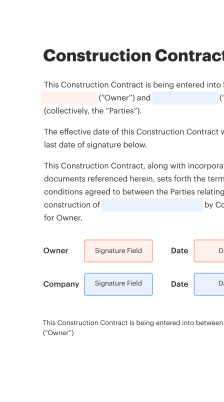
How inventory-linked contracting operates day to day

A typical operational flow links signed contracts to purchase orders and inventory updates so obligations and quantities remain synchronized.

  • Create contract: Draft and approve terms in the CLM system.
  • Tag inventory: Assign SKUs and warehouses to contract clauses.
  • Sync systems: Push terms to ERP and inventory management software.
  • Monitor events: Trigger alerts for deliveries, renewals, or penalties.
Collect signatures
24x
faster
Reduce costs by
$30
per document
Save up to
40h
per employee / month

Quick setup steps for inventory contract management

Follow these core steps to connect contract records with inventory processes and start enforcing terms against stock events.

  • 01
    Gather contracts: Collect existing supplier and service agreements.
  • 02
    Map SKUs: Associate contract clauses with specific SKUs or product groups.
  • 03
    Integrate systems: Connect the contract platform to ERP or WMS.
  • 04
    Enable alerts: Set renewal and SLA notifications tied to inventory events.
be ready to get more

Why choose airSlate SignNow

  • Free 7-day trial. Choose the plan you need and try it risk-free.
  • Honest pricing for full-featured plans. airSlate SignNow offers subscription plans with no overages or hidden fees at renewal.
  • Enterprise-grade security. airSlate SignNow helps you comply with global security standards.
illustrations signature

Recommended workflow configuration for inventory contracts

Begin with standard automation settings aligned to procurement and inventory cadence before refining thresholds and escalations.

Setting Name and short description Default configuration value used by the workflow
Approval timeout threshold 72 hours
Renewal notice window 60 days
Inventory-linked triggers Reorder alert when below safety stock
Supplier SLA monitoring cadence Weekly checks
Automatic escalation path Notify procurement lead then legal

Supported platforms and device considerations

Evaluate desktop web, mobile apps, and tablet compatibility to ensure signing and approvals fit operational workflows across receiving docks and procurement offices.

  • Web browsers: Chrome, Edge, Safari supported
  • Mobile apps: iOS and Android native apps
  • Offline signing: Limited offline capture available

Confirm the provider supports recent browser versions, iOS and Android app releases, and provides offline or low-bandwidth signing options for remote locations, plus enterprise SSO and device management integration for corporate security controls.

Core security and protection controls

Data encryption: AES-256 at rest and TLS in transit
Access controls: Role-based permissions and least privilege
Authentication: Multi-factor authentication and SSO support
Audit logging: Immutable activity and change logs
Document protection: Field-level redaction and watermarking options
Compliance scopes: Supports HIPAA and FERPA use cases where applicable

Industry examples using inventory-focused contract management

Practical deployments show how linking contract terms to inventory flows reduces risk and operational friction across sectors.

Retail replenishment optimization

A regional retailer centralized supplier contracts and SKU-level terms to correlate lead times with safety stock levels

  • Automated reorder triggers based on contract delivery windows
  • Reduced emergency freight spend and stockouts

Leading to measurable decreases in out-of-stock events and lower expedited shipping costs.

Manufacturing supplier compliance

A discrete manufacturer mapped long-term supply agreements to component inventory usage and Kanban thresholds

  • Tracked penalty clauses for late deliveries
  • Measured supplier on-time performance against contractual SLAs

Resulting in clearer remediation steps for underperforming suppliers and improved production continuity.

Best practices for secure and accurate inventory contract handling

Adopt consistent processes and technical controls to reduce errors, protect data, and ensure contract terms drive inventory decisions.

Standardize clause and SKU tagging
Use a controlled vocabulary for clause names, SKU identifiers, and supplier codes to ensure automated rules and analytics correctly match contract terms to inventory items across systems and avoid misapplied pricing or delivery obligations.
Enforce approval and segregation of duties
Implement role-based workflows that separate purchasing approval, legal review, and inventory release responsibilities to reduce fraud, improve compliance, and ensure contractual commitments are reviewed by appropriate stakeholders before execution.
Retain an auditable trail
Preserve immutable logs of document versions, signature events, and system integrations. Maintain retention policies that satisfy internal controls and regulatory requirements, enabling reliable reconstruction of events during audits or disputes.
Test integrations regularly
Schedule periodic tests between the contract system, ERP, and WMS to verify mappings, update API credentials, and confirm that contract-driven triggers correctly affect reorder points, receipts, and supplier performance metrics.

FAQs About contract management software providers for inventory

Common questions address legal validity, integrations, mobile signing, and linking contract terms to stock levels for operational use.

Feature availability comparison: signNow and peers

A concise feature-level comparison highlights availability and capacities relevant to inventory-linked contract management across major eSignature providers.

Feature availability and capacity comparison signNow (Recommended) DocuSign Adobe Sign
eSignature legality in US
Bulk Send capability Bulk Send Bulk Send Bulk Send
API access and rate limits Public API, moderate limits Public API, higher limits Public API, moderate limits
HIPAA support Available Available via BAA Available via BAA
be ready to get more

Get legally-binding signatures now!

Retention and key timeline policies

Define retention and notification timelines to meet regulatory, financial, and operational needs for inventory-related contracts.

Contract retention period:

7 years after contract end

Renewal notification lead time:

60 days before expiration

Document backup cadence:

Daily encrypted backups

Audit log retention:

Retained for 10 years

Disaster recovery RTO:

4 hours recovery objective

Regulatory and operational risks

Contract breaches: Damages or fines
Inventory shortages: Fulfillment delays
Overstocking: Holding cost increases
Data exposure: Confidentiality loss
Noncompliance: Regulatory penalties
Audit failures: Remediation overhead

Pricing and plan comparison for inventory-focused usage

Pricing varies by plan and feature set; compare starting tiers, enterprise capabilities, and channel support for sustained inventory and contract workloads.

Plan and pricing comparison signNow (Recommended) DocuSign Adobe Sign PandaDoc HelloSign
Starting price (per user/month) From $8/user/month billed annually From $10/user/month billed monthly From $14.99/user/month From $19/user/month From $15/user/month
Business-tier features included Templates, Bulk Send, API access Standard sending, templates eSign + document management Templates and workflow Core eSign and templates
Enterprise features availability Advanced admin and SSO Advanced admin and SSO Enterprise admin and integrations Enterprise contracts and analytics Enterprise SSO options
HIPAA-compliant option Available with agreement Available with agreement Available with agreement Contact sales Available with agreement
Typical entry-level limits Moderate API calls, generous templates Higher limits on paid tiers Moderate limits tied to plan Document analytics included API access on paid plans
walmart logo
exonMobil logo
apple logo
comcast logo
facebook logo
FedEx logo
be ready to get more

Get legally-binding signatures now!