User provisioning
Bulk user import and SCIM support for automated onboarding and role assignment, allowing administrators to manage large teams with consistent permissions and minimize manual account creation tasks.




Centralized organization management enforces consistent security, simplifies user provisioning, and makes compliance monitoring more efficient for teams handling signed agreements.

A Platform Administrator manages account-wide settings including user provisioning, single sign-on configuration, retention policies, security controls, and integrations. They approve role assignments and review audit logs to ensure compliance and operational continuity across teams.
A Compliance Officer defines legal and regulatory requirements such as retention schedules and access controls, coordinates with legal counsel for evidentiary needs, and periodically audits signed transaction records and configuration settings.
Administrators, compliance officers, and operations teams use organization controls to enforce policies and manage access across departments.
Smaller teams may delegate limited administration, while larger enterprises typically require hierarchical roles and audit visibility across business units.
Bulk user import and SCIM support for automated onboarding and role assignment, allowing administrators to manage large teams with consistent permissions and minimize manual account creation tasks.
Granular role definitions allow separation of duties for admins, template managers, and regular users with controlled access to sensitive documents and administrative functions.
Centralized, organization-level templates ensure consistent document structure, required fields, and signer workflows, reducing errors and accelerating sending across departments.
Organization dashboards and exportable audit logs give administrators the ability to track sends, completions, and signer activity for operational oversight and compliance needs.
Policy-driven retention and archival settings at the organization level provide consistent document lifecycle management aligned with legal and regulatory obligations.
Organization API keys, usage controls, and webhook management let administrators integrate signature flows into core business systems while monitoring application-level access.
Organization integration with Google Workspace enables administrators to authorize domain-wide access, install shared templates for G Suite users, and configure document sending directly from Google Docs or Drive while maintaining centralized template and retention policies for audit purposes.
Connecting the organization to CRM systems such as Salesforce or HubSpot allows admins to provision API keys, control which teams can send agreements, and map signed document metadata back to CRM records consistently across users.
Organization-level connectors to Dropbox, Box, and OneDrive permit centralized document routing, automated archival of completed agreements, and consistent folder structures managed by administrators for compliance and backup.
Directory synchronization via LDAP or SCIM lets administrators automate user lifecycle management, ensuring onboarding and offboarding follow organizational identity policies and reducing orphaned access.

| Setting Name | Configuration |
|---|---|
| Default Signing Order | Sequential |
| Reminder Frequency | 48 hours |
| Default Expiration | 30 days |
| Retention Policy | Seven years |
| Webhook Notifications | Enabled |
Organization administration is accessible via web-based admin consoles and through available mobile apps with limited management features.
For full configuration and policy enforcement, administrators should use the web console; mobile apps and APIs allow monitoring and selected administrative actions but may not expose every organization-level control.
A mid-size clinic centralizes user accounts and enforces MFA at the organization level to protect PHI
Resulting in auditable flows that support HIPAA compliance and reduce manual record reconciliation.
A university uses organization management to issue role-based access to admissions staff
Leading to consistent processing of student documents and clearer audit trails for FERPA requirements.
| Capability and Availability Comparison Criteria | signNow (Recommended) | DocuSign | Adobe Sign |
|---|---|---|---|
| Legal validity under ESIGN and UETA | |||
| HIPAA-compliant deployment option | |||
| Bulk Send / Bulk Send feature | |||
| Organization API and admin keys |
Seven years by default
Immediate preservation on notice
Daily backups recommended
90 days export readiness
On completion or at set date
| Vendor and Plan Names | signNow (Recommended) | DocuSign | Adobe Sign | Dropbox Sign | OneSpan Sign |
|---|---|---|---|---|---|
| Entry-level offering and target users | Team plan for small teams with organization admin options and per-user billing | Personal and Standard tiers for individuals and small businesses | Document Cloud plans with business and enterprise tiers | Dropbox Sign Essentials for small teams and individuals | OneSpan Standard for midsize regulated teams |
| Enterprise-grade feature availability | Organization-wide templates, SSO, SCIM provisioning, audit exports | Advanced admin controls, SSO, enterprise API access | Enterprise Cloud integration, SSO, advanced governance | Team admin, SSO available on higher tiers | Strong security controls, advanced signing workflows |
| Typical per-user pricing model | Per-user per-month billing with volume discounts | Per-user per-month with tiered limits | Per-user subscription with enterprise licensing | Per-user/month with team plans | Quote-based enterprise pricing |
| Free trial and pilot options | Free trial and product demos available for evaluation | Trial accounts and sandbox environments offered | Trial available through Adobe Creative Cloud trial or business trials | Free trial and developer sandbox available | Pilot engagements available through sales |
| API access and developer resources | REST API with organization keys and webhooks, developer docs provided | Comprehensive REST API, SDKs, and sandbox environment | REST API via Adobe I/O with SDKs | REST API and developer sandbox | APIs with focus on secure, regulated use cases |
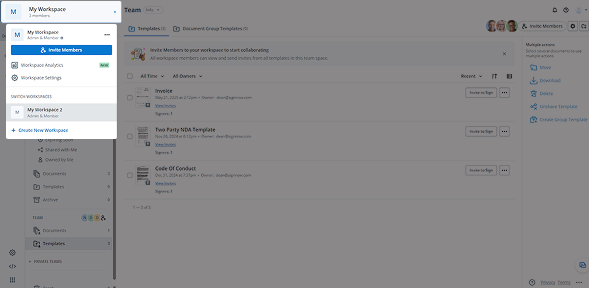
Workspaces let you collaborate with teammates, manage team-wide settings, and monitor team analytics. Workspaces replace legacy Organizations, providing improved usability and user management.
airSlate SignNow makes collaboration simple, regardless of your team size or subscription. Add teammates to your workspace for free anytime, directly from the user dashboard.
Note: Your workspace members will share your airSlate SignNow plan, allowing you to scale your team without paying for extra user seats.
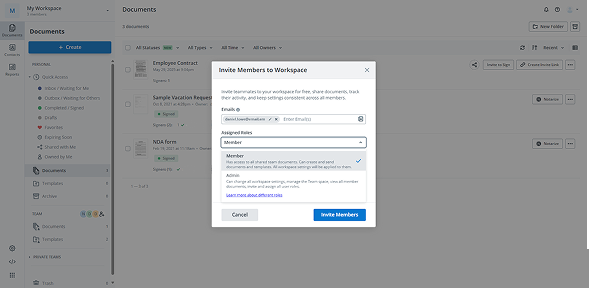
Move documents to your shared team space for easy access. Let teammates reuse templates, co-manage eSignature invites (resend, cancel, reassign), and track shared documents.
Note: Your personal space is visible only to you. Members can’t access your files unless you move them to the shared area.
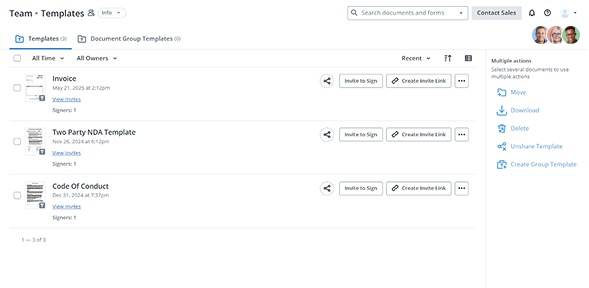
All your personal and workspace settings are in one place, letting you manage users, configure branding and customization, connect payment and cloud storage services, control compliance settings, and more.
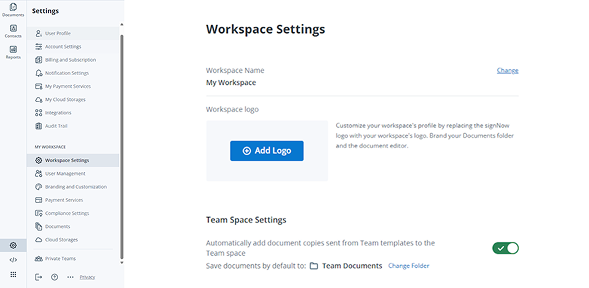
View workspace stats and metrics for individual members, including documents created and sent, completion rates, recipients, and more.
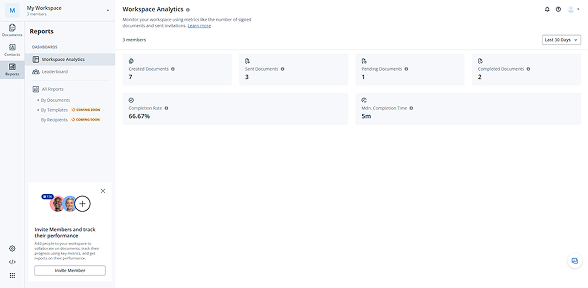
Use a shared address book to send eSignature invites faster, track documents easily, and interact with recipients more efficiently as a team.
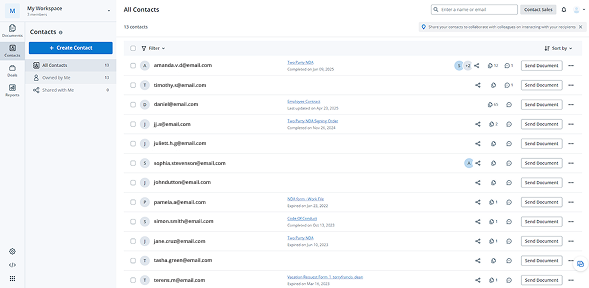
Create workspaces for different departments, teams, or client groups to manage access to documents and track targeted performance reports.