Customer Bill Format for NPOS

Empower your non-profit organization with streamlined billing processes and secure eSigning. Simplify document management while saving time and costs.

Award-winning eSignature solution

What the customer bill format for npos includes

A customer bill format for NPOS (non-profit point-of-sale or non-point-of-sale billing contexts) defines the structure, fields, and metadata used to present charges, donor or customer details, tax treatment, and payment instructions. It typically standardizes invoice numbers, line-item descriptions, unit costs, discounts, donation designations, and total amounts while accommodating organizational identifiers and transaction references. For organizations using eSignature and document workflows, the format also clarifies where signatures, acceptance dates, and digital receipts appear, enabling consistent archival and auditability across systems and vendors.

Why a standardized customer bill format for npos matters

Standardizing the customer bill format for NPOS minimizes billing errors, streamlines reconciliation, and ensures consistent presentation to donors or customers across channels and platforms.

Why a standardized customer bill format for npos matters

Common billing challenges addressed by a clear format

  • Inconsistent field names across systems cause data mapping errors during imports and reconciliations.
  • Missing or ambiguous donation designation fields lead to misapplied contributions or reporting gaps.
  • Manual generation of bills increases the risk of typographical errors and delays in delivery.
  • Lack of standard metadata prevents reliable audit trails and complicates regulatory reporting.

Typical user profiles for customer bill format for npos

Billing Manager

Responsible for designing and maintaining the billing template, the Billing Manager ensures line items, tax treatment, and donation designations align with accounting policies; they coordinate with IT to map fields into the payment and CRM systems and validate reconciliation processes monthly.

Development Director

Manages donor-facing content and compliance with acknowledgment requirements, working with finance to confirm language for receipts and with legal to ensure the format supports tax receipt standards and required disclosures for donors.

Organizations and roles that typically use an NPOS bill format

Small nonprofits, social enterprises, membership organizations, and community programs use a defined customer bill format for consistent donor and customer billing.

  • Finance teams reconciling donations and payments across multiple channels and systems.
  • Development or fundraising staff issuing acknowledgement receipts and campaign-specific charges.
  • Operations managers integrating point-of-sale platforms with accounting and CRM systems.

Clear formats reduce administrative overhead and make reporting, donor acknowledgment, and compliance tasks more reliable across departments.

Additional format elements that increase utility

Beyond basic invoice fields, these elements improve automation, reconciliation, and donor communication when included in the bill format.

Invoice Numbering

Sequential and unique identifiers for tracking and reconciliation of transactions.

Memo Notes

Custom notes to explain special handling, acknowledgements, or conditions for the charge.

Payment Terms

Clear due dates, accepted payment methods, and late fee policies when applicable.

Donation Attribution

Fields for campaign codes, appeal codes, and fundraising events to support reporting.

Contact Information

Billing and support contact details for questions and dispute resolution.

Retention Metadata

Embedded retention tags to support document lifecycle and legal hold processes.

be ready to get more

Choose a better solution

Core features to include in an NPOS billing template

Design templates with features that support automation, clarity, compliance, and donor recognition for reliable financial and stewardship processes.

Line-item Detail

Clearly describe each charge, including quantity, price, and any donation designation, so recipients can understand how totals were calculated and accounting can map revenue correctly.

Donation Designation

Include a discrete field for designations or restricted funds to ensure gifts are allocated to the intended program and reflected accurately in stewardship reports.

Tax Receipt Fields

Provide tax-deductible amounts, donor name, donation date, and statement language required for tax reporting and donor records, ensuring compliance with IRS acknowledgement rules.

Signature & Acceptance

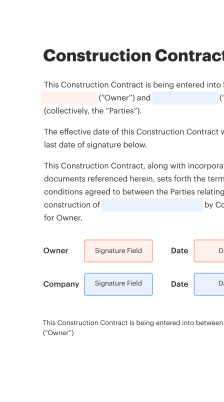
Reserve formal signature or electronic acceptance fields and display the acceptance date to create an auditable commitment record when payments or agreements are required.
How the format integrates with digital workflows

This overview describes how a standardized bill format moves from template to signed record and archival in an electronic environment.

  • Template Design: Create a reusable invoice template with placeholders.
  • Automatic Population: Populate fields from CRM or POS systems.
  • Signature Capture: Capture digital acceptance where required.
  • Archive and Audit: Store signed copies with audit metadata.
Collect signatures
24x
faster
Reduce costs by
$30
per document
Save up to
40h
per employee / month

Step-by-step: Setting up your customer bill format for npos

Follow these practical steps to define and deploy a standardized bill format that supports accounting, donor acknowledgment, and integration with digital signing or payment systems.

  • 01
    Inventory Fields: List required invoice fields and metadata.
  • 02
    Define Tax Rules: Specify taxable vs. non-taxable items.
  • 03
    Map To Systems: Create field mappings for CRM and accounting.
  • 04
    Test and Validate: Run test transactions and reconcile outputs.

Checklist: Final validation before going live

Use this checklist to validate templates, integrations, and compliance before you deploy the customer bill format for NPOS in production.

01

Template Rendering:

Verify layout in browsers and devices.
02

Field Mapping:

Confirm CRM and accounting field mappings.
03

Calculation Accuracy:

Validate totals, taxes, and discounts.
04

Signature Capture:

Test capture and storage of signed records.
05

Retention Rules:

Ensure archival and retention tags apply.
06

User Permissions:

Check role-based access and approvals.
be ready to get more

Why choose airSlate SignNow

  • Free 7-day trial. Choose the plan you need and try it risk-free.
  • Honest pricing for full-featured plans. airSlate SignNow offers subscription plans with no overages or hidden fees at renewal.
  • Enterprise-grade security. airSlate SignNow helps you comply with global security standards.
illustrations signature

Recommended workflow settings for automated billing and signing

These workflow settings support automated generation, notification, and archival for bills rendered in the NPOS format.

Setting Name Configuration
Default Reminder Frequency for Signing Requests 48 hours
Automatic Receipt Generation and Delivery Enabled
Signature Authentication Requirement MFA required
Default Document Retention Period 7 years
Reconciliation Export Schedule Daily

Device and platform considerations for NPOS billing

Ensure templates and signing workflows render correctly on mobile, tablet, and desktop to accommodate donors and customers using different devices.

  • Web Browser Support: Modern browsers, TLS required
  • Mobile Responsiveness: Adaptive layout for small screens
  • Offline Access: Cached receipts for intermittent networks

Confirm compatibility across supported operating systems and browsers, validate responsive layout in test environments, and ensure authentication flows (including MFA) are usable on mobile devices while maintaining security and compliance.

Security and access elements to include in the format

Document Encryption: AES-256 encryption at rest
Transport Security: TLS 1.2 or higher
Access Controls: Role-based permissions
Authentication: Multi-factor authentication
Audit Logging: Immutable access logs
Data Masking: Partial PII redaction

Two real-world examples using a standardized bill format

These examples show how standardized billing formats are applied in common nonprofit scenarios to improve reconciliation and donor communication.

Recurring Donation Billing

A community health nonprofit issues monthly donor statements using the format to group recurring gifts by campaign and donor ID

  • Includes donor name, campaign, amount, and donor-designated tags
  • Improves automated reconciliation and campaign attribution

Resulting in faster month-end close, clearer donor statements, and reduced manual allocations during accounting.

Event Registration Invoice

A university alumni association issues event invoices that separate registration fees, optional donations, and tax-deductible portions

  • Lists attendee details, seat types, and add-on donations
  • Enables tax-compliant receipts and streamlined refunds

Leading to more accurate event revenue reporting, compliant donor receipts, and simpler attendee follow-up for stewardship.

Best practices for accurate, compliant NPOS billing

Apply these guidelines when creating and maintaining your customer bill format for NPOS to reduce errors and support audits.

Standardize field names and data types across systems
Use a canonical field set so imports, exports, and mappings between CRM, accounting, and payment platforms do not require repeated transformation rules; this reduces reconciliation mismatches and simplifies automation.
Include clear donation designation and tax-deductible calculations
Explicitly separate taxable goods from tax-deductible donations on the bill so donors receive accurate receipts and accounting can categorize revenue correctly for financial statements and tax reporting.
Preserve an immutable audit trail for signed documents
Ensure signed invoices capture signer identity, method of authentication, IP address, and timestamps to meet internal audit needs and support compliance with ESIGN and UETA in the United States.
Validate templates with sample transactions regularly
Periodically run end-to-end tests using real transaction types to confirm templates render correctly, calculations match expected outputs, and downstream systems ingest fields without errors.

FAQs About customer bill format for npos

Answers to common operational, legal, and technical questions when implementing a standardized bill format for NPOS organizations.

Feature comparison for NPOS billing and signature support

Compare core capabilities that affect how a customer bill format for NPOS integrates with eSignature and document workflows.

Criteria signNow (Recommended) DocuSign Adobe Acrobat Sign
Supported File Types PDF, DOCX PDF, DOCX PDF, DOCX
Legal Validity in United States ESIGN/UETA ESIGN/UETA ESIGN/UETA
Bulk Send Capability
API Availability and Limits Available, documented Available, documented Available, documented
be ready to get more

Get legally-binding signatures now!

Risks and compliance considerations

Tax Reporting: Incorrect receipts
Donor Relations: Lost trust
Regulatory Fines: Potential penalties
Data Breach: Exposure of PII
Record Retention: Noncompliant retention
Audit Failures: Negative findings

Pricing and plan comparison for billing and eSignature

High-level plan differences that impact cost and access to features useful for NPOS billing and document workflows.

Plan Tier signNow (Recommended) DocuSign Adobe Acrobat Sign Dropbox Sign PandaDoc
Free Plan Availability Free trial available Personal paid plan Free trial available Free tier available Free trial available
Entry-level Starting Price From $8/user/month billed annually From $10/user/month From $14.99/user/month From $15/user/month From $19/user/month
Bulk Send Included Included in business plans Included in higher tiers Included in standard plans Included Included in business plans
API Access Included API in business plans API in developer plans API available API available API available via plans
walmart logo
exonMobil logo
apple logo
comcast logo
facebook logo
FedEx logo
be ready to get more

Get legally-binding signatures now!