Display Title License: Secure eSignature Solutions

Award-winning eSignature solution

What the display title license feature is and why it matters

The display title license is a configurable document metadata element used to present the formal title or license descriptor within an electronic agreement and related workflow interfaces. It appears on templates, signing pages, and audit records so recipients and administrators can immediately identify the type of license or agreement being executed. In practice it is set once per template or dynamically populated from form fields or connected systems, and it travels with the document throughout signing, storage, and reporting processes to support traceability and consistent presentation across platforms.

Clear identification improves accuracy and compliance

A standardized display title reduces signer confusion, supports consistent recordkeeping, and makes classifying signed licenses easier for legal review and retention planning.

Clear identification improves accuracy and compliance

Common challenges when display titles are missing or inconsistent

  • Unclear signer context increases questions and delays final approval, especially with similar agreement types.
  • Inconsistent titles across templates complicate searches and manual classification during audits or legal review.
  • Automated workflows may misroute or misapply retention rules if title metadata is absent or misformatted.
  • Incorrect or blank display titles can create downstream reconciliation errors in CRM and contract repositories.

Representative user personas for display title license

Contract Manager

A contract manager configures display title fields on templates, reviews incoming agreements to confirm title accuracy, and coordinates retention and audit tagging. They use display titles to filter dashboards, enforce version control, and provide context to legal reviewers before countersignature or archival.

Sales Operations

Sales operations specialists map display titles to CRM opportunity records and ensure the correct license appears in quotes and signable documents. They set rules that populate titles automatically from deal metadata to reduce manual errors and speed order completion.

Teams and roles that commonly rely on display title license

Legal, contracting, and operations teams rely on consistent display titles to speed review and reduce ambiguity during signature and post-signature processing.

  • Legal teams ensuring the right license is used for each counterparty and jurisdiction during review and signature.
  • Sales and account management teams verifying contract type and term before finalizing commercial agreements.
  • Records and compliance teams applying retention schedules and audit procedures based on license classification.

Providing a clear display title benefits signers, administrators, and downstream teams who consume agreement metadata for reporting, compliance, and storage.

Core capabilities that support effective display title license management

These capabilities help teams apply, maintain, and audit display titles across templates and signed records for operational and compliance use cases.

Title templates

Predefined title formats that enforce consistent naming conventions across template libraries and reduce manual variation when creating new agreements.


Dynamic fields

Ability to populate titles from form inputs, CRM records, or API calls so titles reflect deal-specific data without sender edits.

Access controls

Role-based permissions to control who can edit or override display titles, preventing unauthorized changes to critical metadata.

Audit visibility

Title changes and population sources recorded in the audit trail for clear provenance and review during compliance checks.

Template reuse

Apply standardized display title configurations across multiple templates to maintain consistency and simplify template governance.

Retention tagging

Map display titles to retention and classification rules so documents inherit correct storage and disposal policies automatically.

be ready to get more

Choose a better solution

Integrations that extend display title license capability

Connecting the display title to content sources improves accuracy and automates consistency across sending and storage systems.

Google Docs

Map document properties or specific fields from Google Docs into the display title when converting a draft to a signable template, ensuring titles match the latest document version and reducing manual copying errors.

CRM systems

Pull opportunity or account metadata such as customer name, contract type, or region into the display title so agreements are identifiable and searchable in both the CRM and the eSignature system.

Dropbox

Use Dropbox file metadata and filename conventions to set display titles automatically when documents are sent from a connected folder, maintaining consistency without extra manual steps.

Document generators

When a document generation tool produces a contract, pass the generated title into the display title field to preserve template context and prevent mismatches between the generated document and signing metadata.
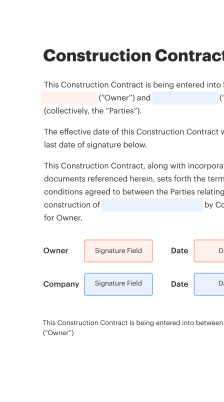
How display title license populates during document workflows

Overview of common population methods and where the title appears in the signing lifecycle.

  • Static assignment: Predefined title fixed on template
  • Field mapping: Populate from form or CRM field
  • API population: Set title via integration at send time
  • User entry: Sender edits title during envelope creation
Collect signatures
24x
faster
Reduce costs by
$30
per document
Save up to
40h
per employee / month

Quick setup steps to add a display title license to a template

A concise walkthrough for configuring a display title in a template so it appears correctly during sending and in the audit log.

  • 01
    Open template: Select the template to edit
  • 02
    Add title field: Place a dedicated display title field
  • 03
    Choose source: Set static text or map to a field
  • 04
    Save and test: Preview signing and audit entries

Detailed actions: configuring, testing, and deploying display title license

A grid of practical actions to validate display titles before full deployment across teams and templates.

01

Define format:

Agree on naming rules and required elements
02

Create template:

Add display title field to master templates
03

Map data:

Connect fields to CRM or generator outputs
04

Set permissions:

Limit who can edit or override titles
05

Test sends:

Run sample envelopes and review audit logs
06

Monitor and adjust:

Review usage and refine validation rules
be ready to get more

Why choose airSlate SignNow

  • Free 7-day trial. Choose the plan you need and try it risk-free.
  • Honest pricing for full-featured plans. airSlate SignNow offers subscription plans with no overages or hidden fees at renewal.
  • Enterprise-grade security. airSlate SignNow helps you comply with global security standards.
illustrations signature

Recommended workflow configuration settings for display title license

Suggested default settings to control how display titles are assigned, validated, and recorded during sending and storage.

Primary setting name (technical) Default configuration value
Default display title behavior setting Map from field
Title validation rule pattern Regex enforced
Reminder Frequency 48 hours
Signature order and routing Sequential
Retention mapping for titles 7 years

Supported platforms and minimum requirements for display title license

Display title functionality is supported across modern desktop browsers and mobile apps that include template editing and metadata mapping features.

  • Desktop browsers: Chrome, Edge, Safari
  • Mobile apps: iOS and Android native apps
  • APIs and SDKs: REST API, client SDKs

For best results ensure senders use the latest app or browser versions and coordinate API integrations so display titles are populated from reliable sources during envelope creation.

Security and protection attributes for display title license metadata

Immutable audit trail: Records title changes with timestamps
Field-level access control: Restricts who edits titles
Encrypted storage: Protects title metadata at rest
Transport encryption: Secures titles in transit
Role-based visibility: Shows title per user role
Tamper detection: Flags unauthorized edits

Practical examples: using display title license across different processes

Two short case examples show how display titles reduce errors and streamline workflows in distinct contexts.

Corporate software license renewal

An accounts team attaches a display title to renewal templates to indicate the license class and term

  • Automatic population of customer name and term from CRM
  • Reduces manual edits and signer confusion

Resulting in faster renewals and fewer amendment requests.

University data-sharing agreement

A research office uses a display title to flag agreements involving student data and FERPA protections

  • Title includes data category and study ID
  • Helps compliance reviewers filter relevant records quickly

Leading to clearer approvals and auditable retention aligned with institutional policy.

Recommended practices for accurate display title license usage

Adopt consistent naming, validation, and review policies to ensure display titles remain reliable as metadata across systems and audits.

Establish a naming convention and template catalog
Define a short, consistent title format including contract type, department, and version to make titles immediately meaningful to signers and reviewers.
Automate title population from authoritative sources
Where possible, map titles to CRM or document-generation fields to prevent manual entry errors and to ensure titles match other business records.
Apply role-based editing controls
Restrict who can change titles and require an approval step for edits to maintain integrity and prevent accidental misclassification.
Validate and audit title values regularly
Include display title checks in periodic audits and when exporting contract reports to detect inconsistencies and enforce corrective actions.

FAQs About display title license

Common questions and answers about setting, validating, and auditing display titles in electronic signature workflows.

Comparison: display title license in electronic signing versus traditional paper

Key differences between maintaining title metadata in eSignature solutions and relying on paper-based document headers and manual filing.

Comparison feature or criteria name signNow (Recommended) DocuSign
Legal enforceability
Automatic metadata population
Audit trail visibility Detailed Detailed
Searchable repository support
be ready to get more

Get legally-binding signatures now!

Retention and recordkeeping recommendations tied to display title license

Suggested retention periods and review cadence based on common regulatory and operational needs in the United States.

Recommended contract retention period (years):

7 years for most commercial contracts

Regulatory review cadence (internal):

Annual title and metadata audit

FERPA-covered agreements retention:

Follow institutional FERPA policies

HIPAA-covered licenses retention:

Retain consistent with HIPAA rules

Litigation hold procedures:

Immediate preservation until release

Risks and compliance consequences of incorrect display titles

Misclassification risk: Incorrect retention
Regulatory exposure: Audit findings
Operational delays: Rework and disputes
Legal ambiguity: Contract enforceability questions
Data retrieval issues: Search failures
Privacy concerns: Wrong disclosure

Pricing snapshot: display title license support across popular eSignature vendors

A high-level comparison of typical entry-level pricing and trial availability; actual costs vary by plan and contract terms.

Pricing comparison vendors header signNow (Recommended) DocuSign Adobe Sign PandaDoc Dropbox Sign
Starting monthly price $8 per user per month $10 per user per month $9.99 per user per month $19 per user per month $15 per user per month
Free trial availability Yes, 7-day trial Yes, 30-day trial Yes, 7-30 day trial Yes, 14-day trial Yes, 14-day trial
Per user entry plan features Basic eSigning and templates Basic sending and fields Core eSign workflows Document creation and eSign Core eSign features
Enterprise contract support Available with enterprise plan Available with enterprise plan Available with enterprise plan Available with enterprise plan Available with enterprise plan
Notable integrations Salesforce, Google Workspace, Dropbox Salesforce, Microsoft, Oracle Microsoft 365, Adobe apps CRMs, Zapier, Doc generators Dropbox, Google Workspace, Slack

How to Display title license For Free

Display title license feature gets easily available when you make use of airSlate SignNow's complete eSignature platform. Use this solution for your business irrespective of the sector you’re doing work in. The set of features presented by airSlate SignNow perfectly suits for people who attempt to make their enterprise strategies more productive and streamline their workflow.

Be assured that your contracts will always be organized properly, filled out by the appropriate parties and signed digitally using the digital signature that complies with the ESIGN Act and also other governmental requirements. Integrate fillable fields to make any document interactive, collect signatures from many persons and apply receiver authentication to make sure that the document was received by the appropriate individual. All this you are able to do when working either from the desktop computer or from the mobile gadget to save lots of time and close essential deals on-the-go.


walmart logo
exonMobil logo
apple logo
comcast logo
facebook logo
FedEx logo
be ready to get more

Get legally-binding signatures now!