Doctor Billing Format for Operations Made Easy

See your invoicing process turn quick and seamless. With just a few clicks, you can execute all the necessary steps on your doctor billing format for Operations and other crucial files from any device with web connection.

Award-winning eSignature solution

What a doctor billing format for operations encompasses

A doctor billing format for operations is a standardized document set used to itemize professional and facility charges related to surgical procedures, including CPT procedure codes, ICD diagnosis codes, time-based units, surgeon and assistant fees, anesthesia charges, implant or supply costs, applicable modifiers, and payer-specific billing notes. It also contains patient demographics, authorization or consent identifiers, and signature fields for clinicians and patients. Proper formatting reduces claim denials, speeds reimbursement, and creates an auditable record when combined with secure signing and storage practices in line with U.S. healthcare regulations.

Why adopt a standardized billing format for surgical operations

Standardized formats reduce coding errors, speed claim submission, and create a consistent audit trail for compliance with payer rules and regulatory requirements in the U.S.

Why adopt a standardized billing format for surgical operations

Common challenges when managing operation billing formats

  • Inconsistent coding or missing modifiers can lead to frequent claim denials and delayed reimbursement.
  • Manual signatures and paper routing introduce time lags and increase the risk of lost documents.
  • Insufficient access controls create privacy risks and potential HIPAA exposure for protected health information.
  • Poor version control causes duplicated or contradictory invoices that complicate payer adjudication.

Representative user profiles for operation billing

Surgical Billing Lead

Responsible for preparing and submitting operation claims, the Billing Lead manages charge capture, verifies CPT/ICD pairings, resolves denials, and maintains documentation for audits. They coordinate with coders, clinical staff, and payers to ensure timely reimbursement and regulatory compliance.

Private Practice Surgeon

Surgeons or their office managers use the format to document services performed, confirm modifier use, obtain patient signatures for consent and financial responsibility, and review itemized charges before submission to insurers or patients for payment.

Who typically uses operation billing formats

Billing, clinical, and administrative teams across surgical settings use billing formats to standardize invoicing and maintain compliant records.

  • Hospital billing departments reconciling facility, surgeon, and anesthesia fees for inpatient procedures.
  • Ambulatory surgery centers preparing bundled charges and supplies for same-day operations.
  • Private practice surgeons and billing managers creating itemized statements for payers and patients.

Standardized formats support cross-team collaboration and simplify audits, payer communications, and internal reporting.

Essential features for efficient operation billing

Look for features that reduce repetitive work, enforce compliance, and provide a clear audit trail for every signed billing document.

eSignature

Legally binding electronic signatures capture signer identity, timestamp, and IP metadata to support ESIGN and UETA compliance for most domestic transactions.


Custom Templates

Template customization supports conditional logic, mandatory field validation, and prefilled code sets so forms conform to payer-specific formatting requirements before submission.

Bulk Send

Bulk Send enables sending identical billing forms to multiple recipients or patients for signature, saving time on routine consents or standardized notices.

Role Access

Role-based access controls restrict who can edit templates, send documents, or view signed records, helping maintain segregation of duties and HIPAA compliance.

Audit Trail

Comprehensive audit trails record every action—view, sign, amend—producing an immutable history useful for audits and dispute resolution.

Mobile Signing

Mobile-optimized signing supports clinicians and patients capturing signatures on tablets or smartphones at point of care to reduce delays.

be ready to get more

Choose a better solution

Integrations and template features that support operation billing

Key integrations and template capabilities streamline data entry, reduce duplication, and preserve document context across systems.

Template Library

A centralized template library allows clinical and billing teams to maintain validated operation billing formats with preconfigured fields, conditional logic, and version control so only approved templates are used for claims preparation.

Google Docs Sync

Two-way sync with Google Docs enables drafting clinical notes and procedure summaries in Google and synchronizing those fields into billing templates to avoid redundant data entry and reduce transcription errors.

CRM Integration

Integration with CRM or practice management systems prepopulates patient demographics, insurance data, and guarantor details into the billing format, reducing manual lookups and improving submission accuracy.

Cloud Storage

Direct saving to cloud storage providers like Dropbox ensures signed billing documents are archived in encrypted folders with access controls and centralized retention policies.
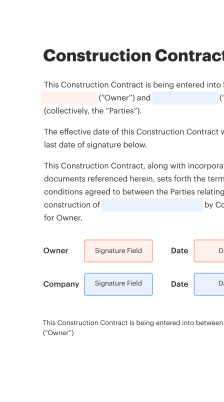
How an online billing template workflow operates

This sequence explains how a digital billing format is completed, signed, and archived using cloud tools and authenticated signatures.

  • Create template: Build a reusable billing form with required fields
  • Assign signers: Designate clinician and patient signing order
  • Capture signatures: Collect eSignatures and authentication metadata
  • Archive: Store signed records with audit logs for retention
Collect signatures
24x
faster
Reduce costs by
$30
per document
Save up to
40h
per employee / month

Quick setup steps for a billing template

Follow these concise steps to create a consistent doctor billing format for operations and prepare it for signing and submission.

  • 01
    Define fields: List CPT, ICD, modifiers, charges, and patient data
  • 02
    Map codes: Map CPT to diagnosis and procedure modifiers
  • 03
    Add signers: Insert clinician and patient signature fields
  • 04
    Test template: Run sample claims to validate formatting

Audit trail setup and recordkeeping steps

Use these steps to ensure signed billing records are auditable, searchable, and compliant with internal and external review requirements.

01

Enable logging:

Activate comprehensive event logging for all documents
02

Capture metadata:

Record IP, device, and timestamp at signature
03

Version control:

Preserve prior versions when templates are updated
04

Retention policy:

Apply legal retention rules to archived files
05

Access reviews:

Schedule periodic permission audits for users
06

Export capability:

Enable CSV or PDF export for compliance audits
be ready to get more

Why choose airSlate SignNow

  • Free 7-day trial. Choose the plan you need and try it risk-free.
  • Honest pricing for full-featured plans. airSlate SignNow offers subscription plans with no overages or hidden fees at renewal.
  • Enterprise-grade security. airSlate SignNow helps you comply with global security standards.
illustrations signature

Recommended workflow settings for operation billing templates

These configuration items represent a starting set of workflow settings tailored to surgical billing, balancing compliance, traceability, and timeliness.

Workflow Setting and Parameter Name Configuration Value
Document Reminder Frequency Interval Setting 48 hours
Signer Order and Routing Mode Setting Sequential
Pre-filled Field and Validation Enforcement Enabled
Business Associate Agreement Requirement Setting Required
Document Retention Period and Disposal 7 years

Supported platforms for drafting and signing

Drafting, sending, and signing billing formats should be possible on common desktop and mobile platforms to support point-of-care workflows.

  • Desktop browsers: Chrome, Edge, Safari compatibility
  • Mobile devices: iOS and Android app support
  • Tablets: Touch-enabled signing and offline caching

Ensure your environment meets browser and OS minimums, keeps apps updated, and uses secure networks to protect PHI during creation and signing.

Security and technical protections relevant to billing documents

Data encryption: AES-256 at rest and in transit
Access controls: Role-based permissions and admin logging
Multi-factor authentication: Optional two-step verification
Audit logs: Comprehensive event history records
Business Associate Agreement: BAA available for HIPAA-covered uses
Secure backups: Redundant cloud backups with retention

Real-world examples of billing format use

Two concise examples show how standardized billing formats streamline operations and compliance in different surgical settings.

Hospital Billing Integration

A large hospital standardized operative billing templates and embedded coding rules to validate CPT/ICD pairs before submission.

  • Automated checks reduced coder rework and corrected modifier errors quickly.
  • The new workflow improved payer acceptance by catching common configuration mistakes.

Resulting in faster reimbursements and fewer denials for complex inpatient surgeries.

Ambulatory Surgery Center Workflow

An ambulatory surgery center adopted a template that combined itemized supply charges, implant identifiers, and surgeon fees in one form.

  • The template prefilled patient demographics and authorization fields from the EHR.
  • Staff could collect signatures on tablets at discharge.

Leading to simplified billing, clearer patient statements, and reduced administrative follow-up.

Best practices for secure, accurate operation billing

Follow these best practices to reduce denials, protect patient data, and improve payment speed while maintaining regulatory compliance.

Verify billing codes and confirm correct modifiers
Implement pre-submission validation to check CPT/ICD pairings and appropriate modifiers. This reduces coding errors that commonly trigger denials and time-consuming appeals processes.
Collect informed consent and signatures at point of care
Capture patient consents and clinician sign-offs electronically at discharge or pre-op using audited mobile signing to ensure timely documentation and reduce missing signature issues.
Enforce role-based access for sensitive billing records
Limit template editing and document access to authorized billing and compliance staff. Regularly review permissions to ensure segregation of duties and HIPAA safeguards.
Maintain an auditable retention and backup policy
Apply consistent retention schedules and encrypted backups. Ensure documents and audit logs remain available for payer audits and internal reviews for the required statutory period.

Frequently asked questions about operation billing formats

Answers to common questions about creating, signing, and storing doctor billing formats for operations in a compliant digital environment.

Feature availability: signNow compared to leading eSignature vendors

This concise comparison highlights core capabilities relevant to doctor billing format workflows across three major eSignature providers.

Comparison Criteria and Feature Name signNow (Recommended) DocuSign Adobe Sign
HIPAA Compliance
Bulk Send
API Access REST API REST API REST API
Mobile App
be ready to get more

Get legally-binding signatures now!

Retention and compliance timeline for surgical billing records

Establish clear retention timelines that reflect payer rules and statutory obligations for medical billing documentation in the United States.

Record Retention Minimum Period for Medical Billing Records:

Minimum seven years recommended

Audit Availability Window for Claims Review:

Maintain 3 to 7 years accessible

Consent and Authorization Storage Duration:

Keep for length of care plus retention

Backup and Disaster Recovery Snapshot Schedule:

Daily incremental, weekly full backups

Scheduled Document Deletion and Disposal Policy:

Secure deletion after retention expiry

Risks and potential penalties for noncompliant billing

Claim denials: Lost revenue
Repayment obligations: Overpayment recoupment
HIPAA violations: Civil penalties
Fraud investigations: Criminal exposure
Audit findings: Operational disruptions
Delayed payments: Cash flow impact

Representative pricing snapshot for eSignature providers

Pricing varies by plan, user count, and required features; below are representative starting points and common plan notes for budgeting.

Pricing Comparison Header signNow (Recommended) DocuSign Adobe Sign Dropbox Sign PandaDoc
Starting Monthly Price From $8 per user monthly From $10 per user monthly From $9 per user monthly From $15 per user monthly From $19 per user monthly
Common Enterprise Add-ons Advanced API, BAA, SSO available Advanced API, SSO, enterprise plans Enterprise SSO and BAA options Team plans and Dropbox integration Document automation bundles available
Free Trial Availability Yes, trial available Yes, trial available Yes, trial available Yes, trial available Yes, trial available
Notable Limitations in Entry Plans Some advanced features require business plan API limits on basic tiers Enterprise features gated behind pricier tiers Limits on team management in lower tiers Automation limited in starter plans
Support and SLAs Email support; premium SLAs on business plans 24/7 on higher tiers Business support with SLAs Business hour support; paid SLAs Priority support on enterprise plans
walmart logo
exonMobil logo
apple logo
comcast logo
facebook logo
FedEx logo
be ready to get more

Get legally-binding signatures now!