Export Data from Template Fields with SignNow

With airSlate SignNow, you can export data collected from template fields using a CSV report. This organized report contains the field data added by a recipient.

Award-winning eSignature solution

What it means to export data from template fields

Exporting data from template fields is the process of extracting structured values entered into predefined form fields within reusable templates, then exporting that field-level data into machine-readable formats such as CSV or JSON. This capability centralizes data capture from repeated form usage, enables downstream processing by CRMs and databases, and preserves a record of which template, which field, and which signer produced each value. Exports can include metadata, timestamps, and identifiers to maintain context for reporting, reconciliation, or integration with business systems.

Legal validity and compliance when exporting template field data

Exported template field data does not change the legal status of electronic signatures under ESIGN and UETA; exported records support audit and retention obligations. Maintain chain-of-custody and data integrity when exporting to meet recordkeeping requirements and regulatory audits in the United States.

Legal validity and compliance when exporting template field data

Common challenges when exporting template field data

  • Inconsistent field naming across templates causes mapping conflicts and requires normalization before aggregation.
  • Different export formats produce mismatched data types, requiring conversion or schema validation in target systems.
  • Ensuring exported data retains audit metadata such as signer identity and timestamps can be overlooked during configuration.
  • Handling protected health information or student records requires special controls to remain compliant with HIPAA or FERPA.

Typical user roles for template field exports

Compliance Officer

A Compliance Officer configures export policies and retention schedules, validates that exports include required audit metadata, and documents chain-of-custody for regulatory reviews. They work with IT to ensure exported files meet internal controls and legal hold requirements.

IT Administrator

An IT Administrator sets up integrations, schedules automated exports, and secures transfer endpoints. They manage access controls, audit logs, and encryption settings to ensure exported data is available to authorized systems while minimizing exposure.

Teams that rely on exporting template field data

Organizations across operations, legal, HR, and finance use exports to automate recordkeeping and analytics.

  • Legal and compliance teams who need verifiable data for audits and regulatory filings.
  • Human resources for onboarding, benefits enrollment, and personnel records consolidation.
  • Finance and accounting for automating invoice capture, approvals, and reconciliation workflows.

Exported field data streamlines reporting and reduces manual reconciliation for teams that process recurring forms and contracts.

Advanced export capabilities for enterprise workflows

Advanced features support scale, compliance, and integrations when exporting complex or sensitive template field data across many templates and accounts.

Audit integration

Exports that include comprehensive audit metadata record signer identity, timestamps, template IDs, and version history to support legal evidence and regulatory responses across enterprise systems.

Conditional exports

Conditional export filters let administrators include or exclude records based on field values or status, enabling targeted extracts for specific departments or compliance scopes.

Field validation

Built-in validation prevents invalid entries at capture time so exported datasets meet schema expectations, reducing downstream errors and manual reconciliation work.

Batch processing

Batch export capabilities handle large volumes by queuing jobs, supporting incremental exports and preventing timeouts when extracting data from many completed templates.

Role-based access

Granular permissions control which users or service accounts can configure exports, view exported files, or connect endpoints, supporting least-privilege security models.

Version control

Maintaining template version histories ensures exported data references the correct template revision so analysts can interpret fields accurately over time.

be ready to get more

Choose a better solution

Core features to look for when exporting template data

Key capabilities determine how reliably and efficiently you can extract and use template field data across internal systems and audits.

Field Mapping

Robust field mapping lets administrators align template field names with target database columns or CRM fields, reducing manual cleanup and ensuring consistent data types and labels for downstream processing and reporting.

Export Formats

Support for CSV and JSON enables both spreadsheet workflows and API-driven integrations, letting teams choose the format that best fits import capabilities and data validation rules in receiving systems.

Scheduled Exports

Automated scheduling of exports reduces manual effort by running periodic extracts and delivering results to secure storage or an integration endpoint according to defined retention and frequency policies.

API Access

A well-documented API allows programmatic exports, flexible query parameters, and integration with middleware so exports can be triggered, filtered, and consumed by enterprise systems.

How the export process works from template to CSV/JSON

The export process moves structured field data from templates through an extraction step into a chosen file format, with optional metadata and audit details attached.

  • Template capture: Fields capture signer input and metadata.
  • Export selection: Choose templates, date range, and records.
  • Format conversion: System compiles CSV or JSON output.
  • Delivery: Download or push to an endpoint.
Collect signatures
24x
faster
Reduce costs by
$30
per document
Save up to
40h
per employee / month

Step-by-step: how to export data from template fields

Follow these core steps to configure and run exports of template field data in a compliant, auditable way.

  • 01
    Create template: Define consistent field names and types.
  • 02
    Map fields: Establish export schema and target mappings.
  • 03
    Run export: Select records and execute CSV or JSON export.
  • 04
    Verify import: Validate data in target systems and logs.
be ready to get more

Why choose airSlate SignNow

  • Free 7-day trial. Choose the plan you need and try it risk-free.
  • Honest pricing for full-featured plans. airSlate SignNow offers subscription plans with no overages or hidden fees at renewal.
  • Enterprise-grade security. airSlate SignNow helps you comply with global security standards.
illustrations signature

Configuring exports: common workflow settings

Use these configuration settings to align exports with operational and security requirements when extracting template field data.

Setting Name Configuration
Export Format CSV or JSON
Export Frequency Daily or ad hoc
Include Audit Trail Yes (full)
Field Mapping Preset Use saved map
Access Scope Account-level or scoped

Exporting template data from desktop, web, and mobile

Export functions for template fields are accessible from modern web browsers and supported native mobile apps, with some differences in advanced options.

  • Web Browser: All export controls available
  • iOS App: Core exports; limited scheduling
  • Android App: Core exports; limited scheduling

For large-scale or scheduled exports, use the web interface or API from a desktop environment; mobile apps typically support immediate or ad hoc exports but may not expose complex scheduling or advanced mapping configuration.

Security and regulatory considerations for exports

ESIGN and UETA: Affects signature evidence
HIPAA safeguards: Encrypted transfers required
FERPA concerns: Limit student data exports
Encryption in transit: TLS 1.2+ recommended
Access controls: Role-based permissions
Audit logging: Export activity recorded

Industry examples of exporting template field data

Practical examples show how exported template field data supports common business processes across regulated and high-volume workflows.

Healthcare intake forms

A regional clinic uses template-based intake forms to capture patient demographics and insurance details, exported nightly as CSV for billing reconciliation

  • Field-level exports include timestamps and form IDs for traceability
  • The billing system validates fields against payer requirements to reduce denials

Resulting in faster claims processing and clearer audit trails for compliance reviews.

HR onboarding automation

A mid-size employer collects onboarding data via reusable templates, exporting new hire fields to the HRIS each morning

  • Exports include role, start date, and tax details
  • Automated imports pre-populate HR records and trigger benefits enrollment tasks

Leading to reduced manual entry, fewer errors, and faster new-employee setup across systems.

Best practices for secure and accurate exports from templates

Follow these guidelines to reduce errors, protect sensitive data, and ensure exported template field data remains reliable for business and compliance needs.

Standardize field names and data types across templates
Establish consistent naming conventions and fixed data types for commonly used fields so exports aggregate cleanly. Document the schema and enforce it when authors create or modify templates to reduce mapping overhead and prevent schema drift.
Limit export scope for protected information
Exclude or tokenize protected health, education, or financial identifiers when exporting for analytics. Use selective exports and minimize PHI exposure to align with HIPAA, FERPA, and internal data minimization policies.
Secure transfer and storage of exported files
Transmit exports over encrypted channels and store files in encrypted repositories with access logging. Rotate credentials for endpoints and apply retention schedules to meet legal and operational requirements.
Validate exports with automated checks
Implement automated schema validation and row-level checks after export to detect missing fields, type mismatches, or unexpected nulls. Notify stakeholders and halt automated imports when validation fails.

FAQs about exporting data from template fields

Answers to common questions about configuring, running, and troubleshooting template field exports in enterprise environments.

How major eSignature platforms handle exporting template field data

Comparison of field export capabilities across common eSignature providers, focusing on availability and supported formats.

Feature signNow (Featured) DocuSign Adobe Sign
Field Data Export Availability Supported Supported Supported
Supported Export Formats CSV, JSON CSV, JSON CSV, JSON
Scheduled Exports
API Export Endpoint Available Available Available
be ready to get more

Get legally-binding signatures now!

Risks and potential penalties related to exports

Noncompliance fines: Monetary penalties
Data breach exposure: Regulatory sanctions
Audit failures: Remediation costs
Lost evidence: Weakened legal position
HIPAA penalties: Civil fines possible
Operational downtime: Business disruption

How to export data from completed documents with airSlate SignNow

Whenever you need to bulk-extract filled-in information from template-generated documents, simply download a CSV report that organizes all the data in a convenient spreadsheet.

Prepare a template and send it for signature

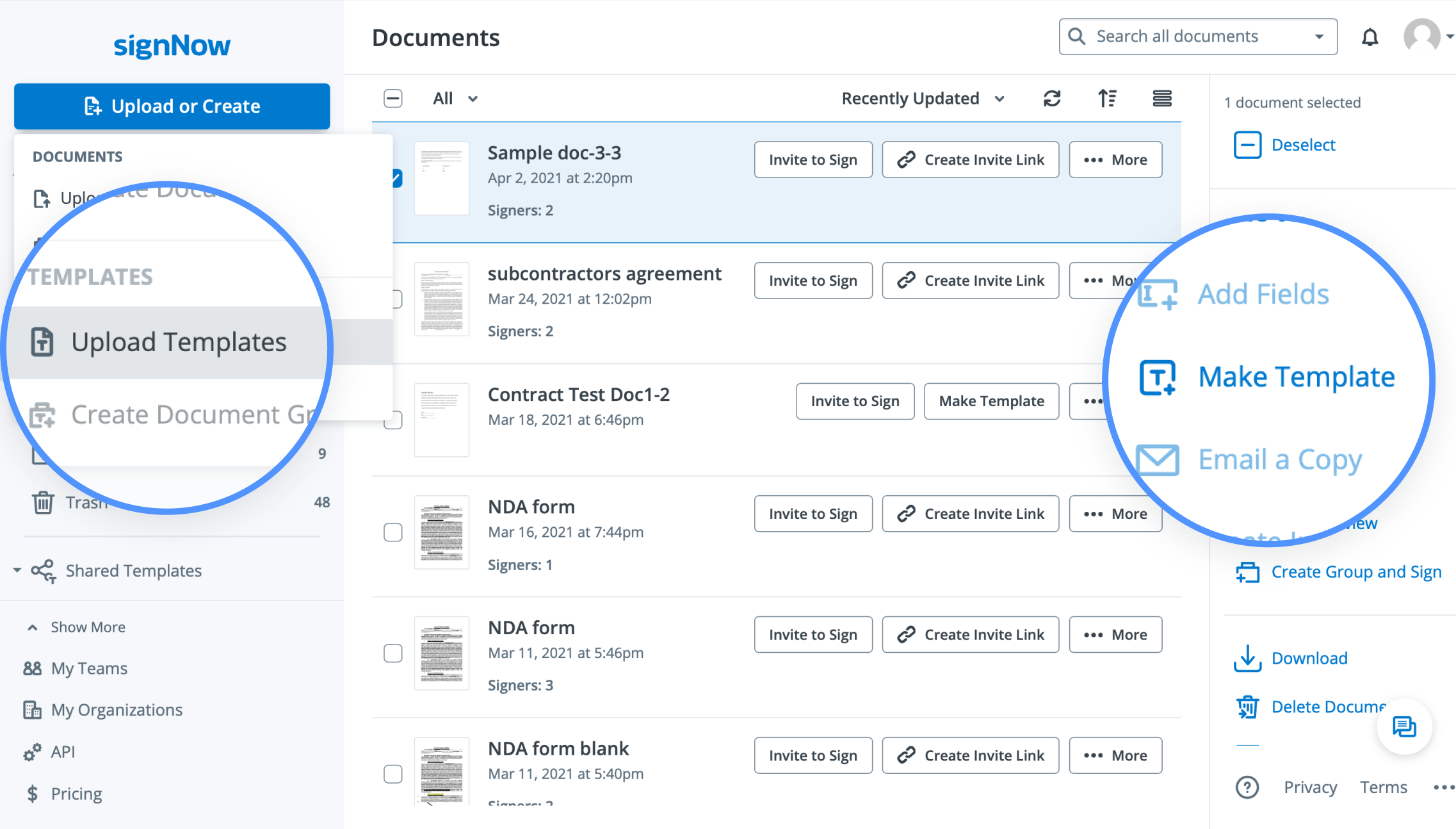
You can either upload a template directly from your device or turn any existing document in your airSlate SignNow account into a template.
fill-guide-illustration

Make sure you add the necessary fillable fields (Signature, Text, Initials, Date fields, etc.), save the changes to your template, and send the document copy for eSignature to one or multiple recipients. Once they fill out and eSign your document, you will receive a notification.

Generate a CSV report

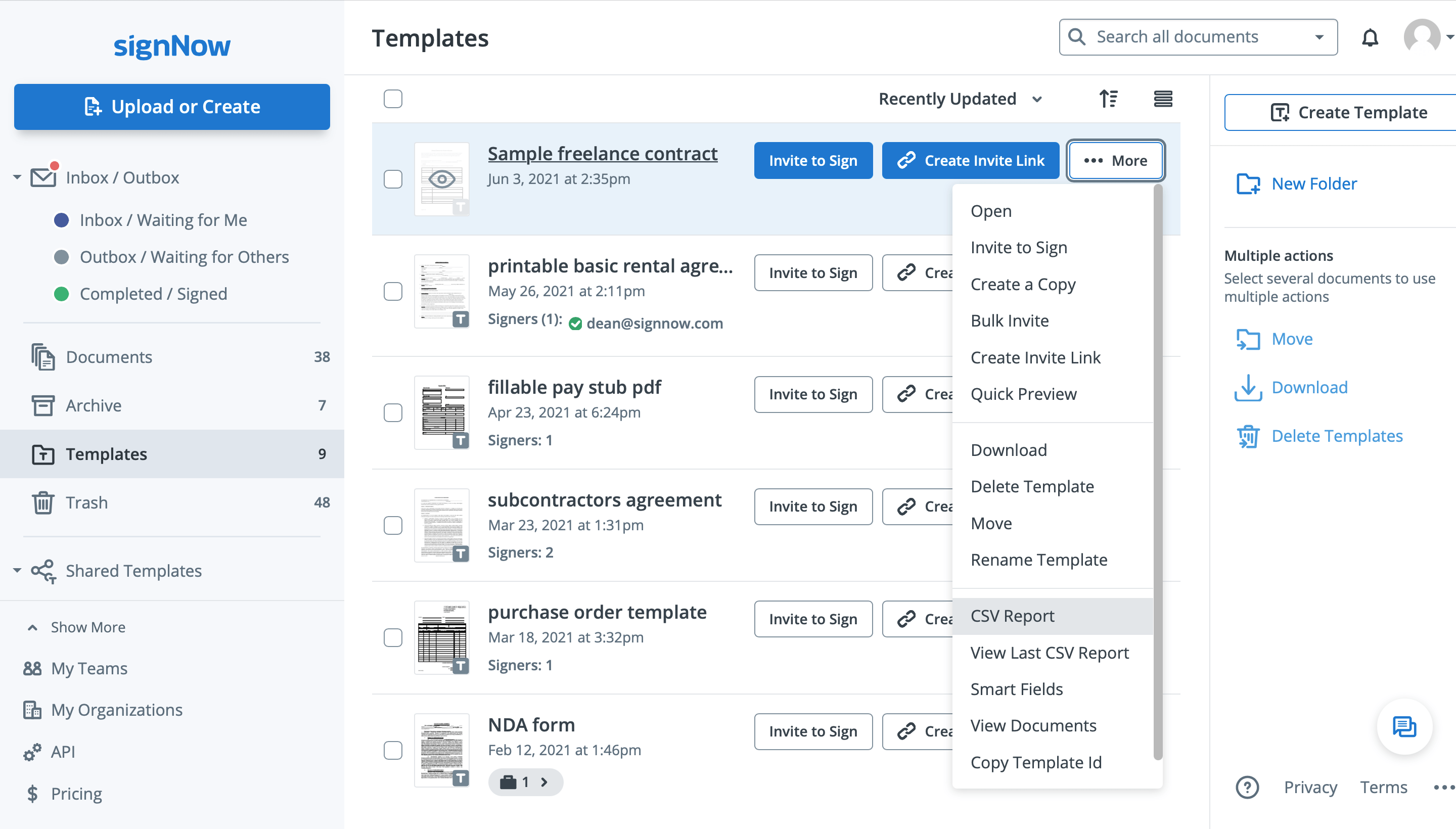
To export data from completed documents, go to your Templates folder, click More next to the template from which those documents were created, and select CSV Report.
fill-guide-illustration

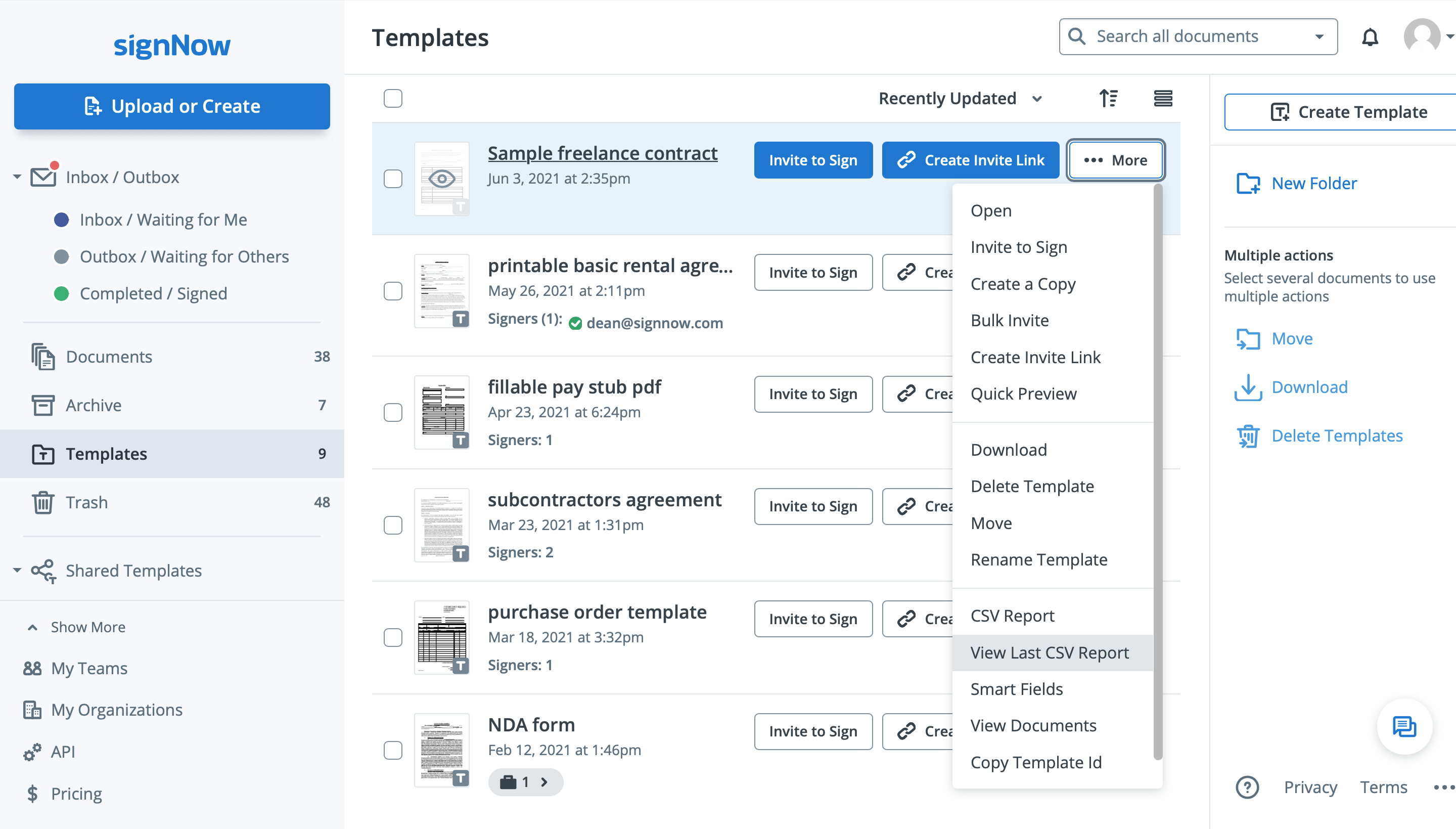
Once a CSV file with all the exported data is generated, it will be sent to your email. You can also download your previous CSV reports by clicking View Last CSV Report.

fill-guide-illustration
walmart logo
exonMobil logo
apple logo
comcast logo
facebook logo
FedEx logo
be ready to get more

Get legally-binding signatures now!