



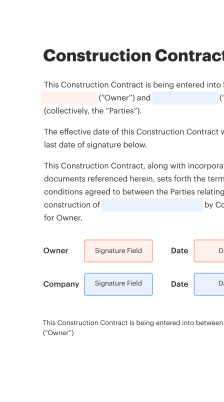
Ejemplo De Términos Y Condiciones De Factura Para La Hospitalidad

See your invoicing process become fast and seamless. With just a few clicks, you can execute all the required actions on your invoice terms and conditions sample text for Hospitality and other important documents from any device with web connection.

Award-winning eSignature solution

What invoice terms and conditions sample text for hospitality covers

Invoice terms and conditions sample text for hospitality provides ready-to-adopt contract language tailored to hotels, restaurants, event venues, and other hospitality operators. It defines payment due dates, accepted payment methods, late fees, dispute handling, tax and service charge disclosures, guest or client responsibilities, and delivery of goods or services. Templates reduce negotiation time, help standardize invoicing across properties and departments, and support consistent records for accounting and audit purposes while remaining adaptable to local law and internal policies.

Why standardized invoice terms matter in hospitality

Clear invoice terms reduce payment delays, limit disputes, and ensure consistent application of service charges and taxes across front- and back-of-house operations.

Why standardized invoice terms matter in hospitality

Common invoicing challenges in hospitality

  • Inconsistent clause language across outlets causes client confusion and increases dispute resolution time and administrative overhead.
  • Variable tax and service charge rules across jurisdictions require careful, frequently updated wording to avoid compliance gaps.
  • Split bills, group events, and third-party bookings complicate liability, payment routing, and refund policies for hospitality vendors.
  • Late payments and guest chargebacks can disrupt cash flow and require explicit late-fee and collections procedures in terms.

Typical users and responsibilities

Front Desk Manager

Front Desk Managers use invoice terms to explain charges at checkout, authorize incidental holds, and guide guests through dispute and refund procedures. They ensure front-line staff present terms consistently at booking and arrival to reduce post-stay disagreements.

Accounts Receivable Lead

Accounts Receivable Leads configure invoicing templates, manage payment terms for corporate accounts, monitor aging receivables, and escalate disputes. They also coordinate with legal counsel when contract language requires modification for large groups or third-party vendors.

Who relies on invoice terms and conditions in hospitality

Hospitality finance, operations, and events teams use standardized invoice terms to speed billing and reduce disputes.

  • Hotel revenue managers who standardize group and corporate billing procedures across multiple properties.
  • Catering and events coordinators who issue complex invoices with deposits, milestones, and cancellation terms.
  • Accounts receivable teams that need clear dispute windows and remittance instructions to reconcile payments quickly.

Consistent terms help teams scale billing processes and maintain clear audit records across seasonal staffing changes.

be ready to get more

Choose a better solution

Essential features for effective hospitality invoice terms

Select features that enforce terms consistently, integrate with operations, and preserve an auditable record of acceptance.

Custom Templates

Template engines let finance teams create standardized invoice terms and clauses that auto-populate with guest names, booking numbers, tax rates, and event details to reduce manual edits and maintain legal consistency across all properties.

Clause Library

A clause library stores approved legal language for deposits, cancellations, and refunds so staff can assemble compliant invoices quickly while ensuring consistent customer-facing terms across sales and operations channels.

E-sign Integration

Integrated e-signature support captures client acceptance of terms at booking or contract signing, providing time-stamped consent and a verifiable audit trail tied to each invoice or event order.

Multi-property Sync

Centralized management synchronizes term updates across locations, ensuring changes to tax handling, service charges, or cancellation policies propagate reliably and reduce local misapplication.

How to implement sample invoice terms online

Use a template-driven workflow to apply controlled invoice terms across reservations, events, and merchant accounts.

  • Choose template: Select a hospitality-specific invoice template.
  • Customize clauses: Edit payment, cancellation, and tax language.
  • Attach documents: Add event orders or itemized charges.
  • Distribute invoices: Send via email or integrate with PMS.
Collect signatures
24x
faster
Reduce costs by
$30
per document
Save up to
40h
per employee / month

Step-by-step: Drafting hospitality invoice terms

Follow these concise steps to prepare invoice terms and conditions sample text for hospitality tailored to your operation.

  • 01
    Identify parties: Name the provider and client clearly.
  • 02
    Define payment terms: Set due dates, deposits, and methods.
  • 03
    Specify fees: Declare late fees, taxes, and service charges.
  • 04
    Dispute process: Describe timelines and resolution steps.
be ready to get more

Why choose airSlate SignNow

  • Free 7-day trial. Choose the plan you need and try it risk-free.
  • Honest pricing for full-featured plans. airSlate SignNow offers subscription plans with no overages or hidden fees at renewal.
  • Enterprise-grade security. airSlate SignNow helps you comply with global security standards.
illustrations signature

Configuring workflow for invoice terms and conditions

Configure automated steps to ensure invoice terms are attached, accepted, and recorded before billing or event confirmation.

Feature Configuration
Approval Sequence Two-step approval
Reminder Frequency 48 hours
Signature Requirement Client e-signature
Template Locking Enabled
Archival Period 7 years

Device and platform considerations for creating and signing terms

Ensure templates and e-sign workflows work reliably across desktop, tablet, and mobile platforms before rolling out.

  • Desktop browsers: Chrome, Edge, Safari supported
  • Mobile devices: iOS and Android apps
  • Offline access: Limited document caching

Test PDF rendering, clause visibility, and signature capture on representative devices to prevent formatting errors and to ensure guests can accept terms during check-in or event confirmation.

Security and protection features to include

Encryption at rest: AES-256 encryption
Encryption in transit: TLS 1.2+ protocols
Access controls: Role-based permissions
Multi-factor authentication: Optional MFA for users
Audit logging: Immutable activity trails
HIPAA support: BAA available on request

Real-world examples of hospitality invoice terms in action

Two concise case examples show how tailored invoice terms reduce disputes and speed collections for hospitality providers.

Boutique Hotel Group

A three-property boutique hotel standardized deposit, cancellation, and incidental charge language across bookings to reduce front-desk confusion and minimize refunds.

  • Included a 72-hour cancellation window for non-refundable rates.
  • Resulted in clearer guest expectations and fewer post-stay chargeback requests.

Leading to improved cash flow and a measurable drop in dispute-related refunds over a 12-month period.

Catering and Events Company

A regional caterer implemented milestone invoicing for large events, defining deposit amounts, interim payments, and final settlement terms to protect margins.

  • Added explicit vendor pass-through costs and tax handling clauses.
  • This clarified responsibilities for third-party rentals and expedited final reconciliations.

Ensures faster final payments and reduced accounting time for multi-day events.

Best practices for secure, accurate hospitality invoice terms

Adopt operational and legal practices that keep terms enforceable and easy for guests and clients to understand.

Use clear, plain-language clauses to describe payment obligations and deadlines
Write terms in accessible language to minimize misunderstandings and reduce dispute rates. Avoid legalese where operational clarity is more important than attorney-style wording. Include examples for split bills and third-party payers.
Include specific tax and service charge breakdowns to ensure compliance
State applicable tax rates, whether service charges are discretionary or mandatory, and whether gratuities are distributed to staff. This reduces regulatory risk and guest complaints related to unexpected fees.
Define dispute timelines and evidence requirements for chargebacks
Specify how long clients have to contest invoices, required supporting documents, and escalation steps. Clear dispute processes speed resolution and strengthen collections when evidence is preserved.
Keep templates centralized and version-controlled across properties
Control updates with a single source of truth and maintain version history. This ensures auditing, reduces conflicting language, and simplifies training for seasonal or temporary staff.

FAQs and troubleshooting for invoice terms and conditions

Common questions and practical answers to help hospitality teams avoid errors and resolve issues with invoice terms and e-sign workflows.

Feature availability: signNow compared with leading eSignature vendors

Quick capability matrix for common invoice terms and signature needs across major eSignature providers.

Criteria signNow (Recommended) DocuSign
HIPAA support Available Available
Bulk Send
Template library
Native mobile app
be ready to get more

Get legally-binding signatures now!

Typical invoicing and retention timelines for hospitality

Standard timelines help teams manage deposits, final billing, and document retention consistently across properties.

Deposit due date timeframe:

7 to 30 days prior to event

Final payment deadline:

At checkout or as specified contractually

Late fee activation period:

Applied after 30 days past due

Dispute submission window:

Typically 14 to 30 days

Document retention period:

Retain records for seven years

Common risks and penalties to address

Late payment fines: Percent-based fees
Chargeback exposure: Dispute handling costs
Tax misstatement: Regulatory penalties
Data breach fines: Notification costs
Reputation loss: Guest complaints
Contract disputes: Litigation expenses

Pricing and plan notes for signNow and competitors

Overview of plan-level distinctions and practical pricing notes for organizations managing hospitality invoice terms and signing workflows.

Plan / Feature Comparison signNow (Recommended) DocuSign Adobe Sign Dropbox Sign PandaDoc
Free plan available Trial-only, no permanent free tier Trial-only, no permanent free tier Trial-only, no permanent free tier Free tier with limited sends Free tier with limited documents
Starting monthly price (per user) $8 per user/month billed annually $10 per user/month entry-level $9.99 per month individual $15 per user/month starter $19 per user/month essentials
Bulk send and templating Bulk Send and templates included on business plans Bulk Send available on advanced plans Templates available, bulk features on higher tiers Templates and bulk sends on paid plans Templates included, bulk sends on paid tiers
API availability REST API and SDKs available Comprehensive REST API and developer tools REST API with developer resources REST API available via Dropbox platform REST API with template support
HIPAA and enterprise support HIPAA options and enterprise SLAs on request HIPAA and BA available for eligible accounts Enterprise options, HIPAA via agreement HIPAA on request for qualified accounts HIPAA available for enterprise customers
walmart logo
exonMobil logo
apple logo
comcast logo
facebook logo
FedEx logo
be ready to get more

Get legally-binding signatures now!