Medical Receipt Generator for Production

See your billing procedure become fast and seamless. With just a few clicks, you can execute all the required actions on your medical receipt generator for Production and other crucial files from any gadget with internet access.

Award-winning eSignature solution

What a medical receipt generator for production does

A medical receipt generator for production produces standardized, itemized receipts for clinical services, supplies, and payments in a live operations environment. It automates line-item formatting, pricing codes, tax treatment, insurer and patient fields, and optional eSignature capture. In production use it integrates with practice management, billing systems, and electronic health records to reduce manual entry, ensure consistent recordkeeping, and enable automated archival. The generator supports compliance-ready output formats and metadata that help with audits, reconciliations, and downstream insurance or patient inquiries.

Why use a production-grade medical receipt generator

A production generator improves consistency, reduces billing errors, and speeds patient-facing financial workflows while preserving auditability and integration with existing clinical and administrative systems.

Why use a production-grade medical receipt generator

Common operational challenges addressed

  • Inconsistent receipt formats causing payer or patient confusion and processing delays.
  • Manual editing of receipts increases human error and wastes administrative time.
  • Difficulty proving receipt authenticity during audits or insurance inquiries.
  • Integrating receipts with multiple systems without disrupting live billing workflows.

Representative user roles in production environments

Billing Supervisor

Oversees daily invoicing, resolves payer disputes, and configures receipt templates to match insurer requirements. Requires reliable, auditable receipts that integrate with the practice management system and provide exportable logs for month-end reconciliation and compliance reviews.

Front Desk

Handles point-of-care payments, issues patient receipts, and updates demographic or payment data. Needs a fast, clear receipt generator with mobile and desktop access, accurate price breakdowns, and options for signed confirmations when required.

Teams that typically use a production receipt generator

Clinical billing teams, front-desk staff, and practice administrators use receipt generators to streamline financial and documentation tasks while maintaining compliance.

  • Medical billing departments that reconcile payments and submit insurer statements.
  • Front-desk and revenue-cycle staff issuing patient payment confirmations and receipts.
  • IT teams responsible for integrating billing workflows with EHRs and CRMs.

Use often spans small clinics to large hospitals where operational consistency and audit trails for receipts are required.

Advanced capabilities for enterprise production use

Enterprises benefit from higher-level features that support complex billing rules, security posture, and integration scale for production receipt workflows.

Bulk Send

Send thousands of receipts in scheduled batches with variable data mapping, throttling, and retry logic to handle insurer and patient workflows efficiently.


API Access

RESTful APIs with predictable rate limits, webhooks for event handling, and SDKs to embed receipt generation into custom systems.

Custom Fields

Support for custom metadata fields for internal tracking, departmental codes, and external payer references to ensure downstream reconciliation.

Role Controls

Granular RBAC to limit who can create, edit, sign, or delete receipts, with admin audit visibility for compliance oversight.

Encryption at rest

Server-side encryption for stored receipts and keys managed under enterprise security controls to protect PHI.

Localization

Multi-language templates and regional formatting for currency, dates, and tax handling to support multi-site operations.

be ready to get more

Choose a better solution

Core features to look for in production

Production environments require reliability, configurability, compliance controls, and system-level integrations to handle high-volume receipt generation.

Template engine

A flexible template engine supports conditional logic, line-item grouping, insurer-specific formats, and clinically relevant code insertion so receipts meet payer and patient expectations without manual edits.

Integrations

Prebuilt connectors and APIs allow receipts to be generated automatically from EHRs, practice management systems, POS terminals, and CRMs, ensuring data consistency across billing and clinical records.

Compliance controls

Built-in retention rules, HIPAA-conscious data handling, and options for signed attestations ensure that generated receipts meet audit and regulatory requirements for healthcare operations.

Scalability

The generator should handle concurrent transactions, batch issuance, and peak-volume processing while maintaining consistent formatting and performance under production load.
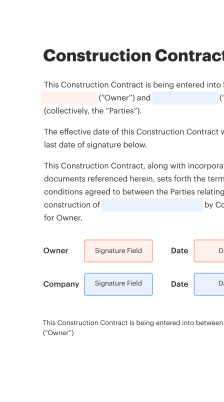
How a production generator flows in operations

A production generator collects transaction data, formats line items, applies rules, and outputs signed receipts while logging activity for compliance.

  • Capture: Collect patient, service, and payment data.
  • Format: Apply templates and pricing rules.
  • Sign: Attach electronic signature if required.
  • Archive: Store receipt with audit metadata.
Collect signatures
24x
faster
Reduce costs by
$30
per document
Save up to
40h
per employee / month

Quick production setup steps

Basic steps to configure a medical receipt generator for live use in a clinical billing environment.

  • 01
    Map data fields: Identify required patient and billing fields.
  • 02
    Design template: Create an itemized, compliant receipt layout.
  • 03
    Configure integrations: Connect EHR, POS, or billing systems.
  • 04
    Enable logging: Activate audit and retention settings.

Operational checklist before going live

Validate these items to ensure a smooth transition to production receipt generation.

01

Data mapping:

Confirm field mappings between source and receipt templates.
02

Template QA:

Test layout with sample transactions and edge cases.
03

Integration tests:

Simulate EHR and billing system interactions.
04

Security validation:

Verify encryption and access controls.
05

Performance tests:

Stress-test concurrency and batch processing.
06

User training:

Train staff on issuing and correcting receipts.
be ready to get more

Why choose airSlate SignNow

  • Free 7-day trial. Choose the plan you need and try it risk-free.
  • Honest pricing for full-featured plans. airSlate SignNow offers subscription plans with no overages or hidden fees at renewal.
  • Enterprise-grade security. airSlate SignNow helps you comply with global security standards.
illustrations signature

Recommended workflow configuration for production

Typical workflow settings to configure when deploying a receipt generator in a live clinical environment.

Workflow Configuration and Setting Name Default configuration and current value
Reminder Frequency for Outstanding Receipts 48 hours before receipt due date
Automatic Archive Delay for Issued Receipts 7 days after issuance
Audit Log Retention Duration Policy Six years as default
Signature Requirement for High-value Transactions Enabled for amounts above threshold
Batch Processing Window and Throttling Nightly batches with rate limits

Supported platforms and device considerations

Production receipt generators must run reliably on desktop, mobile, and server environments and integrate with typical healthcare IT stacks.

  • Desktop access: Modern browsers supported
  • Mobile access: iOS and Android apps
  • Server integration: API and webhook support

Ensure your chosen solution supports responsive templates, stable browser-based editors for staff, native mobile signing experiences for patients, and server-side APIs that can be orchestrated by your existing EHR or billing systems.

Security and protection features

Data encryption: TLS and AES encryption
Access controls: Role-based permissions
Audit logging: Immutable activity records
Document integrity: Tamper-evident seals
User authentication: Multi-factor options
Session protection: Timeouts and monitoring

Production use cases in healthcare settings

Real-world examples show how a generator fits into billing, retail pharmacy, and ambulatory workflows.

Ambulatory clinic receipts

A community clinic issues standardized receipts at checkout to capture co-pays and itemized services for each visit, including CPT codes and insurance adjustments

  • Integration with the EHR writes receipt metadata back to the patient chart
  • Patients receive searchable PDFs and signed receipts for reimbursement

Ensures faster reconciliation and clearer insurer adjudication, resulting in fewer claims disputes and smoother month-end close.

Pharmacy point-of-sale receipts

A retail pharmacy produces production receipts listing medication NDCs, patient copays, and dispenser details for each transaction

  • The generator links to inventory and POS systems to update stock and pricing
  • Receipts include pharmacist initials and optional electronic signature for controlled substances

Leading to accurate inventory tracking, compliant dispensing documentation, and a defensible audit trail during inspections.

Operational best practices for production receipts

Follow these applied practices to reduce errors, maintain compliance, and ensure reliable receipt delivery in live healthcare operations.

Verify patient identity and insurer details before generation
Implement identity checks and real-time insurer lookups to reduce misapplied charges and returned receipts, which minimizes reconciliation work and potential billing disputes.
Use standardized code sets and pricing rules
Enforce CPT, HCPCS, and NDC codes with mapped prices and adjustment logic to avoid billing inconsistency and ensure compatibility with payer adjudication systems.
Maintain clear retention and archival policies
Establish document retention schedules aligned with HIPAA and payer requirements, including secure backups and a documented deletion process for expired records.
Log every issuance with tamper-evident audit trails
Capture signer identity, timestamps, IP addresses, and versioning to provide defensible evidence of receipt origin and changes for audits and dispute resolution.

FAQs About medical receipt generator for production

Frequently asked operational and technical questions with concise troubleshooting guidance for production deployments.

Feature availability comparison among eSignature platforms

A feature-level comparison highlights capabilities relevant to production receipt generation and compliance in U.S. healthcare settings.

Capability Criteria and Availability Across Vendors signNow (Recommended) DocuSign Adobe Sign
HIPAA and Privacy Compliance Status Attestation available Attestation available Attestation available
Bulk Send Capability and Typical Limits Yes — high-volume batches Yes — enterprise plans Yes — enterprise plans
API Access and Rate Limit Policies Public REST API, predictable limits Robust API, tiered limits Comprehensive API, tiered limits
Mobile Signing Support Across Platforms Native iOS/Android apps Native iOS/Android apps Native iOS/Android apps
be ready to get more

Get legally-binding signatures now!

Retention and compliance timeline considerations

Establish concrete retention periods, audit windows, and schedule checks to meet legal and payer obligations without over-retention.

Initial issuance record retention:

Keep original receipt records for at least six years.

Audit log preservation period:

Preserve audit trails for a minimum of six years.

Temporary staging for refunds or adjustments:

Hold receipts in staging for 90 days before final archive.

Patient-requested copies timeframe:

Provide copies within 30 days of request.

Periodic compliance review cadence:

Conduct reviews at least annually.

Regulatory risks and penalties to avoid

HIPAA violations: Fines and corrective action
Incorrect billing: Repayments and penalties
Data breaches: Notification costs
Record retention failure: Compliance citations
Unauthorized access: Disciplinary measures
Tampered documents: Legal disputes

Pricing and plan comparison for receipt generation needs

Compare entry pricing and common production features across popular eSignature vendors to evaluate cost and compliance fit for receipt generation.

Plan Comparison for Popular Vendors signNow (Featured) DocuSign Adobe Sign Dropbox Sign PandaDoc
Entry-level plan starting price Starting at $8 per user per month Starting at $10 per user per month Starting at $14.99 per user monthly Starting at $15 per user per month Starting at $19 per user per month
Free trial and evaluation options Free trial and limited free tier available Free trial available Free trial available Free trial available Free trial available
HIPAA support and add-on costs HIPAA-compliant configurations available, pricing varies Enterprise HIPAA add-on available Business+ with compliance options Enterprise plans for compliance Enterprise HIPAA compliance available
API availability and typical integration support Public API with SDKs and webhooks Extensive API and developer tools Enterprise APIs and SDKs Developer API and webhooks Full API with templates
Bulk sending and high-volume features Bulk Send and scheduled batches included in plans Bulk send in higher tiers High-volume sending in enterprise Bulk sending options available Bulk workflows in paid tiers
walmart logo
exonMobil logo
apple logo
comcast logo
facebook logo
FedEx logo
be ready to get more

Get legally-binding signatures now!