



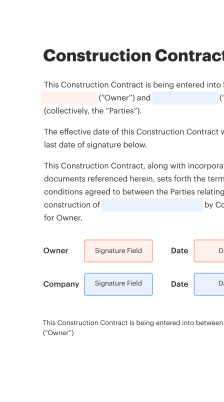
Mobile Phone Bill Format for Human Resources

Streamline your document signing process with airSlate SignNow's intuitive eSignature solution and elevate your HR efficiency.

Award-winning eSignature solution

What the mobile phone bill format for human resources covers

A mobile phone bill format for human resources is a standardized document template HR teams use to capture employee mobile expenses, itemize charges, and support reimbursement or allocation decisions. It typically includes account holder details, billing period, line-item charges for calls, data, and roaming, cost allocation fields, and signatures or approvals. Using a consistent format reduces disputes, speeds payroll or accounts payable processing, and supports auditability. In U.S. HR practice, templates should align with record retention and privacy expectations and be compatible with secure electronic signature workflows.

Why a standardized mobile phone bill format matters for HR compliance

A consistent mobile phone bill format simplifies internal audit, supports ESIGN and UETA electronic records, and documents reimbursement decisions with clear metadata for legal and tax review.

Why a standardized mobile phone bill format matters for HR compliance

Common challenges when managing mobile phone bills in HR

  • Inconsistent bill formats across carriers cause manual rework and delay reimbursements, increasing administrative overhead for HR and payroll teams.
  • Missing itemization or unclear charge descriptions make it difficult to verify business versus personal use, raising compliance and tax reporting risks.
  • Unsecured email transmission of bills or PDFs exposes sensitive employee data such as phone numbers and usage details, creating privacy liabilities.
  • Manual approval routing and paper signatures lengthen processing times and reduce traceability for audits and expense reconciliation.

Representative HR users and their responsibilities

HR Manager

An HR Manager defines the mobile phone expense policy, selects the approved bill format, and reviews exceptions. They coordinate with payroll and legal to ensure the template captures required fields for tax reporting and compliance, and they maintain the master template used across the organization.

Payroll Specialist

A Payroll Specialist receives completed mobile phone bill submissions, verifies supporting details and approvals, encodes reimbursements into payroll or AP systems, and ensures retention of electronic records consistent with company and legal retention schedules.

Teams and roles that use a mobile phone bill format

HR, payroll, and finance departments rely on standardized bill formats to manage reimbursements and cost allocation efficiently.

  • HR managers who maintain policy, validate eligibility, and approve monthly reimbursements.
  • Payroll and accounts payable teams that process payments and reconcile expenses against budgets.
  • Compliance and audit personnel who review records for tax treatment and regulatory adherence.

Clear templates and digital workflows help these groups collaborate with IT and legal to enforce policy, document approvals, and retain records for audit readiness.

be ready to get more

Choose a better solution

Key tools that make a mobile phone bill format effective

Choose features that enforce consistency, reduce manual entry, and maintain secure, auditable records when processing mobile phone bills for HR.

Template Library

A centralized template library enforces a single mobile phone bill format across departments, enables version control, and reduces disputes by ensuring every submission includes the same fields for employee info, billing period, line-item charges, business-use allocation, and approval metadata.

Field Auto-fill

Auto-fill and OCR capabilities extract dates, totals, and usage lines from carrier PDFs to populate the template, reducing manual transcription errors and accelerating verification for high-volume HR operations.

Approval Routing

Configurable approval workflows route bills to managers, payroll, or compliance reviewers in sequence or parallel, include reminders and escalation rules, and record each approver’s identity and timestamp for audit purposes.

Audit Trail

Comprehensive, immutable logs capture who submitted, edited, or approved a bill, with timestamps and IP or device metadata to support internal audits, tax reviews, and compliance obligations.

How to create and use the bill format online

An online template plus digital workflow streamlines collection, approvals, and storage while retaining an auditable history.

  • Upload bill: Attach PDF or image of carrier invoice.
  • Map fields: Auto-extract date, amount, and line items.
  • Route for approval: Send to manager and payroll in sequence.
  • Archive securely: Store with retention metadata and audit trail.
Collect signatures
24x
faster
Reduce costs by
$30
per document
Save up to
40h
per employee / month

Step-by-step: completing the mobile phone bill format

Follow these core steps to collect, validate, and approve a mobile phone bill submission using a standard HR template.

  • 01
    Gather bills: Collect carrier invoices and employee statements.
  • 02
    Populate template: Enter line items and business-use percentages.
  • 03
    Validate charges: Cross-check totals and spot unusual items.
  • 04
    Approve and record: Obtain manager sign-off and store records securely.
be ready to get more

Why choose airSlate SignNow

  • Free 7-day trial. Choose the plan you need and try it risk-free.
  • Honest pricing for full-featured plans. airSlate SignNow offers subscription plans with no overages or hidden fees at renewal.
  • Enterprise-grade security. airSlate SignNow helps you comply with global security standards.
illustrations signature

Recommended workflow configurations for processing mobile phone bills

These settings balance control and efficiency when routing, validating, and storing mobile phone bill submissions for HR and payroll.

Setting Name Configuration
Reminder Frequency 48 hours
Approval Sequence Manager then Payroll
Field Validation Rules Mandatory line-item totals
Retention Period 7 years
Access Roles HR, Payroll, Compliance

Supported platforms for mobile phone bill processing

The mobile phone bill format and associated workflows should work across web, mobile, and tablet platforms to accommodate field and remote employees.

  • Web browsers: Chrome, Edge, Safari supported
  • Mobile apps: iOS and Android apps
  • Offline capture: Photo upload with sync

Ensure browser compatibility with current stable releases, require the latest mobile app builds when possible, and provide an offline capture option so employees can submit photographed bills that synchronize when connectivity resumes.

Security and protection controls to include

Encryption at rest: AES-256 encryption
Encryption in transit: TLS 1.2+ channels
Access control: Role-based permissions
Authentication: Multi-factor required
Audit logging: Immutable event trail
Data redaction: Selective sensitive masking

Illustrative HR use cases for a mobile phone bill format

Two concise examples show how templates and structured workflows reduce processing time and support audits while maintaining privacy controls.

Employee reimbursement process

An HR specialist receives monthly mobile bills with itemized lines for calls, data, and taxes, and uses a standardized template to mark business usage and employee portion

  • Template auto-calculates reimbursable amount
  • Reduces manual calculations and disputes

Resulting in consistent approvals, faster payroll entry, and a clear audit trail that supports tax and expense audits across payroll cycles.

Audit and compliance response

During an internal audit, compliance requests mobile expense records for a subset of employees and months, and HR extracts standardized bill templates with approval metadata

  • Templates include signer, date, and account fields for quick filtering
  • Simplifies review and evidence collection

Leading to compact, verifiable records that satisfy auditors while limiting exposure of unrelated personal usage data.

Best practices for secure and accurate bill submissions

Implementing clear standards and technical controls reduces errors, maintains privacy, and ensures consistent treatment of mobile expenses.

Standardize a single company template
Adopt one mobile phone bill format with mandatory fields for employee identification, billing period, itemized charges, and business-use percentage. Consistency reduces manual reconciliation and supports automated parsing and reporting across HR and payroll systems, creating a single source of truth for expense data.
Limit and document approvals
Define a minimal approval chain—typically manager then payroll—with rules for exceptions. Document delegated approvers and maintain timestamps and signatory identities to preserve accountability and simplify audits or tax inquiries.
Protect personal data
Redact or mask personal identifiers not needed for reimbursement decisions and enforce role-based access. Align practices with HIPAA or FERPA when bills include protected data, and retain only the fields necessary for tax and expense recordkeeping.
Automate retention and deletion
Set retention periods consistent with payroll and tax requirements, automate archival to secure storage, and schedule deletions when records are no longer required, ensuring defensible retention practices and reducing data exposure risk.

FAQs about mobile phone bill format for human resources

Answers to common questions about creating, validating, and storing mobile phone bills in HR systems, including legal and technical considerations.

Digital versus paper signing: capability comparison

A capability matrix highlights common technical and compliance differences between digital eSignature solutions and paper-based processes for HR mobile bill processing.

Feature signNow (Recommended) Adobe Sign DocuSign
ESIGN and UETA compliance
Mobile app availability
API and integrations REST API REST API REST API
HIPAA compliance option Available Available Available
be ready to get more

Get legally-binding signatures now!

Risks and penalties for inadequate bill handling

Regulatory fines: Monetary penalties
Tax exposure: Incorrect reporting
Data breaches: Liability costs
Audit failures: Findings and remediation
Payroll errors: Overpayments
Policy disputes: Employee grievances

Vendor feature comparison for HR mobile bill workflows

Compare common capabilities across major eSignature providers to assess fit for HR processes; columns list leading vendors and their general availability of features.

Metric signNow (Recommended) DocuSign Adobe Sign HelloSign PandaDoc
Free trial availability Free trial offered Free trial offered Free trial offered Free trial offered Free trial offered
Mobile app iOS and Android apps iOS and Android apps iOS and Android apps iOS and Android apps iOS and Android apps
API access Public REST API and SDKs Public REST API and SDKs Public REST API and SDKs Public REST API Public REST API
HIPAA support Available with BAA Available with BAA Available with BAA Available with BAA Available with BAA
Enterprise controls SAML, RBAC, audit logs SSO, RBAC, audit logs SSO, RBAC, audit logs SSO, team controls SSO, team controls
walmart logo
exonMobil logo
apple logo
comcast logo
facebook logo
FedEx logo
be ready to get more

Get legally-binding signatures now!