Proposal and Contract Software for Product Management

Empower your team to create and eSign documents effortlessly. Experience an easy-to-use, cost-effective solution that enhances collaboration and speeds up your processes.

Award-winning eSignature solution

What proposal and contract software for product management does

Proposal and contract software for product management centralizes creation, distribution, signing, and storage of commercial documents used throughout a product lifecycle. It combines reusable templates, role-based workflows, eSignature capability, and audit trails so product teams can standardize vendor agreements, partner terms, NDAs, and customer proposals. The software reduces manual steps for approvals, ensures consistent formatting and clause usage across documents, and records actions and timestamps to support compliance and dispute resolution in routine product management activities.

Why product teams adopt proposal and contract software

Product managers use this software to accelerate approvals, reduce manual errors, and keep contractual history tied to releases and vendors while maintaining legal and audit readiness in everyday processes.

Why product teams adopt proposal and contract software

Common challenges without dedicated proposal and contract software

  • Version drift across email and shared drives causes conflicting contract terms and lost change history that complicates negotiations and audits.
  • Lengthy approval cycles with manual handoffs and unclear responsibilities delay launches and vendor on-boarding, increasing time-to-market for product features.
  • Inconsistent templates and ad hoc redlining lead to legal exposure and uneven commercial terms across customers and partners.
  • Tracking signed documents and retention periods manually increases compliance risk and creates gaps in audit evidence for regulatory reviews.

Representative user roles and responsibilities

Product Manager

Product Managers use the software to assemble vendor statements of work, coordinate internal approvals, and attach signed contracts to release plans. They rely on templates and workflow automation to reduce negotiation cycles and keep contractual obligations aligned with product roadmaps and delivery timelines.

Legal Counsel

Legal Counsel reviews and approves contract language, maintains approved clause libraries, and verifies signature methods meet legal standards. They use audit trails and version history to support compliance reviews and to resolve disputes or questions arising from contract terms.

Typical users inside product and adjacent teams

Product teams, legal counsel, procurement, and sales operations are primary users of proposal and contract software within product organizations.

  • Product managers coordinating vendor contracts, feature rollouts, and customer agreements to maintain release schedules.
  • Legal teams reviewing clauses, applying approved language, and ensuring compliance with corporate policies and regulations.
  • Sales operations streamlining proposal assembly and signature capture to shorten sales cycles and standardize pricing terms.

Cross-functional adoption ensures documents are consistent, auditable, and integrated into product planning and vendor management processes.

Core features product teams should evaluate

Assess these six functional areas to match the software with product requirements, scale, and compliance needs.

Templates

Robust template management with variable fields, clause libraries, and role-specific sections enables product teams to generate consistent proposals and SOWs while minimizing manual edits and legal review time.


Workflow automation

Configurable approval flows, conditional routing, and automated reminders reduce bottlenecks in the review process and ensure documents move through necessary stakeholders efficiently.

Bulk Send

Bulk Send capability allows teams to distribute identical documents to large groups or multiple customers simultaneously, tracking completion and handling asynchronous responses without manual re-sending.

Conditional fields

Fields that display based on prior inputs let proposals adapt dynamically to product options, pricing tiers, or regional clauses, reducing errors and simplifying complex offer generation.

Audit trail

Comprehensive, tamper-evident logs record signer identity, timestamps, IP addresses, and document changes to support legal admissibility and internal audits.

Advanced authentication

Support for SSO, two-factor authentication, and optional identity verification services provides configurable signer validation appropriate to contract sensitivity and regulatory needs.

be ready to get more

Choose a better solution

Integrations that streamline document workflows

Integrating with common tools reduces manual entry, preserves context, and keeps contracts linked to customer and product records.

Google Docs integration

Connects document drafts in Google Docs to the contract system so teams can prepare proposals collaboratively, preserve formatting, and then convert or push the final draft into a signing workflow without rekeying customer or product details.

CRM connectivity

Syncs customer records, contract status, and signature events with CRM systems so product, sales, and operations teams see real-time agreement status alongside opportunities and feature entitlements.

Cloud storage sync

Integrates with Dropbox and similar services to keep signed documents stored in a preferred repository, maintain folder structures, and apply organization-wide retention controls.

REST API and webhooks

Provides programmatic access to generate, send, and track documents from internal product tooling and triggers downstream systems when signature events occur to automate provisioning or billing actions.
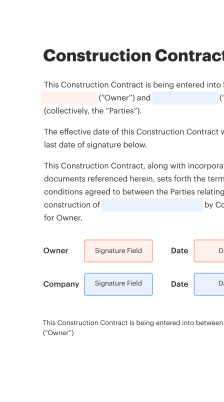
How proposals and contracts move through a product workflow

A typical document lifecycle includes drafting, applying templates, routing for approvals, and capturing signatures with an auditable trail.

  • Draft: Upload or generate document from template
  • Tag fields: Add signature, date, and data fields
  • Authenticate: Apply chosen signer authentication
  • Complete: Capture signature and archive final copy
Collect signatures
24x
faster
Reduce costs by
$30
per document
Save up to
40h
per employee / month

Quick setup steps for product teams

Follow these four steps to configure proposal and contract software for routine product management needs and accelerate initial adoption across teams.

  • 01
    Create templates: Import standard clauses and reusable fields
  • 02
    Map approvals: Define sign-off order and approvers
  • 03
    Set authentication: Choose signer verification methods
  • 04
    Launch workflows: Assign owners and start live documents

Managing audit trails and evidence

Maintain an auditable record of actions to support compliance, legal review, and internal investigations.

01

Enable logging:

Turn on detailed event capture
02

Capture signer metadata:

Record IP, timestamps, and device info
03

Store version history:

Keep drafts and final signed copies
04

Export audit reports:

Generate reports for legal or compliance
05

Retain per policy:

Apply retention rules by document type
06

Preserve chain of custody:

Protect logs from alteration
be ready to get more

Why choose airSlate SignNow

  • Free 7-day trial. Choose the plan you need and try it risk-free.
  • Honest pricing for full-featured plans. airSlate SignNow offers subscription plans with no overages or hidden fees at renewal.
  • Enterprise-grade security. airSlate SignNow helps you comply with global security standards.
illustrations signature

Typical workflow configuration settings

Example configuration items to review when setting up workflows for proposal and contract usage in product processes.

Workflow Setting Name and Configuration Setting Default
Reminder Frequency for Pending Signatures 48 hours Two reminders
Automatic Expiration for Sent Documents 30 days Expire unsigned
Signer Authentication Methods and Options Email only MFA optional
Template Version Control and Access Role-restricted Enabled
Storage Location and Retention Policy Cloud region 7 years

Supported platforms and device considerations

Confirm supported operating systems, browser versions, and mobile apps to ensure reliable access for distributed teams.

  • Supported OS: Windows, macOS, modern Linux
  • Browser requirements: Chrome, Edge, Firefox, Safari
  • Mobile applications: iOS and Android apps available

Verify device compatibility, enable automatic updates where possible, and plan for offline or low-bandwidth usage to support field teams and remote stakeholders.

Security controls commonly used

Encryption at rest: AES-256 or equivalent
Encryption in transit: TLS 1.2+ enforced
Access logging: Comprehensive event logs
Single sign-on: SAML or OIDC
Multi-factor auth: TOTP or SMS options
Data residency: Regional storage options

Industry use examples for product teams

Two concise examples show how teams integrate proposal and contract software into product workflows.

Hardware supplier agreements

A hardware product team consolidated vendor SOWs into template-driven contracts to reduce manual edits and ensure consistent liability clauses

  • Centralized templates and approval routing
  • Faster procurement and fewer legal exceptions

Resulting in repeatable onboarding and clearer supplier obligations that shortened procurement cycles and reduced negotiation variance.

SaaS feature licensing

A SaaS product group used configurable proposal templates to create customer feature addenda with conditional pricing fields

  • CRM integration auto-filled customer data
  • Configurable approval steps for discounts

Leading to faster deal closure, fewer billing errors, and consistent application of commercial terms across global accounts.

Recommended practices for secure and accurate usage

Adopt consistent processes and controls to reduce risk and improve document velocity while preserving legal and audit integrity.

Use approved templates and clause libraries
Maintain a curated set of templates and pre-approved clauses managed by legal to ensure consistent language, reduce review cycles, and limit exceptions. Version control and access restrictions prevent unauthorized edits and preserve an auditable history of changes.
Apply role-based approvals and segregation
Define clear approver roles for commercial, legal, and finance reviews with sequential or parallel workflows. Segregation of duties reduces risk and speeds approval by routing documents only to responsible parties.
Standardize signer authentication choices
Select authentication strength according to contract sensitivity—email verification for low-risk agreements and multi-factor or knowledge-based authentication for regulated or high-value contracts to strengthen enforceability.
Preserve audit records and retention settings
Ensure every signed document includes a timestamped audit trail, signer metadata, and a defined retention schedule aligned to corporate policy and legal obligations to support future audits and dispute resolution.

FAQs About proposal and contract software for product management

Answers to common questions product teams ask when evaluating or operating proposal and contract solutions.

Feature comparison for common providers

A concise capability matrix highlights availability and notable differences across eSignature providers frequently used by product organizations.

Feature Criteria and Vendor Comparison signNow (Recommended) Adobe Sign DocuSign
Legal validity (US)
API availability REST API REST API REST API
Bulk Send capability Bulk Send Batch send add-on Bulk Send
Advanced signer auth MFA & SSO MFA & SSO MFA & SSO
be ready to get more

Get legally-binding signatures now!

Key timing settings to configure

Configure timing controls to prevent stale requests, remind signers, and manage document lifecycle events consistently.

01

Reminder cadence

Frequency of signatory reminders

02

Document expiration

Automatic expiry for unsigned docs

03

Approval SLA timers

Internal review time limits

04

Retention recall dates

Dates for record review

Retention and review schedule examples

Sample dates and intervals help teams align document lifecycles with legal and operational requirements.

Retention start date:

Date of signature

Mandatory review interval:

Every 24 months

Contract renewal reminder:

90 days prior to end

Archival transfer date:

One year after expiration

Destruction eligibility date:

Seven years after signature

Risks from improper document handling

Noncompliance: Regulatory fines
Unauthorized access: Data breaches
Data loss: Irrecoverable records
Invalid signatures: Contract disputes
Poor auditability: Failed reviews
Retention gaps: Legal exposure

Pricing and capability summary

High-level plan and capability notes to compare cost posture and included features across providers; consult vendor sites for current pricing and limits.

Pricing and Feature Summary signNow (Recommended) DocuSign Adobe Sign PandaDoc Dropbox Sign
Entry-level plan type Subscription, low-cost plans Per-user subscription Included with Creative Cloud Subscription with templates Simple eSign plans
API access availability Included in paid plans Available on business plans Included in enterprise tiers Available on business tiers API available
HIPAA support option Business associate agreement available BAA available BAA available Requires vendor review BAA by request
Template and workflow features Robust templates and workflows Advanced workflow engine Integrated with Adobe tools Strong template library Basic workflows
Enterprise support and SLAs Enterprise plans with SLAs Enterprise SLA options Enterprise agreements available Enterprise packages Enterprise support options
walmart logo
exonMobil logo
apple logo
comcast logo
facebook logo
FedEx logo
be ready to get more

Get legally-binding signatures now!