Repair Bill Format in Word for Logistics

Repair bill format in Word for logistics offers a structured template for documenting repairs. SignNow provides a secure eSignature solution for seamless transactions.

Award-winning eSignature solution

What the repair bill format in Word for logistics is and why it matters

A repair bill format in Word for logistics is a standardized document template used to record vehicle or equipment repair work, parts, labor rates, and cost allocations inside a logistics operation. It ensures consistent billing, supports accounting reconciliation, and provides a clear audit trail for carriers, fleet managers, and third-party vendors. Properly designed Word templates can include itemized line entries, repair codes, service dates, and signatures to meet internal controls and customer requirements while remaining editable for incident-specific details and attachments.

Benefits of using a standardized Word repair bill for logistics

A consistent Word repair bill format reduces errors, speeds approvals, and keeps repair cost data structured for finance and operations teams.

Benefits of using a standardized Word repair bill for logistics

Primary users of a Word repair bill in logistics

Logistics Manager

Responsible for fleet cost controls and vendor relationships, the Logistics Manager uses the repair bill template to audit charges, authorize payments, and analyze repair spend trends across routes and assets to inform budgeting and procurement decisions.

Maintenance Clerk

The Maintenance Clerk fills repair details, tracks parts usage, and submits bills for approval; this role needs a template that enforces required fields, supports attachments like photos and receipts, and integrates with work order systems for accurate recordkeeping.

Core features to include in a logistics repair bill template

A robust repair bill format in Word for logistics combines financial, operational, and compliance fields so teams can process repairs quickly and accurately.

Header fields

Company and customer identification, fleet number, repair order ID, and contact details to ensure accurate routing and accounting reconciliation.


Itemization

Detailed rows for part numbers, labor tasks, quantities, unit costs, and repair codes that support cost analysis and inventory updates.

Labor tracking

Fields to capture technician ID, labor hours, rate type, and overtime flags for payroll and chargeback accuracy.

Tax and adjustments

Dedicated lines for tax calculation, discounts, credits, and warranty adjustments to avoid downstream billing disputes.

Approval chain

Sections for supervisor approvals, vendor confirmations, and conditional signoffs to maintain control over high-value repairs.

Attachments

Space to reference photos, diagnostic reports, and parts receipts that substantiate charges and aid claims processing.

be ready to get more

Choose a better solution

Integrations and templates that improve repair bill processing

Connect your Word repair bill template to common operational systems and use reusable templates to reduce manual work and errors.

Fleet management

Link repair bill fields to fleet telematics and maintenance records so vehicle and service histories populate automatically and reduce duplicate data entry.

Accounting systems

Map totals and GL codes to ERP or accounting software to accelerate invoice posting and reconcile repair expenses with minimal manual adjustments.

Document storage

Save finalized repair bills and attachments to cloud repositories like Dropbox or enterprise document stores for retention and audit access.

Reusable templates

Create template variants for scheduled maintenance, emergency repairs, and warranty work so teams use a consistent format tailored to common scenarios.
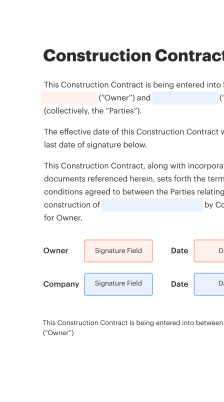
How the repair bill format in Word integrates into digital workflows

This sequence shows how a Word repair bill moves from creation to approval and signature across devices and services.

  • Draft: Create or upload the Word template and fill incident-specific lines.
  • Review: Route the document to cost controllers and maintenance leads for validation.
  • Sign: Apply electronic signatures and record signer identity and timestamp.
  • Archive: Store the final PDF and metadata in a secure document repository.
Collect signatures
24x
faster
Reduce costs by
$30
per document
Save up to
40h
per employee / month

Quick steps to create a repair bill format in Word for logistics

Follow these four concise setup steps to produce a usable, repeatable repair bill template for your logistics workflows.

  • 01
    Create template: Start with a Word document outlining header, recipient, and invoice fields.
  • 02
    Add line items: Include part number, description, quantity, unit price, and labor hours.
  • 03
    Insert totals: Calculate subtotals, taxes, discounts, and final payable amount.
  • 04
    Include signatures: Reserve fields for preparer and approver signatures and dates.

Audit trail steps for repair bills: recording and review

Maintain an auditable sequence of actions to prove integrity and approvals for every repaired asset and associated cost.

01

Create record:

Generate initial repair bill draft with metadata
02

Attach evidence:

Add photos, parts receipts, and diagnostics
03

Route for approval:

Send to designated approvers in sequence
04

Capture signatures:

Record signer identity and timestamp
05

Finalize document:

Lock final PDF and store
06

Audit review:

Periodically review logs and access history
be ready to get more

Why choose airSlate SignNow

  • Free 7-day trial. Choose the plan you need and try it risk-free.
  • Honest pricing for full-featured plans. airSlate SignNow offers subscription plans with no overages or hidden fees at renewal.
  • Enterprise-grade security. airSlate SignNow helps you comply with global security standards.
illustrations signature

Suggested workflow settings for repair bill approvals and automation

Configure these workflow settings to route, remind, and archive repair bills consistent with logistics approval policies.

Feature Configuration
Approval routing Two-step approval
Reminder frequency 48 hours
Auto-archive policy After completion
Signature type Electronic signature
Retention tag 7 years

Device and platform considerations for working with Word repair bills

Use a modern device and Word-compatible software to preserve layout and formulas when preparing repair bills for logistics.

  • Desktop Word: Full feature support
  • Mobile editing: Basic edits, limited layout
  • Browser viewing: Good for approvals

For signing and workflow automation, PDFs generated from Word are more consistent across platforms and integrate better with eSignature providers and document management systems.

Security and access controls for repair bill documents

Encryption at rest: AES-256 encryption
Encryption in transit: TLS 1.2 or higher
Role-based access: Least-privilege permissions
Document watermarking: Visual tamper deterrent
Multi-factor authentication: Added signer verification
Activity logging: Comprehensive event records

Real-world logistics scenarios using a Word repair bill

Two brief examples show how a Word repair bill format streamlines common maintenance and billing workflows in logistics.

Interstate fleet repair

A long-haul carrier documents roadside repairs using a standardized Word repair bill template that captures parts and labor

  • The template auto-calculates totals and includes repair codes for billing
  • The finance team receives a consistent invoice format for rapid posting

Resulting in faster reimbursement and clearer carrier cost tracking.

Third-party workshop billing

A logistics provider receives itemized repair bills from external workshops and standardizes them into a common Word layout

  • The format enforces required fields like warranty status and technician ID
  • Procurement reconciles charges efficiently and flags nonconforming entries

Leading to fewer disputes and more predictable repair spend.

Best practices for secure, accurate repair bill templates

Follow these practices to make repair bill templates reliable, auditable, and easy to integrate into logistics workflows.

Standardize field names and codes across teams
Use consistent part numbers, labor codes, and header fields to prevent reconciliation errors. Standardization enables automation between maintenance software, accounting, and reporting systems and reduces manual mapping when consolidating costs across multiple workshops or carriers.
Validate required fields before approval
Enforce validation rules for critical fields like total amount and repair order ID. Requiring those fields prevents incomplete submissions, accelerates approvals, and reduces back-and-forth communication with vendors or internal maintenance teams.
Capture signer identity and timestamps
Record authentication methods and timestamps for each signature to create a robust audit trail. This practice supports compliance with ESIGN and internal audit requirements and helps resolve disputes about who authorized charges and when.
Maintain version control and template history
Track template revisions and document effective dates so teams use the correct format. Version control prevents accidental use of deprecated fields and ensures historical bills remain interpretable over time for audits or claims.

FAQs About repair bill format in Word for logistics

Common questions and solutions related to creating, signing, and managing repair bill templates used in logistics operations.

Feature support: signNow compared with leading eSignature platforms

This compact comparison highlights availability and basic technical support across signNow, DocuSign, and Adobe Sign for common repair bill features.

Electronic Signature Service Comparison Table signNow (Recommended) DocuSign Adobe Sign
ESIGN Act compliance
Bulk Send
API Access REST API REST API REST API
HIPAA-ready features Optional Add-on Optional
be ready to get more

Get legally-binding signatures now!

Recommended retention and review deadlines for repair bills

Set clear deadlines for review, retention, and deletion to comply with accounting practices and reduce storage risk.

Submission deadline:

30 days after repair

Approval turnaround:

7 business days

Invoice posting:

Within month-end close

Retention period:

7 years standard

Periodic review:

Annually

Risks and compliance considerations

Incorrect billing: Disputes or chargebacks
Unauthorized access: Data exposure risks
Missing audit trail: Regulatory issues
Noncompliant signatures: Legal enforceability concerns
Retention failures: Penalties or fines
Incomplete records: Claims denial risk

Pricing and plan differences for repair bill eSignature workflows

Below are typical pricing characteristics and plan notes for signNow and four major eSignature providers to consider when automating repair bill signatures and approvals.

Pricing Plans Overview signNow (Recommended) DocuSign Adobe Sign HelloSign PandaDoc
Starting monthly price From $8 per user From $10 per user From $14 per user From $15 per user From $19 per user
Free trial availability Yes, 7 days Yes, 30 days Yes, 30 days Yes, 14 days Yes, 14 days
API included in plan Available with business plans Available with most plans Available with enterprise Paid add-on Available with enterprise
Per-signature cost No extra per-signature fee Variable add-ons Variable add-ons No per-signature fee No per-signature fee
Enterprise support options Dedicated support available Comprehensive enterprise services Global enterprise support Enterprise tier available Enterprise tier available
walmart logo
exonMobil logo
apple logo
comcast logo
facebook logo
FedEx logo
be ready to get more

Get legally-binding signatures now!