Fusion par lot
Traitement simultané de centaines de fichiers avec gestion automatique des erreurs et optimisation des performances pour gains de temps significatifs.




La fusion de documents réduit la complexité des échanges, améliore la cohérence des dossiers et accélère les cycles de signature tout en centralisant le suivi et la conservation des preuves transactionnelles.

Le responsable RH utilise la fusion pour assembler contrats, formulaires d'embauche et politiques internes en un seul fichier, simplifiant l'envoi aux nouveaux employés et la conservation des signatures électroniques dans un dossier centralisé conforme aux exigences internes.
Le gestionnaire de contrats regroupe propositions, annexes et accords de non-divulgation en un document unique pour réduire les risques d'omission, assurer l'ordre des pièces et faciliter le traitement par le service juridique et les signataires externes.
Les équipes qui gèrent des contrats ou des dossiers longs tirent un bénéfice immédiat de la fusion automatisée.
L'adoption réduit les tâches manuelles et améliore la cohérence des dossiers finaux.
Traitement simultané de centaines de fichiers avec gestion automatique des erreurs et optimisation des performances pour gains de temps significatifs.
Interface de glisser-déposer pour définir précisément l'ordre des pages et sections avant la création du document consolidé.
Réduction de la taille finale sans perte notable de qualité pour faciliter l'envoi et l'archivage.
Regroupement et normalisation des métadonnées des fichiers sources pour assurer traçabilité et recherche documentaire.
Contrôles pré-fusion pour déceler pages manquantes, formats incompatibles et champs de formulaire non remplis.
Options d'horodatage et d'archivage conforme aux exigences de conservation documentaire en entreprise.
Permet de sélectionner plusieurs fichiers Google Docs et de créer un PDF fusionné, tout en conservant les styles et les liens internes pour un rendu cohérent avant signature.
Intègre les dossiers partagés pour récupérer automatiquement les pièces jointes et générer un document consolidé prêt à être envoyé pour signature électronique.
Rassemble propositions, devis et annexes depuis les enregistrements CRM pour produire un paquet contractuel unique lié à l'opportunité commerciale.
Templates personnalisables qui définissent l'ordre des documents, les champs de signature et les règles de fusion pour standardiser les envois récurrents.

| Setting Name | Configuration |
|---|---|
| Paramètre de fusion de documents par défaut | PDF linéarisé |
| Intervalle de traitement par lot programmé | Toutes les 2 heures |
| Politique d'archivage post-fusion | Archivage 7 ans |
| Notification après fusion réussie | Email aux parties |
La fonctionnalité de fusion est disponible sur navigateurs modernes, applications mobiles et via API, permettant l'assemblage depuis plusieurs terminaux.
Pour de meilleures performances, utilisez une connexion sécurisée, assurez-vous que les fichiers source sont dans des formats courants (PDF, DOCX) et testez la fonctionnalité sur un jeu de données représentatif avant déploiement.
Une agence regroupe contrat de vente, annexes et diagnostics en un document unique pour chaque transaction
Resulting in une remise au notaire plus rapide et une traçabilité claire des signatures et des versions.
Un établissement combine formulaires d'inscription, pièces justificatives et politiques en un dossier complet
Leading to une conformité accrue lors d'audits FERPA et une gestion administrative plus efficace.
| Criteria | signNow (Recommended) | DocuSign |
|---|---|---|
| Support de fusion de fichiers | ||
| Limite de fichiers par fusion | Illimité | 100 |
| API intégration disponible | ||
| Conformité HIPAA disponible | Optional | Optional |
Tout ce que vous avez à faire est de sélectionner les fichiers à fusionner et d'organiser leur ordre. La fusion de fichiers peut faciliter le traitement des documents et des demandes de signature pour vous et vos signataires.
Cliquez sur le bouton Plus à côté du document que vous souhaitez fusionner, puis sélectionnez Fusionner le document avec dans le menu déroulant.
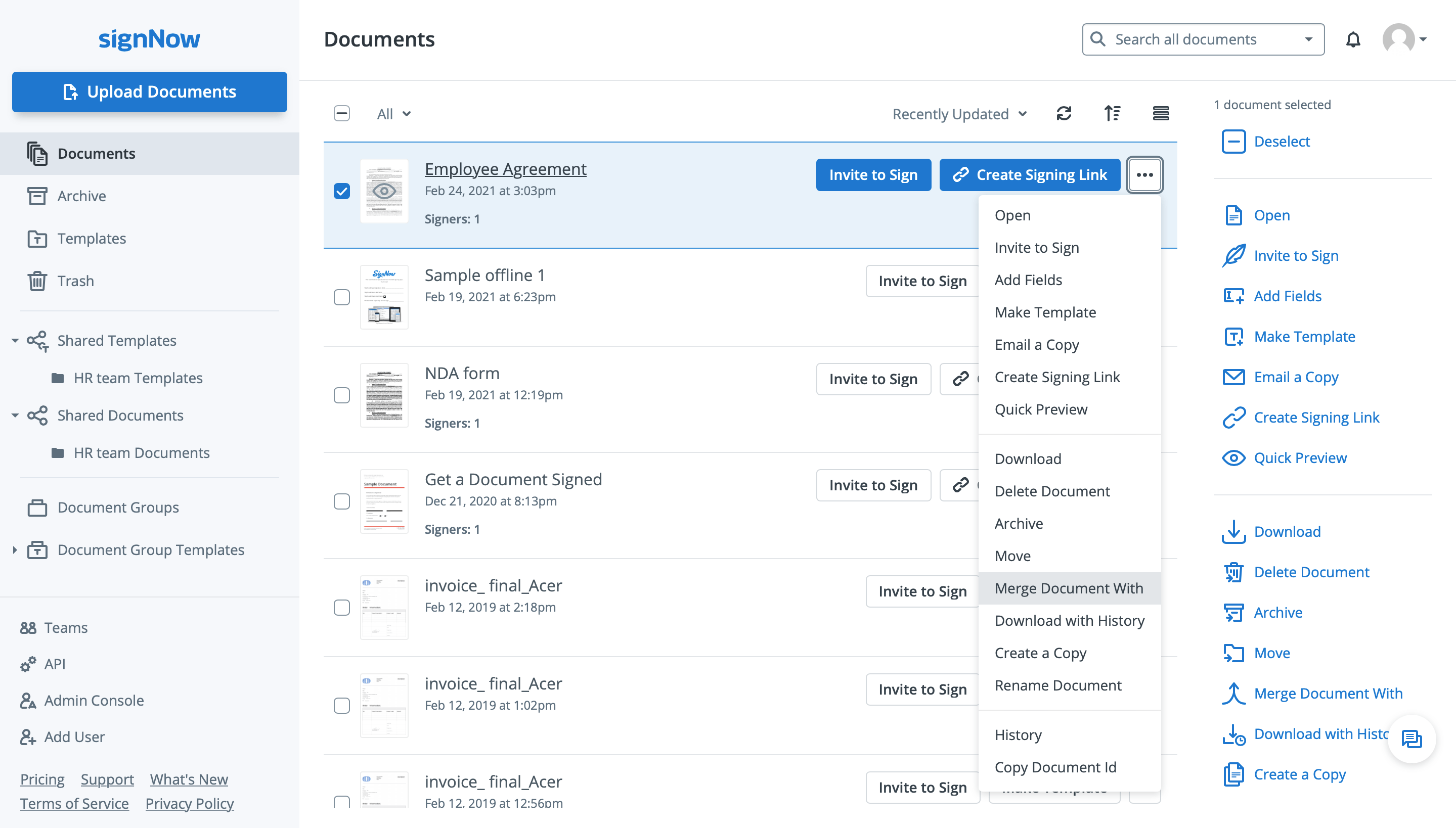
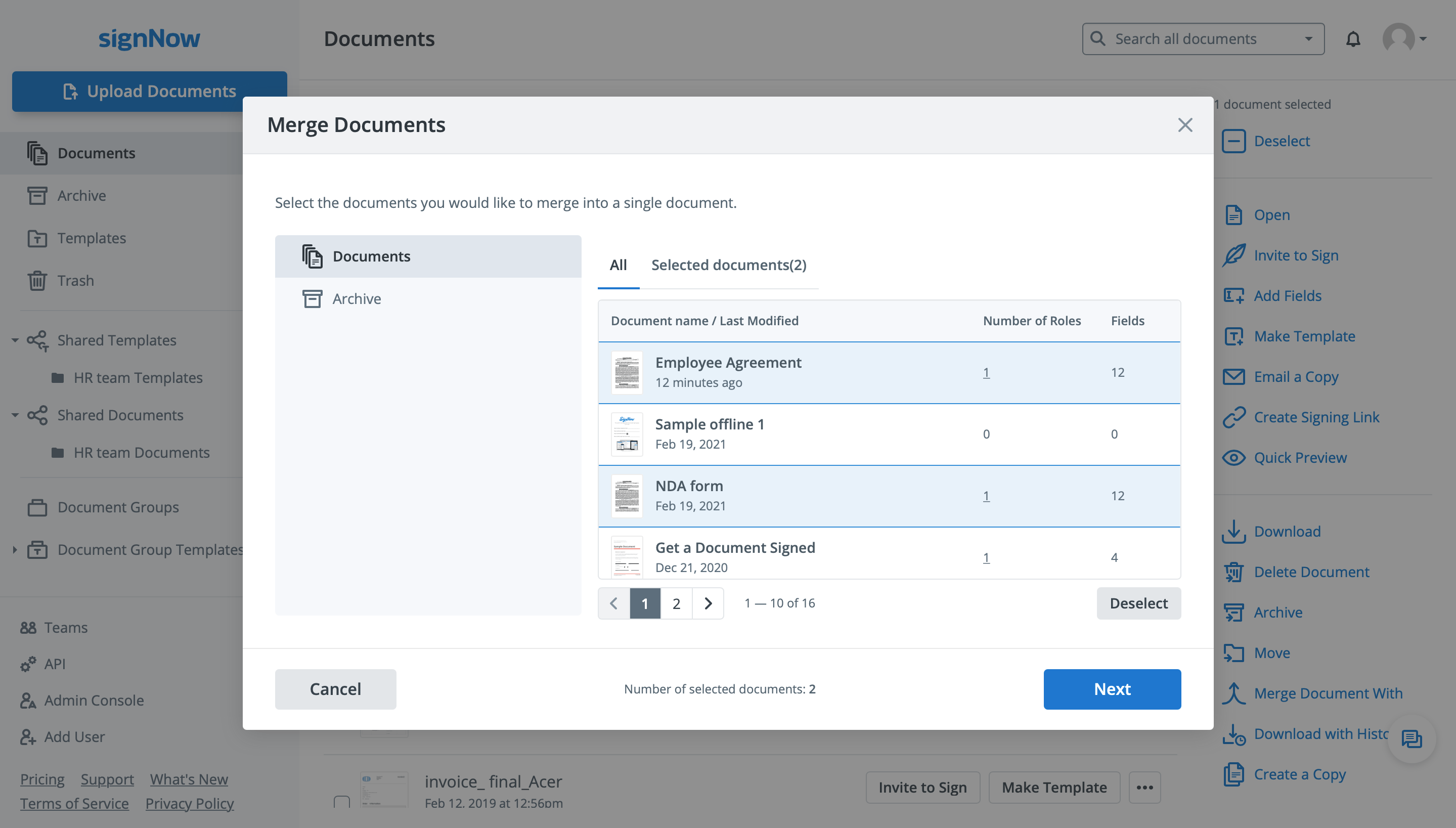
Sélectionnez les fichiers que vous souhaitez fusionner dans la liste et cliquez sur Suivant. Vous pouvez basculer entre les dossiers pour trouver les documents dont vous avez besoin. Le menu de sélection de dossier apparaît à gauche. Vous pouvez également voir tous vos fichiers sélectionnés en passant à l'onglet Documents sélectionnés.
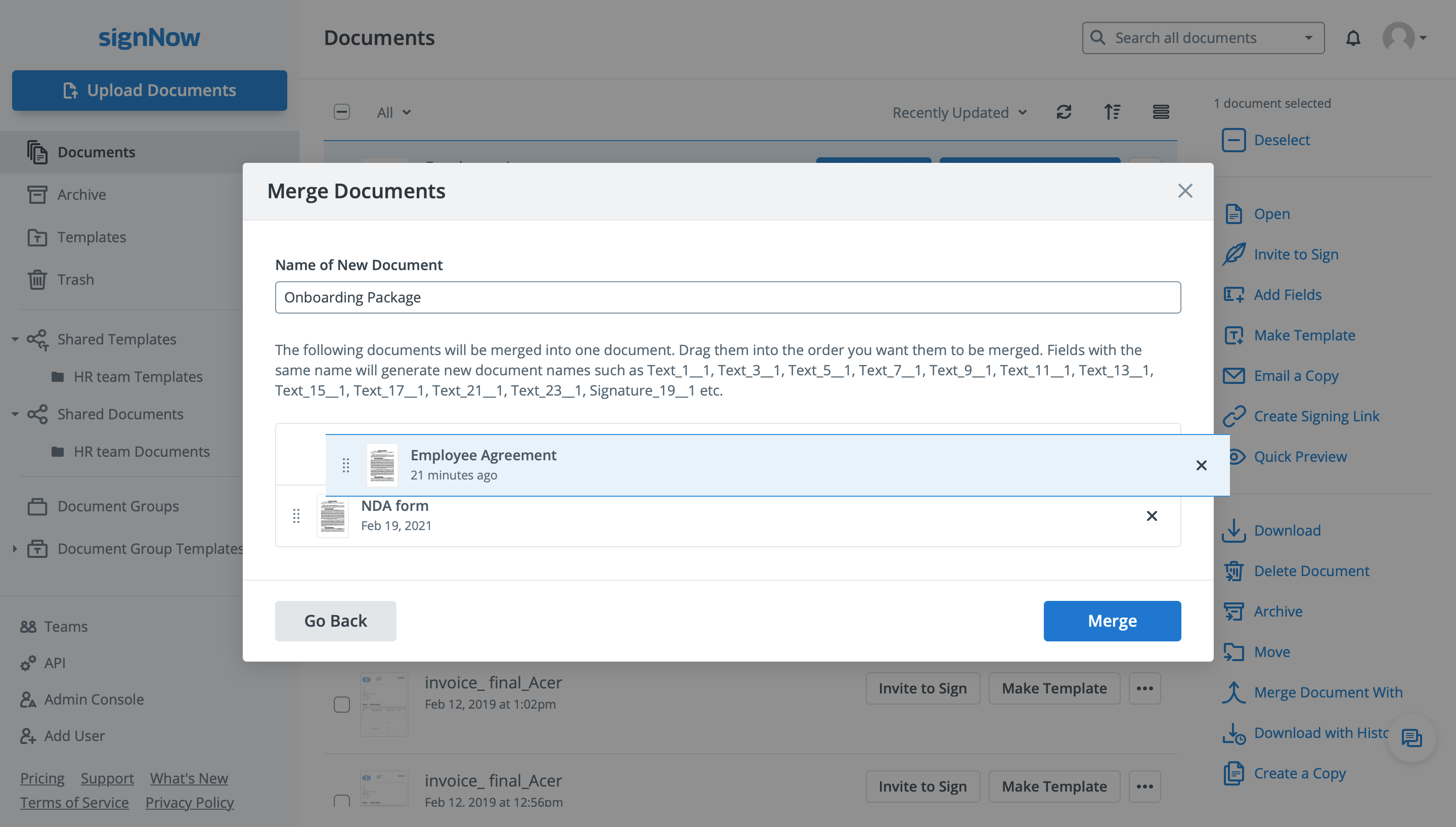
Faites glisser et déposez les documents pour définir l'ordre dans lequel ils apparaîtront dans le fichier fusionné. Ensuite, remplissez le champ Nom du nouveau document et cliquez sur le bouton Fusionner.
Le PDF fusionné apparaîtra en haut de la liste des documents. Les fichiers que vous avez utilisés pour créer le document ne seront pas affectés et resteront dans leurs répertoires d'origine.











