Establishing secure connection…Loading editor…Preparing document…

Agreement for Commission of Public Artwork

This template is fully customizable. Edit the text, fill out the fields, and send it for signature. Give it a try!
Agreement for Commission of Public Artwork

What the Agreement for Commission of Public Artwork Is

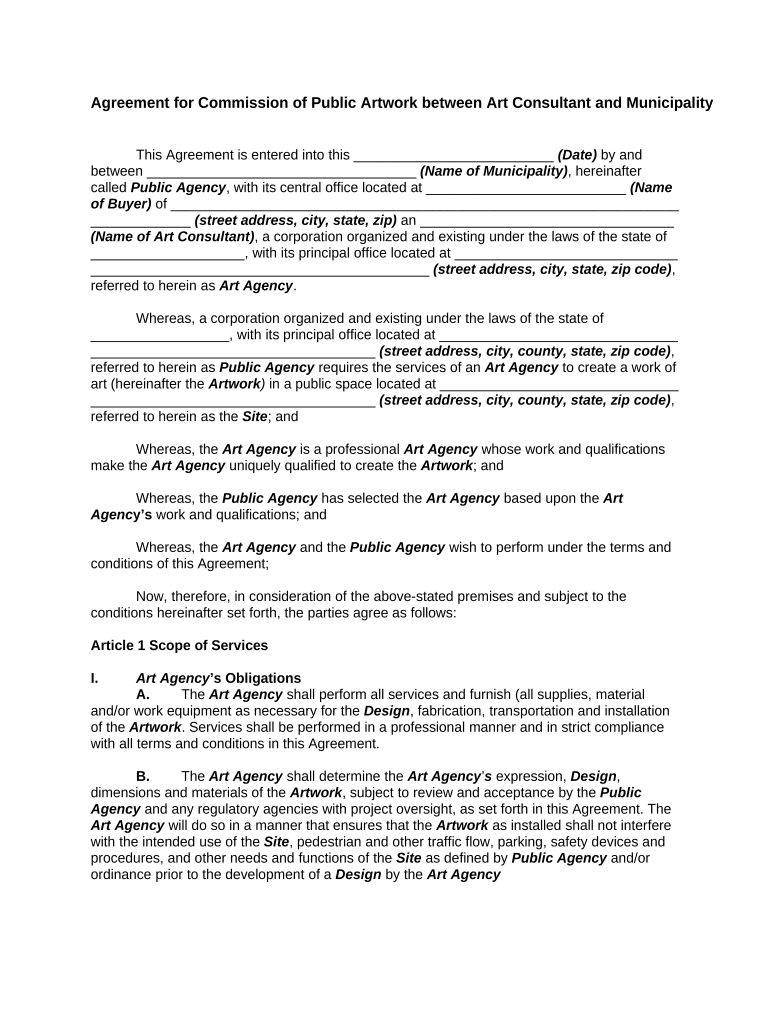
An Agreement for Commission of Public Artwork is a written contract that formalizes the relationship between a commissioning body (municipality, public arts agency, or private developer) and an artist or artist team for the design, fabrication, installation, and maintenance of artwork in a public setting. The document defines scope of work, site specifications, materials, timeline, payments and schedule, intellectual property and copyright allocation, insurance and indemnity obligations, permitting responsibilities, acceptance criteria, and procedures for relocation or deaccession. It is enforceable as a contract when properly executed by authorized signatories.

Why a Clear Commission Agreement Matters

A precise commission agreement reduces disputes by documenting deliverables, payment milestones, ownership of rights, and maintenance obligations. It allocates risk through insurance and indemnity clauses, establishes acceptance criteria, and creates an enforceable record that supports public procurement standards and accountability.

Why a Clear Commission Agreement Matters

Who Typically Uses This Agreement

Typical users include commissioning agencies, private developers, and artists engaged in public installations; each party has distinct responsibilities and legal needs.

  • Municipal arts commissions and public agencies managing procurement, rights, and long-term maintenance obligations.
  • Artists and artist teams negotiating compensation, IP assignment, fabrication standards, and delivery schedules.
  • Property owners and developers addressing site access, permits, insurance, and warranty requirements.

Step-by-Step: Complete the Agreement

Follow these steps to complete and execute the Agreement for Commission of Public Artwork accurately and efficiently.

  • 01
    Prepare: Assemble artist resume, design drawings, and site documents before drafting contract.
  • 02
    Define Scope: Describe artwork dimensions, materials, milestones, and acceptance tests clearly.
  • 03
    Set Payments: List payment amounts tied to deliverables and inspection signoffs.
  • 04
    Execute: Obtain signatures from authorized representatives and any required witnesses or notary.

Frequently Asked Questions and Practical Answers

Common questions about execution, ownership, and compliance when using an Agreement for Commission of Public Artwork are answered below.


Need help? Contact support

Core Sections Every Commission Agreement Should Include

Key sections of a professional Agreement for Commission of Public Artwork ensure clarity on technical, legal, and administrative responsibilities for all parties.

Scope

Defines artwork specifications, site, materials, dimensions, and performance standards. Include exhibits, drawings, and inspection tests to avoid disputes during fabrication and installation.
Compensation

Details total fee, deposit, milestone payments, retainage, reimbursable expenses, invoicing requirements, and final payment tied to acceptance and completion criteria.

Intellectual Property

Specifies copyright ownership, licenses, reproduction rights, moral rights waiver (where permitted), and whether the artist retains rights for future reproductions.

Insurance

Lists required insurance types and limits (general liability, installation floater, workers' compensation), naming commissioning entity as additional insured where appropriate.

Acceptance

Sets inspection procedures, acceptance tests, remedy periods for defects, and final acceptance that triggers final payment and transfer of risk.

Maintenance

Assigns ongoing maintenance obligations, funding for upkeep, responsibility for conservation, and procedures for deaccession or relocation of the artwork.

Required Agreement Data at a Glance

Artist Name: Full legal name as on ID
Commissioning Entity: Legal entity name and department
Project Site: Street address and GPS coordinates
Scope Reference: Exhibit numbers and drawing references
Payment Terms: Total fee and milestone amounts
Insurance Proof: Policy types, limits, and carrier

Common Penalties and Contract Risks

Ownership Dispute: Litigation risk and removal costs
Permit Violation: Fines or installation delays
Backup Withholding: 24% if missing TIN
Insurance Lapse: Uncompensated damage or liability
Late Delivery: Liquidated damages or penalties
Breach of Contract: Termination and damage claims

Frequent Preparation Mistakes to Avoid

  • Vague scope descriptions lead to disputes over material, size, and site preparation; include drawings and performance measurements to prevent differing expectations.
  • Failing to require proof of insurance or correct policy endorsements exposes public entities to liability; always verify certificates and additional insured endorsements.
  • Not specifying ownership of intellectual property can trigger copyright disputes; state whether rights are assigned, licensed, or retained by the artist.
  • Missing or inconsistent signature authority delays execution; confirm signer's authority, include titles, and require corporate resolution when necessary.

How Online Signing and Submission Works

Online completion and eSubmission streamline approvals, signature capture, and record retention for public artwork commission agreements.

  • Upload: Upload contract PDF and attached exhibits to the signing platform.
  • Place Fields: Add signature, initials, date, and conditional fields per role.
  • Authenticate: Use email, SMS, or stronger methods for signer identity.
  • Complete: Signed copies and audit trail are saved and distributed.

Configuring an Online Workflow for This Agreement

Set up role-based signing, authentication, and field logic to match procurement rules and approval hierarchies.

Field Configuration
Authentication Method Email or SMS code
Signing Order Role-based sequential
Conditional Fields Use to show fields based on responses
File Formats PDF, DOCX, HTML accepted

Delivery and Integration Considerations

Choose platforms and delivery methods that meet procurement and records requirements for public artwork commissions.

  • Integrations: Salesforce, NetSuite, Microsoft 365 integrations
  • File Types: PDF, DOCX, HTML supported
  • Authentication: Email, SMS, KBA, SSO options

Timelines and Processing Expectations

Typical deadlines and processing expectations in a public artwork commission must be scheduled and documented in the agreement.

Contract Effective Date:

Establishes when obligations and warranties begin.

Design Approval Deadline:

Date for final design signoff prior to fabrication.

Fabrication Start:

Begin fabrication after permits and approvals are obtained.

Installation Window:

Schedule installation dates with contingency for weather.

Final Acceptance:

Date of inspection and final payment release.

Key Milestones from Selection to Acceptance

Use this milestone sequence to track procurement, production, and installation from selection through acceptance.

01

Selection and Award

Complete selection, negotiate terms, and execute contract.

02

Design and Permitting

Finalize design, obtain permits, and complete engineering reviews.

03

Fabrication and Inspection

Fabricate artwork and perform interim quality inspections.

04

Installation and Acceptance

Install artwork, conduct final inspection, and issue acceptance.

How This Agreement Differs from Related Documents

Compare the Agreement for Commission of Public Artwork with related documents to choose the appropriate legal instrument for your transaction.

Document Type Typical Use
Commission Agreement permanent public artwork contract
Artist Contract private commission contract
Gift Agreement donation and title transfer
Loan Agreement temporary display arrangement

eSignature Provider Comparison for Commission Workflows

Compare eSignature vendors and plan features relevant to executing and managing Agreement for Commission of Public Artwork documents and workflows.

signNow DocuSign Adobe Sign PandaDoc HelloSign
Starting Price $8/user/mo $15/user/mo $14/user/mo $19/user/mo $15/user/mo
Free Trial 7-day trial Trial available Trial available Trial available Trial available
Bulk Send Yes Yes Yes Yes No
Audit Trail Yes Yes Yes Yes Yes
HIPAA Compliant Yes Yes Yes No No
Envelope Cap No cap 100 envelopes/user/year Varies by plan Varies by plan Varies by plan

Real-World Examples of Commission Agreements

Real-world examples show how Commission Agreements allocate risk, payment, and IP in different procurement scenarios. They illustrate negotiation points and common contract provisions used by public agencies and private developers.

City Arts Program

A municipal arts program contracted a sculptor for a waterfront installation with municipal procurement oversight and public review.

  • Design revisions were limited by the contract.
  • The agreement specified maintenance responsibilities, a 10-year warranty, and an IP license allowing the city to reproduce images for civic promotion; clear acceptance procedures avoided costly disputes during installation.

Developer Commission

A private developer commissioned a mural as part of a mixed-use plaza, requiring coordination with construction schedules and tenant access.

  • Payment tied to staged approvals and inspection.
  • The contract included an assignment of certain display rights to the property owner, required proof of insurance, and used an escrow for final payment pending safety inspection, which expedited completion.

Practical Tips for Accurate and Efficient Completion

Practical drafting and execution tips reduce disputes and improve procurement efficiency for public artwork commissions. Follow the practices below when preparing and executing agreements.

Specify clear acceptance criteria and tests
Describe measurable tests, inspection protocols, remediation timelines, and the person or body responsible for signoff. Tie final payment and transfer of risk to formal acceptance to prevent disputes over damage or workmanship.
Require insurance and indemnity provisions
Require adequate commercial general liability, installation floaters, and workers' compensation coverage. Name the commissioning entity as additional insured, set minimum limits, and include indemnity clauses covering third-party claims and property damage during fabrication and installation.
Tie payments to milestones and inspections
Define milestone deliverables, invoice requirements, retainage amounts, and conditions for release of funds. Use escrow or surety if appropriate for high-value works, and specify remedies for late delivery or noncompliance.
Document IP and licensing terms explicitly
State whether copyright transfers, exclusive licenses, or limited reproduction rights are being granted. Address moral rights, credit attribution, and permissions for reproduction in publicity or merchandising to prevent post-installation disputes.
be ready to get more
Join over 28 million airSlate SignNow users