Establishing secure connection…Loading editor…Preparing document…

Sub-Administration Agreement

This template is fully customizable. Edit the text, fill out the fields, and send it for signature. Give it a try!
Sub-Administration Agreement

What a Sub-Administration Agreement Is and when it’s used

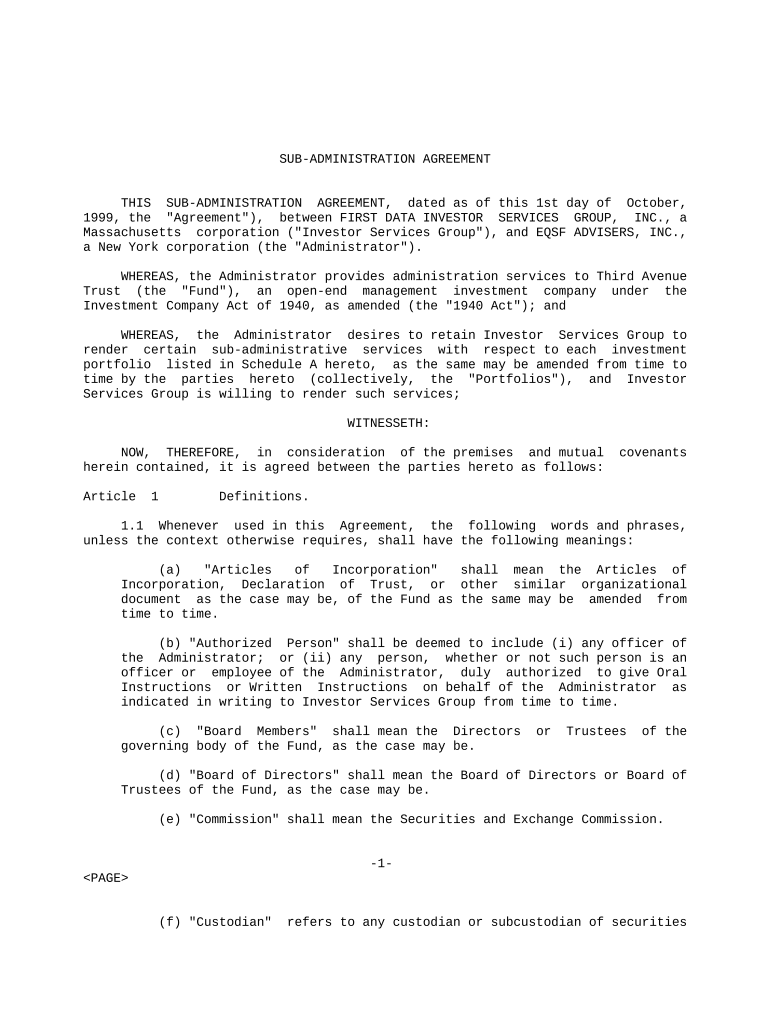
A Sub-Administration Agreement is a written contract by which a primary administrator (plan sponsor, trustee, or recordkeeper) delegates specific administrative duties to a third party. Typical duties include claims processing, benefits adjudication, recordkeeping, participant communications, and reporting. The agreement sets scope, service levels, data access, confidentiality, liability allocation, and termination rights. It is used in employee benefit plans, trust administration, insurance programs, and other regulated arrangements where the primary administrator retains ultimate responsibility but needs specialist or local support.

Why parties use a Sub-Administration Agreement

The agreement creates clear boundaries of responsibility, documents service levels and access to confidential data, and reduces operational gaps that otherwise can lead to compliance failures or benefit disputes.

Why parties use a Sub-Administration Agreement

Typical organizations and roles that use this agreement

Examples of organizations and roles commonly involved in sub-administration relationships.

  • Plan sponsors and employers administering retirement or health plans under ERISA and related rules.
  • Primary administrators and recordkeepers delegating specialized functions to third-party vendors.
  • Insurers, third-party administrators (TPAs), and trustees handling enrollment, claims, or compliance activities.

These parties need a written agreement to allocate duties, address regulatory obligations, and manage data protections.

Representative signers and decision-makers

Plan Sponsor — HR Director

A typical signer responsible for authorizing delegation and ensuring the sub-administrator meets ERISA fiduciary and recordkeeping obligations. They review scope, SLAs, and indemnity clauses and coordinate internal counsel and benefits teams.

TPA — VP Operations

Operational lead who accepts delegated duties, confirms staffing and systems, and signs to assume operational obligations, data security controls, and performance metrics under the agreement.

Core provisions to include in a professional Sub-Administration Agreement

A robust agreement balances operational detail with legal protections; include measurable obligations and dispute-resolution mechanics.

Scope of Services

Precise description of delegated tasks, excluded duties, and any limits on authority to make benefit determinations or issue notices.
Authority and Access

Permissions for data access, systems integration, recordkeeping rights, and role-based authority for decisions and communications.

Service Levels

Turnaround times, accuracy targets, reporting cadence, escalation paths, and remedies for missed SLAs.

Confidentiality

Data protection obligations, permitted disclosures, encryption and handling of PHI where HIPAA applies, and breach notification timelines.

Liability and Indemnity

Allocation of harm, caps on liability, indemnification triggers, and insurance requirements for professional and cyber liability.

Term and Termination

Start and end dates, renewal mechanics, notice and cure periods, transition assistance, and document transfer on termination.

Key compliance and security references to address

Encryption: TLS 1.2/1.3 in transit; AES-256 at rest.
Audit Trail: Detailed signing logs with timestamps and IP addresses.
HIPAA (if PHI): Execute a BAA where protected health information is handled.
ESIGN / UETA: E-signature compliance under ESIGN and UETA as applicable.
SOC 2: SOC 2 Type II report available upon request.
21 CFR Part 11: Consider controls for FDA-regulated records.

Quick step-by-step: preparing and executing the agreement

A concise sequence to complete and implement a Sub-Administration Agreement with minimal friction.

  • 01
    Draft: Assemble scope, SLAs, and compliance clauses.
  • 02
    Review: Have internal counsel and compliance teams review.
  • 03
    Sign: Collect authorized signatures and dates.
  • 04
    Distribute: Provide executed copies to all stakeholders and integrate systems.

Typical workflow from draft to operational handoff

Follow this operational flow to reduce downtime and ensure continuity when changing or adding sub-administrators.

  • Prepare Document: Use a template and populate core fields.
  • Internal Approval: Legal and risk teams confirm terms.
  • Execute Signatures: Sign electronically or with notarization when required.
  • Operational Handoff: Transfer data, access, and run parallel testing.

Digital workflow settings to configure for e-execution

Recommended configuration options when using an e-signature platform for the agreement.

Field Configuration
Authentication Method Email plus SMS code for signer verification
Field Types Signature, Initials, Date, Checkbox, Text
Conditional Logic Enable to show role-specific attachments
Notifications Email reminders at 3 and 7 days

Technical considerations for e-signing and integration

Confirm the platform supports required formats, signer authentication, audit trails, and any regulatory controls needed for your industry.

  • File Formats: PDF, Word DOCX accepted
  • Integrations: Connectors for Salesforce, NetSuite, Google Workspace
  • Authentication: Email, SMS, KBA, SSO options

Ensure cryptographic or audit-trail options match your compliance needs; document the platform selections in procurement and the agreement.

Key timeframes and typical notice periods to include

Include clear dates and notice periods to reduce disputes and ensure smooth transitions when services change or terminate.

Effective Date:

Date agreement becomes binding; use MM/DD/YYYY format

Initial Term:

Specify months or years for the primary service term

Renewal Notice:

Often 30–90 days before expiration

Cure Period:

Commonly 30 days to correct a breach

Transition Assistance:

Define days of post-termination support and data handoff

Potential consequences of incomplete or incorrect agreements

Breach Claims: Contract damages and litigation risk
Fiduciary Liability: ERISA exposures for plan sponsors
Regulatory Penalties: HIPAA or other compliance fines
Operational Disruption: Service gaps and participant harm
Tax Consequences: Withholding or reporting issues
Data Breach Costs: Notification and remediation expenses

Common preparation mistakes to avoid

  • Using vague scope language that fails to define delegated decisions and required approvals, which increases dispute risk and operational confusion.
  • Neglecting data access details and security obligations, especially when protected health information is involved and a BAA is required.
  • Failing to require transition assistance and data export formats, which can delay continuity and increase conversion costs.
  • Omitting insurer or indemnity limits and insurance requirements, leaving parties exposed to unexpected losses and litigation.

Representative e-signature pricing and feature comparison

Compare basic pricing and key platform features relevant to executing and managing Sub-Administration Agreements.

signNow DocuSign Adobe Sign PandaDoc HelloSign
Starting Price $8/user/mo $15/user/mo $14/user/mo $19/user/mo $15/user/mo
Free Trial 7-day free trial Varies by plan Varies by plan Varies by plan Varies by plan
Bulk Send Yes (Business Premium) Varies by plan Varies by plan Varies by plan Varies by plan
Audit Trail Yes Yes Yes Yes Yes
HIPAA Compliant Yes Yes Yes No No
Envelope Cap No cap 100 envelopes/user/year Varies by plan Varies by plan Varies by plan

Practical examples of how organizations use sub-administration

Two brief scenarios showing common use patterns and outcomes when a Sub-Administration Agreement is implemented correctly.

Case Study 1

A regional benefits sponsor delegated claims intake to a specialized TPA to reduce backlog and speed approvals.

  • The TPA handled eligibility checks and initial adjudication.
  • After six months the sponsor reported fewer participant complaints, faster claims cycles, and a documented transition plan that minimized service interruptions during vendor onboarding.

Case Study 2

A trustee appointed a sub-administrator for asset reconciliation and participant reporting to meet regulatory timelines.

  • The sub-administrator provided monthly reconciliations and standardized reports.
  • The clear SLA and audit access allowed timely SEC/ERISA reporting and simplified annual audits by external counsel and auditors.

Frequently asked questions and practical answers

Common questions about enforceability, notarization, signature authority, amendments, revocation, and storage for Sub-Administration Agreements.


Need help? Contact support

be ready to get more
Join over 28 million airSlate SignNow users