Establishing secure connection…Loading editor…Preparing document…

Amended and Restated Principal Underwriting Agreement

This template is fully customizable. Edit the text, fill out the fields, and send it for signature. Give it a try!
Amended and Restated Principal Underwriting Agreement

What an Amended and Restated Principal Underwriting Agreement Is

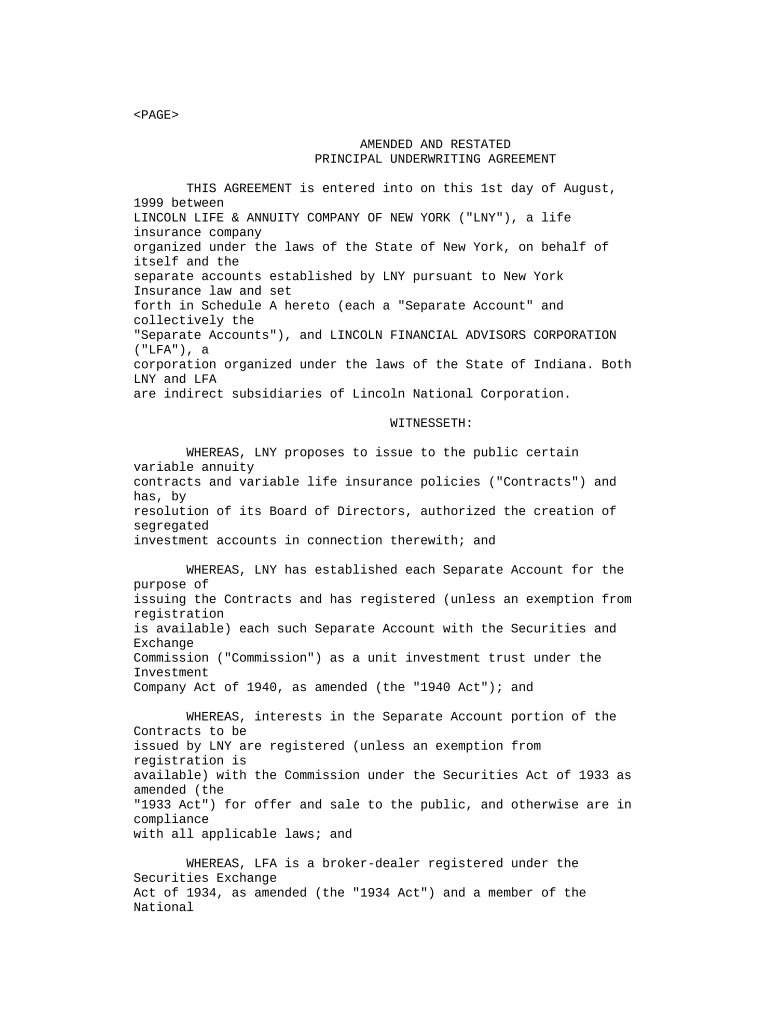
An Amended and Restated Principal Underwriting Agreement consolidates and replaces earlier underwriting terms between an issuer and its principal underwriter(s). It restates commitments, allocation mechanics, fee and commission schedules, representations and warranties, indemnities, closing conditions, and post-closing obligations in a single, current contract. The amendment component documents discrete changes to prior agreements; the restatement repackages those changes into a unified text to reduce ambiguity. Parties typically use it when market conditions, corporate reorganizations, or regulatory updates require clarified allocation procedures and updated sponsor or underwriter responsibilities.

Why Parties Use an Amended and Restated Agreement

Using an amended and restated version centralizes updated underwriting terms, reduces disputes over legacy language, documents allocation and indemnity changes, and aligns commercial terms with regulatory or corporate changes, helping to manage counterparty risk and execution clarity.

Why Parties Use an Amended and Restated Agreement

Who Typically Executes and Relies on This Agreement

Common signatories include the issuer, lead underwriter or bookrunner, and syndicate members who require a single, current contract to guide underwriting operations.

  • Issuing company finance and legal teams coordinating capital raising and disclosure obligations.
  • Lead underwriter or bookrunner negotiating fees, firm commitments, and syndication mechanics.
  • Syndicate members and co-managers confirming allocation methods and secondary market settlement responsibilities.

Key Roles and Their Responsibilities

Chief Legal Officer

Counsel reviews amendments for compliance with securities laws, confirms representations and indemnities, coordinates counsel sign-offs, and ensures that changes do not create disclosure issues under SEC rules or trigger required public filings.

Head of Capital Markets

Manages commercial terms with underwriters, negotiates fees and allocation methodology, coordinates syndicate commitments, and ensures operational readiness for closing and settlement.

Essential Information to Include

Parties' legal names: Exact entity names
Effective date: MM/DD/YYYY format
Underwriting commitments: Firm or best-efforts
Fees and commissions: Dollar amounts / percentages
Representations: Issuer and underwriter reps
Governing law: Chosen state jurisdiction

Risks and Consequences of Errors

Contract voidability: Ambiguous terms risk unenforceability
Regulatory exposure: SEC or FINRA inquiries possible
Allocation disputes: Buyer and syndicate conflicts
Tax consequences: Improper reporting or withholding
Closing delays: Missed settlement deadlines
Reputation damage: Market counterparties affected

Common Preparation Mistakes to Avoid

  • Failing to incorporate all prior amendments leads to inconsistent obligations and creates ambiguity during syndication or settlement.
  • Not updating allocation mechanics to reflect current market practice causes disputes among syndicate members during primary distribution.
  • Overlooking changes to fee schedules or reimbursement terms can result in unpaid expenses or unexpected claims after closing.
  • Insufficient signatory authority confirmation — unsigned or improperly executed agreements may be challenged in enforcement or regulatory review.

Core Sections to Verify in the Agreement

A complete amended and restated agreement should contain clear recitals, definitions, commitments, compensation, indemnity, and termination provisions to reduce future disputes.

Recitals

Summarize prior agreements and state the purpose of the amendment and restatement; provides transactional history and context for subsequent clauses.
Definitions

Define key terms such as 'Firm Commitment', 'Syndicate Member', 'Closing Date', and 'Underwriting Fee' to avoid interpretive disputes during execution and settlement.

Underwriting obligations

Specify each underwriter’s commitment level, allocation formula, delivery and settlement mechanics, and responsibilities for unsold securities or oversubscription handling.

Compensation

Detail underwriting discounts, fees, reimbursements, and payment timing, including any fee sharing among syndicate members and expense caps.

Indemnification

Allocate responsibility for misstatements, omissions, and third-party claims; include procedural requirements for indemnity claims and notice timing.

Termination

List events of termination, cure periods, survival of certain clauses, and effect on closing obligations and post-closing indemnities.

Step-by-Step: Completing the Agreement

Follow these sequential steps to prepare, review, and finalize the amended and restated agreement.

  • 01
    Collect prior documents: Gather original agreement and all amendments
  • 02
    Draft integrated text: Combine prior terms into a single document
  • 03
    Legal and finance review: Counsel and treasury confirm terms
  • 04
    Execute and distribute: Obtain signatures; circulate finalized copies

Where to Send and File the Executed Agreement

After execution, distribute copies to internal and external parties that require the agreement for operational, compliance, or recordkeeping purposes.

  • Issuer counsel: Maintain legal record and disclosure files
  • Lead underwriter: Retains original for syndicate administration
  • Transfer agent: Receives documents for settlement needs
  • Internal finance: Files for accounting and audit trails

Configuring an Online Signing Workflow

Set up a digital workflow that enforces signer order, authentication strength, and a verifiable audit trail before sending for signature.

Field Setting
Signature field Require signature and date fields
Authentication Use email plus SMS code for signers
Template Create reusable agreement template
Audit trail Capture IP, timestamps, action log

How to Distribute and Share the Agreement Securely

Choose distribution methods that preserve integrity and provide a clear audit trail for each signer.

  • Email delivery: Standard signer notifications
  • API integration: Automated routing via CRM or ERP
  • Bulk send: Distribute to multiple signers efficiently

eSignature Pricing and Feature Comparison

Comparing common eSignature options for executing underwriting agreements; signNow appears first per vendor sourcing and includes plans suitable for high-volume document workflows.

signNow DocuSign Adobe Sign PandaDoc HelloSign
Starting Price $8/user/mo $15/user/mo $14/user/mo $19/user/mo $15/user/mo
Free Trial 7-day free trial Varies by plan Varies by plan Varies by plan Varies by plan
Bulk Send Yes Yes Yes Yes No
Audit Trail Yes Yes Yes Yes Yes
HIPAA Compliant Yes Yes Yes No No

Typical Timeline Milestones and Deadlines

Track critical dates from agreement execution through closing and post-closing obligations to avoid missed conditions or indemnity windows.

Execution date:

Date parties sign the amended and restated text

Effective date:

Date obligations begin, may differ from execution date

Closing date:

Scheduled date for delivery and settlement of securities

Post-closing period:

Indemnity notice windows and claim periods

Record retention start:

Begins on execution or effective date, as specified

Tips for Accurate, Efficient Completion

Follow these practical tips to minimize risk and reduce execution friction.

Use a single integrated document
Consolidate all prior amendments into the restated agreement to eliminate contradictory language and reduce interpretation disputes during syndication and settlement.
Confirm signatory authority
Obtain corporate authorizations or board resolutions when necessary and include capacity details in signature blocks to prevent later challenges to enforceability.
Standardize allocation language
Adopt a clear allocation formula and tie-break rules for oversubscription to avoid syndicate disputes and ensure transparent distribution of securities.
Preserve an audit trail
Use an e-signature platform that captures timestamps, IP addresses, and an immutable activity log for regulatory compliance and future dispute resolution.

Real-World Examples of Use

Practical scenarios show how amended and restated underwriting agreements streamline operations across typical transactions.

Corporate Follow-on Offering

A public issuer consolidates three prior underwriting amendments into one restated agreement to align fees and allocation rules

  • Syndicate members accept clarified oversubscription rules to speed allocations
  • The unified agreement reduced reconciliation disputes and provided a single reference for transfer agents and counsel during settlement, improving post-closing reporting accuracy and audit readiness.

Private Placement

A sponsor updates underwriting terms to reflect a new lead underwriter and changed commission structure

  • Parties confirm updated indemnity and closing conditions
  • The amended and restated agreement documented the new commercial terms, simplified counterparty review, and ensured the placement documents were consistent with subscription agreements.

Frequently Asked Questions

Answers to common legal, procedural, and technical questions about preparing and executing an amended and restated underwriting agreement.


Need help? Contact support

be ready to get more
Join over 28 million airSlate SignNow users