Establishing secure connection…Loading editor…Preparing document…

Letter Requesting Filing of Compromise Settlement Application

This template is fully customizable. Edit the text, fill out the fields, and send it for signature. Give it a try!
Letter Requesting Filing of Compromise Settlement Application

What this Letter Is and when it's used

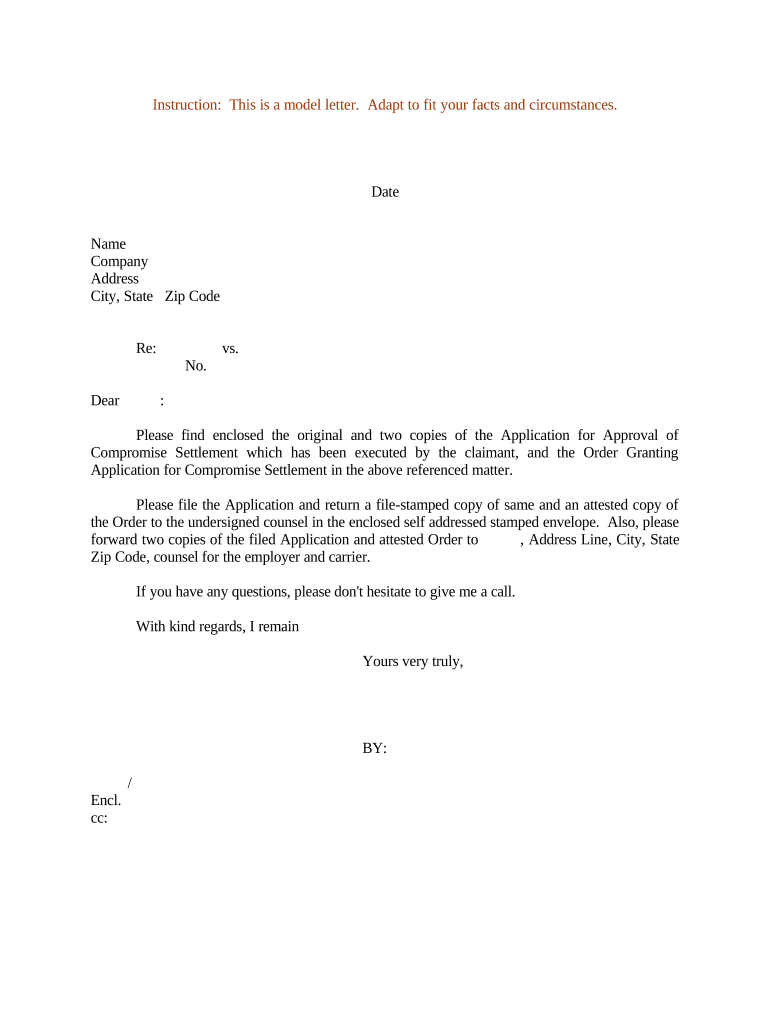
A Letter Requesting Filing of Compromise Settlement Application is a formal written request submitted to a creditor, tax authority, or other claimant asking that a proposed compromise settlement be accepted and the settlement application be filed with the appropriate office. The letter summarizes the parties, the disputed obligation, the settlement amount or terms, and the legal or factual basis for compromise. It creates a paper and electronic record that supports processing, evidences consent to terms, and helps expedite agency or creditor review when paired with required attachments and signatures.

Why this letter matters

A clear filing request centralizes settlement terms, reduces misunderstandings, and establishes a formal record for the creditor or agency to act on. When complete and properly authenticated, it supports enforceability and faster administrative processing while documenting consent and the scope of compromise.

Why this letter matters

Who typically prepares and submits these letters

Several roles prepare or submit compromise filing requests depending on context and authority.

  • Individual taxpayer or authorized payer representative submitting a negotiated tax or debt settlement.
  • Attorney or authorized legal representative preparing settlement terms and legal rationale.
  • Corporate finance officer or collections manager on behalf of a business settling a disputed claim.

Common signer profiles and responsibilities

Taxpayer Representative

A tax professional or attorney typically prepares the letter, attaches settlement calculations, and includes power-of-attorney documentation when acting for a taxpayer. The representative must ensure the client's consent, accurate taxpayer identification, and full disclosure of tax consequences.

Company Officer

An authorized company officer (CFO or accounts payable manager) signs on behalf of the business, confirms internal approvals and payment arrangements, and provides corporate resolution or authority evidence when required by the creditor or agency.

Security and compliance considerations to note

Encryption: TLS 1.2/1.3 in transit
Data at Rest: AES-256 encrypted storage
Audit Trail: Tamper-evident signing history
Regulatory Compliance: ESIGN and UETA recognition
Healthcare: HIPAA requires BAA where PHI exists
Access Controls: Multi-factor authentication available

Key legal risks and penalties to avoid

Filing Rejection: Incomplete submissions may be rejected
Tax Penalties: IRC §6721 penalties may apply
Loss of Settlement: Delayed filing can void negotiated terms
Authentication Failure: Missing signature or improper notarization
Privacy Violation: Improper PHI handling risks HIPAA
Misattribution: Wrong signer can render document invalid

Frequent preparation mistakes

  • Leaving out required attachments such as the settlement computation, proof of authority, or a signed release — this often causes processing delays and requests for more information.
  • Providing inconsistent names or tax identification numbers between the letter, attachments, and official records, which can trigger identity verification issues or rejection.
  • Using vague or ambiguous settlement terms such as 'reasonable amount' instead of a precise dollar figure or structured payment schedule, leading to disputes later.
  • Failing to confirm notarization or witness requirements for the receiving jurisdiction, resulting in an unsigned or noncompliant filing.

Step-by-step: preparing the filing letter

Follow a short, ordered process to prepare a complete, properly authorized Letter Requesting Filing of Compromise Settlement Application.

  • 01
    Draft Letter: State parties, facts, disputed amounts, and settlement offer concisely.
  • 02
    Attach Evidence: Include calculations, receipts, and proof of authority.
  • 03
    Authenticate: Signatures, notarization, or eSignature methods as required.
  • 04
    Submit: Send to the designated agency or creditor using documented delivery.

How the filing and review process typically proceeds

A standard workflow moves from submission through verification and either acceptance or follow-up requests; know each step and typical recipients.

  • Submission: Send letter and attachments to creditor or agency intake point.
  • Administrative Review: Clerks verify completeness and identification.
  • Substantive Review: Decision-maker evaluates compromise terms and law.
  • Outcome: Agency accepts, requests amendment, or rejects.

What a professional filing letter includes

A well-crafted letter is concise, cites authority, summarizes settlement math, and includes clear signature and filing instructions to limit follow-up requests.

Clear Identification

Identify parties by full legal name, taxpayer or account number, and current mailing and email addresses so the agency or creditor can match records without ambiguity.
Concise Summary

Provide a short factual summary of the dispute, the relief requested, and the specific amount or terms of the proposed compromise so reviewers can see the core request at a glance.

Settlement Calculation

Attach a line-item calculation showing principal, interest, penalties, and how the compromise amount was reached to support numerical accuracy and transparency during review.

Legal Basis

Cite the statutory, administrative, or contractual authority permitting compromise or settlement to show reviewers the legal footing for the request.

Supporting Documents

Include authorization letters, power of attorney, payment authorization, and any releases or waivers required by the creditor or agency to finalize the settlement.

Signature Block

Provide a dated signature block for the signing party and an area for notarization or witness information if the receiving jurisdiction requires additional authentication.

Typical digital workflow settings for online completion

Configure a straightforward digital workflow that captures identity, enforces required fields, and retains an auditable history for the filing.

Field Configuration
Document Upload Single PDF with attachments; combine into one package
Authentication Email plus SMS code or ID verification as required
Signature Type Standard eSignature or digitally-signed PKI if mandated
Retention Export signed package and audit trail to secure archive

Technical and format requirements for eSubmission

Confirm format, authentication, and delivery options before e-submitting the filing package.

  • File Formats: PDF is preferred; DOCX accepted by some agencies
  • Integrations: Supports CRM and cloud storage integrations
  • Audit Trail: Keep timestamp, IP, and signer metadata

Retain both the signed document and the audit trail in your records to prove execution and to address any later challenges or verification requests.

Typical timelines and processing expectations

Processing times vary by creditor and agency; allow time for administrative review, substantive evaluation, and possible follow-up. Planning for realistic deadlines reduces risk of missed opportunities.

Acknowledgment Period:

Many organizations send an acknowledgment within 7–14 business days of receipt.

Initial Review:

Administrative completeness checks commonly take 10–30 days depending on workload.

Substantive Decision:

Agencies or creditors may take 30–90 days to accept, request more info, or deny the compromise.

Payment Deadline:

Settlement payment terms should be stated clearly—commonly 30 days after acceptance.

Appeal or Reconsideration:

If denied, the creditor may permit a refile or appeal within a specified period; confirm with the agency.

Key milestones from draft to final filing

Track these sequential milestones to manage approvals and ensure timely submission and documentation of the compromise request.

01

Draft Completed

Letter and supporting exhibits prepared and internally reviewed.

02

Internal Approval

Authorized signers or corporate officers sign off on terms and payment plans.

03

Authentication

Signatures obtained and notarization or electronic identity verification performed if required.

04

Filing Sent

Package delivered to creditor or agency with tracking and retained audit trail.

Practical examples of letter use

Two brief scenarios illustrate how a well-prepared filing letter supports settlement acceptance and recordkeeping.

Municipal Tax Compromise

A taxpayer disputed municipal penalties and submitted a letter summarizing the assessment, attaching payment plan options and supporting receipts.

  • The letter proposed a fixed compromise amount to settle the account in full.
  • The municipality confirmed acceptance in writing and issued a formal settlement notice that the taxpayer kept with the signed package for future proof of resolution.

Commercial Creditor Settlement

A small business negotiated a reduced payoff with a vendor and drafted a concise filing letter listing invoices, proposed lump-sum payment, and corporate authorization.

  • The vendor required a corporate resolution and a signed release.
  • After receiving the executed documents, the vendor filed the settlement and provided a receipt and release, preventing further collection actions.

eSignature vendor pricing and capability snapshot

Compare common plan and capability dimensions for eSignature vendors often used to complete and file settlement applications; signNow appears first for vendor parity.

signNow DocuSign Adobe Sign PandaDoc HelloSign
Starting Price $8/user/mo $15/user/mo $14/user/mo $19/user/mo $15/user/mo
Free Trial 7-day free trial Yes Yes Yes Yes
Bulk Send Yes Yes Yes Yes No
Audit Trail Yes Yes Yes Yes Yes
HIPAA Compliant Yes Yes Yes No No

Tips for accurate and efficient completion

Adopt consistent practices to minimize rework, protect privacy, and speed approval of compromise filings.

Use a standardized template
Prepare and reuse a vetted template that includes fields for party identification, account numbers, precise settlement figures, and a checklist of required attachments; standardized language reduces legal ambiguity and speeds reviewer understanding.
Verify signer authority
Before obtaining signatures, confirm the signer has documented authority to bind the party and attach a corporate resolution or power of attorney if required to prevent later disputes about capacity.
Confirm jurisdictional needs
Check whether the receiving party requires notarization, witnesses, or a specific submission format; complying upfront avoids rejected filings and additional processing time.
Keep an auditable copy
Retain the signed package with a complete audit trail showing timestamps, signer authentication, and delivery receipts to support enforcement or future verification requests.

Frequently asked questions

Answers to common questions about preparing, authenticating, and submitting a Letter Requesting Filing of Compromise Settlement Application.


Need help? Contact support

be ready to get more
Join over 28 million airSlate SignNow users