Establishing secure connection…Loading editor…Preparing document…

Charitable Remainder Trust

This template is fully customizable. Edit the text, fill out the fields, and send it for signature. Give it a try!
Charitable Remainder Trust

What a Charitable Remainder Trust Is and how it works

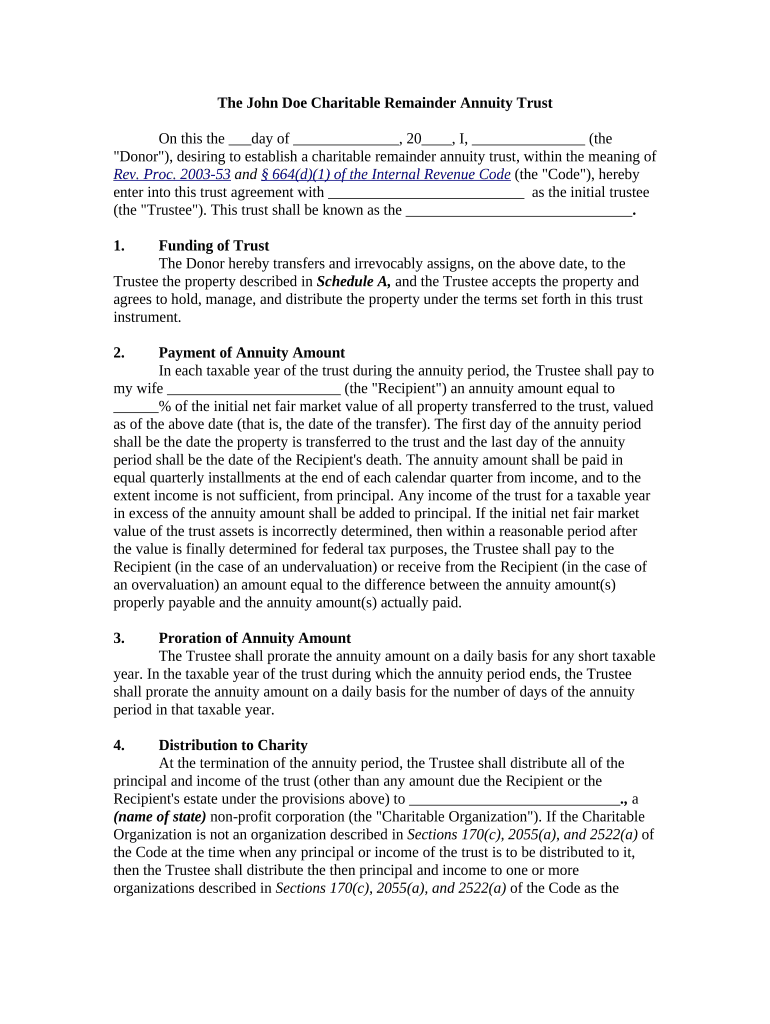
A Charitable Remainder Trust (CRT) is a tax-exempt split-interest trust that provides income to one or more noncharitable beneficiaries for a specified term or for life, with the remaining trust assets distributed to one or more qualified charities at termination. Donors transfer assets into the trust, can claim a partial income tax charitable deduction when the trust is funded, and may reduce estate and capital gains tax exposure. CRTs are governed by federal tax rules for split-interest trusts and by state trust law for execution, administration, and trustee duties.

Why a Charitable Remainder Trust may be appropriate

A CRT can convert highly appreciated assets into diversified income, defer capital gains tax on the sale of donated assets, and provide a charitable deduction while ultimately transferring the remainder to a designated charity.

Why a Charitable Remainder Trust may be appropriate

Who commonly creates or prepares a Charitable Remainder Trust

Typical creators include high-net-worth donors, estate planners, fiduciaries, and nonprofit gift officers coordinating planned giving.

  • Wealthy individual donors seeking income and philanthropic legacy
  • Estate planning attorneys drafting tax-efficient wills and trusts
  • Financial advisors structuring post-sale income streams for clients

Trustees, tax preparers, and nonprofit gift officers will also interact with the CRT for administration, annual reporting, and final distribution to charities.

Key components you will see in a professional CRT document

A standard CRT contains purpose and trust classification, payout type and schedule, remainder beneficiary designation, trustee powers, funding provisions, and termination mechanics.

Trust Classification

Specifies whether the CRT is a charitable remainder annuity trust (CRAT) or charitable remainder unitrust (CRUT), which affects payout calculation and flexibility under tax rules.
Payout Terms

Describes amount or percentage delivered to noncharitable beneficiaries each period, frequency of payments, and whether payments are fixed or variable based on annual valuation.

Remainder Beneficiary

Names the qualifying charitable organization(s) entitled to the trust remainder and includes taxpayer-identifying information for proper charitable deduction substantiation.

Funding and Acceptance

Specifies which assets fund the trust, procedures for asset transfer, liabilities assumed, and required trustee acceptance language to effectuate funding.

Trustee Powers

Enumerates investment, distribution, delegation, sale, and administrative authorities given to trustees to manage trust assets and meet payout obligations.

Termination and Reporting

Defines events that terminate the trust, distribution mechanics to charities, and requirements for tax and financial reporting on termination.

Essential data fields required in a Charitable Remainder Trust

Donor Name: Full legal name
Beneficiary Names: All income beneficiaries
Charity Details: Name and EIN
Trust Term: Years or life
Payout Rate: Percentage or fixed amount
Funding Assets: Description and value

Step‑by‑step: completing and funding a Charitable Remainder Trust

Follow these core steps in sequence to create and fund a CRT and preserve tax benefits while ensuring administrative readiness.

  • 01
    Plan: Confirm donor goals and tax considerations with advisors.
  • 02
    Draft: Prepare trust instrument and specify payout/remainer terms.
  • 03
    Sign: Execute trust with required signatures and notarization.
  • 04
    Fund: Transfer assets and retitle accounts into the trust.

Digital workflow settings for completing the CRT online

Configure a secure electronic workflow to collect signatures and supporting attachments while preserving an audit trail.

Field Configuration
Signature Type Allow drawn, typed, or cryptographic signatures
Authentication Use email plus SMS or ID check for trustees
Document Format PDF/A for archiving, DOCX for drafts
Retention Enable export to encrypted cloud storage

Typical steps to execute the CRT using an eSignature workflow

A reliable online signing flow reduces handling time while producing a tamper-evident audit trail and downloadable final records.

  • Upload Document: Sender uploads finalized trust instrument.
  • Place Fields: Assign signature, date, and initial fields.
  • Invite Signers: Email or link sent to trustees and donor.
  • Complete Signing: Signers authenticate, sign, and receive copies.

Technical and compliance considerations for eSigning a CRT

Pick a platform that captures intent, consent, attribution, and retention in line with ESIGN/UETA.

  • Authentication: Multi-factor recommended
  • Audit Trail: Timestamp, IP, and action log
  • Document Export: PDF/A and certificate

Ensure the chosen solution supports notarization workflows or RON if a notary acknowledgement is required by state practice.

Key legal and tax risks of an incorrectly prepared CRT

Loss of Tax Benefits: Charitable deduction denial
Trust Reclassification: May be treated as taxable entity
Fiduciary Liability: Trustee breach exposure
Valuation Errors: Capital gains misreporting
Reporting Failures: Late returns or penalties
Improper Funding: Asset transfer defects

Common preparation errors to avoid

  • Using inconsistent beneficiary names across documents that delay distributions or reduce deduction validity.
  • Failing to retitle assets properly into the trust, which can negate the intended tax outcome.
  • Choosing the wrong payout structure (CRAT vs CRUT) without modeling tax and income consequences over time.
  • Neglecting trustee powers or successor trustee provisions, creating administration difficulties on incapacity or death.

Timing considerations and reporting deadlines

Key dates include the trust effective/funding date, tax year reporting requirements, and payout or valuation dates that trigger calculations.

Effective / Funding Date:

Date trust is signed and funded; determines valuation and deduction year

Annual Reporting:

Fiduciary tax returns and disclosures required according to tax year

Valuation Date:

Date used to determine remainder value and deduction amount

Payout Schedule Date:

Dates when income beneficiaries receive distributions

Termination Date:

When remainder transfers to charity and final reporting occurs

Practical examples of Charitable Remainder Trust use

These short scenarios show how CRTs typically function in estate and tax planning contexts.

Income for Retiree

A donor funds a CRUT with appreciated securities to provide lifetime income

  • The unitrust pays 5% annually based on revaluation
  • At the donor's death the charity receives the remainder and the donor's estate benefits from reduced capital gains exposure.

Sale Without Immediate Gain Hit

An owner transfers real estate into a CRT before sale to defer capital gains tax

  • Trustees sell the property inside the trust and reinvest proceeds tax-free at trust level
  • Income beneficiaries receive distributions while charities obtain the net remainder later.

Practical tips for accurate and efficient CRT completion

Follow these best practices to reduce risk and simplify administration from funding through final distribution.

Coordinate advisors early
Engage tax, legal, and financial advisors before drafting to align payout rates, funding assets, trustee selection, and tax reporting so timing and valuation are consistent.
Document asset transfer
Provide complete transfer paperwork, account re‑titling instructions, and closing memos to avoid assets remaining in the donor's name and triggering adverse tax consequences.
Choose trustee with care
Select a trustee or co‑trustee with investment and administrative capabilities; include successor trustee language and delegation powers to ensure continuity.
Maintain detailed records
Preserve appraisals, brokerage confirmations, trustee minutes, valuations, and distribution records to support tax filings and future audits.

eSignature vendor comparison for completing and executing the CRT

Common platform capabilities vary by plan and vendor; signNow is listed first to align with platform-specific data and pricing noted below.

signNow DocuSign Adobe Sign PandaDoc HelloSign
Starting Price $8/user/mo $15/user/mo $14/user/mo $19/user/mo $15/user/mo
Free Trial 7-day free trial Varies by vendor Varies by vendor Varies by vendor Varies by vendor
Bulk Send Yes Yes Yes Yes No
Audit Trail Yes Yes Yes Yes Yes
HIPAA Compliant Yes Yes Yes No No

Frequently asked questions about Charitable Remainder Trusts

Answers to common questions about CRT mechanics, execution, taxes, and administration.


Need help? Contact support

be ready to get more
Join over 28 million airSlate SignNow users