Establishing secure connection…Loading editor…Preparing document…

Contingency Fee Agreement

This template is fully customizable. Edit the text, fill out the fields, and send it for signature. Give it a try!
Contingency Fee Agreement

What a Contingency Fee Agreement Is

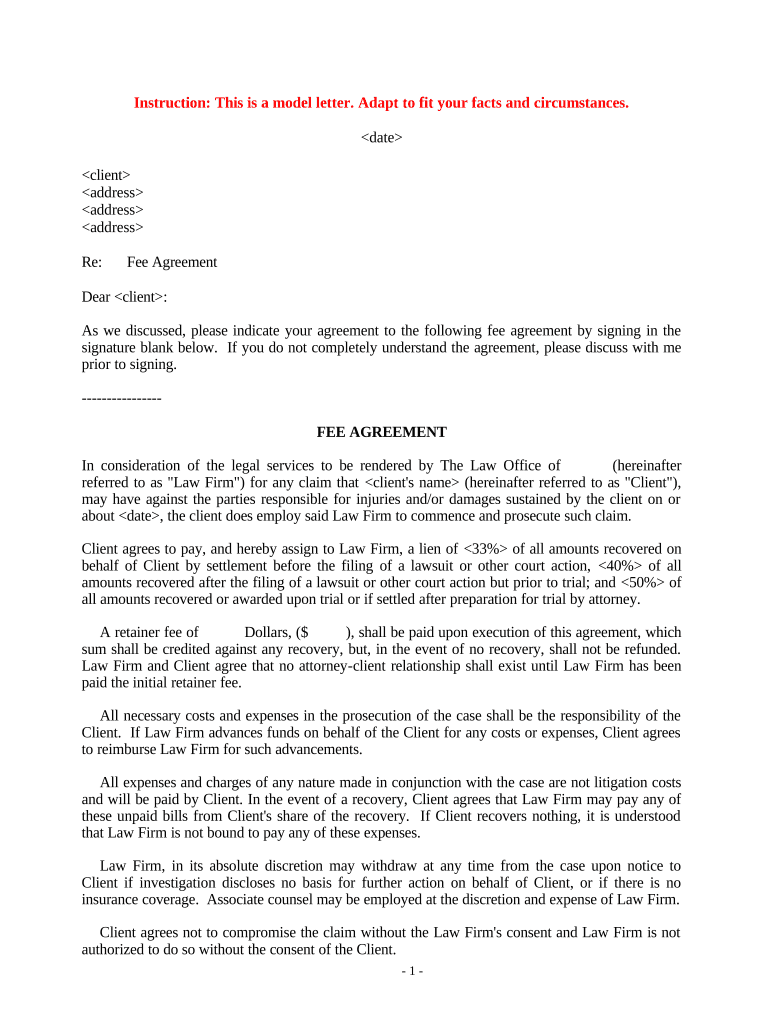
A Contingency Fee Agreement is a written contract between an attorney and a client that conditions the attorney’s fee on a successful recovery or other specified result. It defines the fee calculation method, allocation of costs and expenses, the scope of representation, and how proceeds will be distributed after settlement or judgment. These agreements are common in personal injury, employment, and certain civil litigation matters. When executed properly they clarify expectations, document client consent, and can be completed electronically where state law permits.

Why a Clear Contingency Fee Agreement Matters

A written contingency agreement aligns incentives, removes upfront cost barriers for clients, and sets objective rules for fee calculation and expense allocation. It protects both parties by documenting consent, fee percentages, and termination terms and supports ethical compliance when signed and retained correctly under ESIGN and UETA frameworks.

Why a Clear Contingency Fee Agreement Matters

Who Typically Uses These Agreements

Contingency Fee Agreements are primarily used in litigation and claim contexts where clients cannot or prefer not to pay hourly fees upfront.

  • Plaintiffs and claimants pursuing monetary recovery in civil matters
  • Small and mid-size law firms handling personal injury or employment claims
  • Public interest and contingency-driven boutique practices

Primary Signatories and Their Roles

Attorney

The attorney or law firm signs to accept representation, disclose fee methodology and advance assumptions about costs; must ensure the agreement complies with state bar rules and preserve the executed agreement in the client file for audit and billing purposes.

Client

The client signs to acknowledge understanding of the contingency percentage, expense deductions, and termination rights; the client’s informed consent is essential to enforceability and to avoid later malpractice or ethics claims.

Core Elements to Include in the Agreement

A professional Contingency Fee Agreement spells out the relationship, fee calculation, and handling of costs so both parties understand financial outcomes and obligations.

Parties

Full legal names and addresses for the client and the law firm; identify the responsible attorney and any delegated associates or co-counsel responsible for the matter.
Scope

A clear description of the legal matter covered, services excluded, and any limitations on representation or required court approvals.

Fee Calculation

Precise formula for the contingency percentage or sliding scale, whether applied to gross recovery or net after expenses, and treatment of structured settlements.

Costs and Expenses

Which expenses the firm will advance, how they will be recovered, interest or lien treatment, and whether costs reduce the client’s recovery before fee calculation.

Termination

Conditions under which the client or attorney may end representation, notice requirements, and how fees or costs are handled on termination.

Dispute Resolution

Choice of law, forum selection, and any arbitration or mediation clauses for fee disputes or ethical complaints.

Step-by-Step: Completing the Agreement

Follow these steps to draft, review, and execute a compliant Contingency Fee Agreement.

  • 01
    Gather information: Collect client ID, matter facts, and fee model.
  • 02
    Draft terms: Set scope, percentage, and expense allocation clearly.
  • 03
    Review with client: Discuss fee structure and obtain informed consent.
  • 04
    Execute and retain: Sign, date, and store the signed agreement securely.

How to Configure an Online Signing Workflow

Set up a repeatable workflow that secures signatures, captures consent, and preserves an audit trail for each executed agreement.

Field Configuration
Signature Type Click-to-sign | Capture timestamp and IP
Signer Authentication Email + SMS code | Optional ID verification
Template Reusable template | Conditional fields for expenses
Audit Trail Retention enabled | Store certificate and logs

Typical Routing: From Draft to File

A standard route sends the agreement for review, captures the client signature, stores the executed copy, and notifies relevant stakeholders.

  • Attorney Sends: Upload and place signature fields, then send link.
  • Client Signs: Client authenticates and applies electronic signature.
  • Store Copy: Save signed PDF and audit trail in client file.
  • Internal Notice: Notify billing and case teams for tracking.

Platform and Format Considerations

Choose a platform that supports secure e-signatures, audit trails, and the document formats used in your firm.

  • File Formats: PDF, DOCX, fillable forms
  • Integrations: Salesforce, NetSuite, Google Workspace, Microsoft 365
  • Authentication Options: Email, SMS code, advanced auth

Verify the provider’s ESIGN/UETA compliance, availability of a BAA for matters involving PHI, exportable audit trails, and integrations with your document management or practice management systems to preserve records and support billing and trust-account controls.

Security and Compliance Checklist

Encryption in Transit: TLS 1.2 / 1.3
Encryption at Rest: AES-256
HIPAA Support: BAA available for PHI
Audit and Controls: SOC 2 Type II available
FDA / 21 CFR: 21 CFR Part 11 compliance options
Information Security: ISO 27001 certified

Common Preparation Mistakes to Avoid

  • Failing to specify whether the contingency percentage applies to gross or net recovery, which commonly causes disputes and billing errors.
  • Not itemizing costs and expenses the firm will advance, leaving ambiguity about reimbursement and potential client objections.
  • Using vague language about scope or exclusions, increasing the risk of malpractice claims or scope creep during litigation.
  • Relying on verbal confirmations instead of a signed written agreement, undermining enforceability and ethical compliance.

Risks and Consequences of an Improper Agreement

Unenforceable Fee: Client may challenge and void the fee
Bar Discipline: Ethics violations can lead to sanctions
Client Lawsuit: Potential malpractice or fee litigation
Financial Loss: Firm may forfeit unrecoverable costs
Reputational Damage: Negative complaints to bar authorities
Recordkeeping Failure: Audit findings and compliance risk

Real-World Example Scenarios

Two practical scenarios illustrate typical contingency arrangements and how key clauses are applied in practice.

Personal Injury Matter

A claimant hires counsel for accident-related injuries

  • Agreement uses a 33% contingency on gross settlement
  • The agreement specifies the firm will advance medical-record fees and that costs will be repaid from the recovery before distribution to the client.

Employment Discrimination Claim

An employee engages counsel to pursue unpaid-wage claims

  • Fee set as a sliding percentage depending on recovery stage
  • The agreement clarifies attorney obligations, client approval for settlement, and allocation of taxable awards.

Key Milestones from Agreement to Distribution

Track the agreement lifecycle from drafting through distribution to ensure timely execution and accurate accounting.

01

Agreement Drafted

Counsel prepares terms and calculates fee model.

02

Client Review

Client reviews terms and asks clarifying questions.

03

Execution

Parties sign; authentication and audit trail recorded.

04

Settlement Distribution

Costs paid, fees calculated, client receives net recovery.

Practical Tips for Accurate and Efficient Agreements

Follow firm-level standards to reduce disputes, support compliance, and streamline billing.

Use a clear fee formula
Spell out whether the percentage applies to gross or net recovery, include examples showing calculations, and define treatment of structured settlements to avoid later ambiguity or client disputes.
Itemize anticipated costs
List common expenses the firm may advance, describe the repayment mechanism, and indicate whether interest or administrative fees apply to advanced costs.
Document informed consent
Discuss the agreement in plain language with the client, retain signed disclosures, and consider recording a summary of the consent conversation in the client file for audit purposes.
Maintain secure storage
Store executed agreements and audit trails in an access-controlled system with exportable logs to support billing, regulatory review, and potential fee dispute resolution.

Frequently Asked Questions

Answers to common legal and practical questions about Contingency Fee Agreements and electronic execution.


Need help? Contact support

be ready to get more
Join over 28 million airSlate SignNow users