Establishing secure connection…Loading editor…Preparing document…

Agreement By Heirs to Substitute New Note for Note of Decedent

This template is fully customizable. Edit the text, fill out the fields, and send it for signature. Give it a try!
Agreement By Heirs to Substitute New Note for Note of Decedent

What the Agreement By Heirs to Substitute New Note for Note of Decedent Is

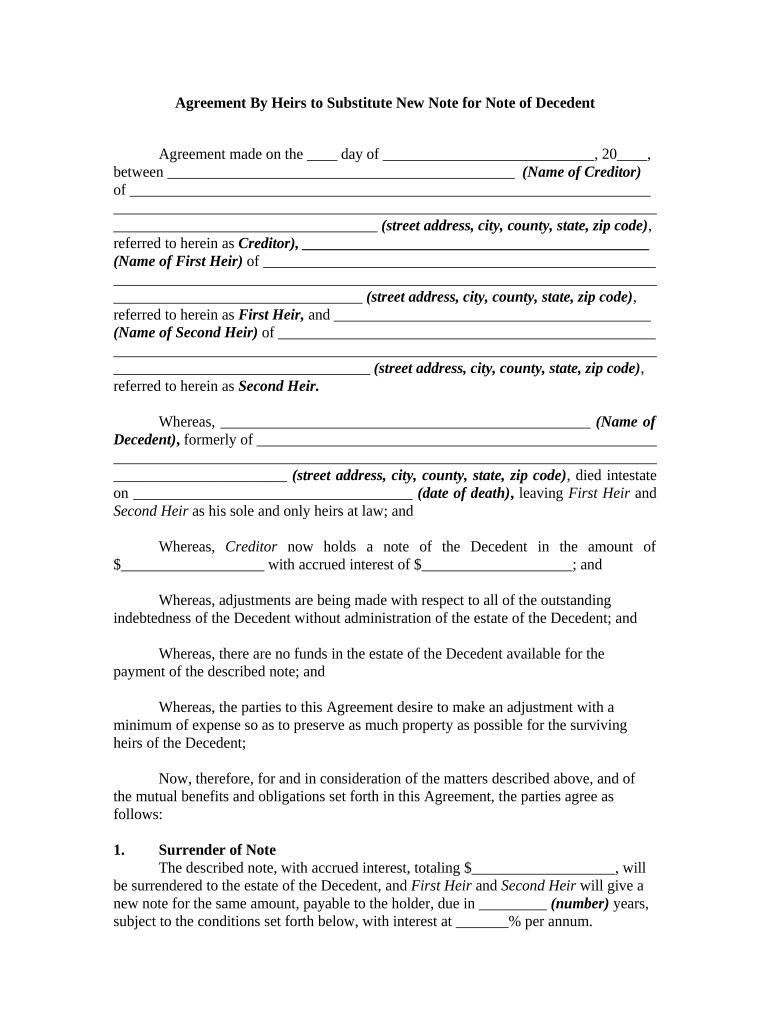
An Agreement By Heirs to Substitute New Note for Note of Decedent is a written instrument in which the decedent's heirs and the lender agree to replace an existing promissory note held in the decedent's estate with a newly issued note under specified terms. The document records the parties, recitals about the decedent's original obligation, the terms of the new note, any changes to interest, payment schedule, or security, and acknowledgments of release or assumption. It often requires lender consent, execution by authorized signers, and recording or notarization consistent with state law. Electronic execution and secure audit trails can be used where permitted by ESIGN and UETA, and platforms such as signNow support e-signature workflows and retention of audit records.

Why Use an Agreement By Heirs to Substitute a New Note

The substitution clarifies obligations, preserves lender security, and enables estate administration without forcing foreclosure or loan acceleration, reducing disputes among heirs and creditors.

Why Use an Agreement By Heirs to Substitute a New Note

Who Typically Prepares and Signs This Agreement

Executors, heirs, mortgagees, and estate attorneys commonly prepare or review the substitution agreement before execution.

  • Estate representatives and executors who manage probate assets and coordinate creditor consents.
  • Lenders or mortgage servicing agents who must approve modification or substitution of a secured obligation.
  • Estate or real estate attorneys who draft agreement language and confirm recording and priority effects.

Typical Signers and Their Roles

Heir / Executor

An heir or named executor executes the substitution to accept estate liability or transfer obligations; they must match names to probate records and may need court authority if probate supervision requires it. Parties should confirm identity and furnish letters testamentary or administration when requested by the lender.

Mortgagee Representative

A lender's representative signs to acknowledge acceptance of the new note and to confirm any release of the original note; the lender's signature often triggers instructions for recording, escrow, or amendment of the mortgage or deed of trust.

Essential Legal and Security Details to Include

Parties: Heirs, executor, lender
Original Note: Date, loan number, principal
New Note Terms: Principal, rate, schedule
Security Description: Property legal description
Consent Evidence: Lender signature, written release
Notarization: Acknowledgement or RON details

Risks and Consequences of an Incorrect Agreement

Invalid Assignment: Note unenforceable without consent
Probate Delay: Court may withhold approval
Tax Liability: Estate or heirs face tax issues
Lien Priority: Security interest priority may shift
Litigation Exposure: Disputes among heirs or creditors
Recording Errors: Mortgage not properly recorded

Common Preparation Mistakes to Avoid

  • Using names that do not match probate or title records, which can invalidate the substituted note or require corrective affidavits.
  • Failing to obtain explicit, written lender consent before altering note terms, risking acceleration or foreclosure by the lender.
  • Neglecting to record the substitution or amendment in county records, which can impair lien priority and title transfer.
  • Assuming e-signature acceptance without verifying state RON or notary rules and any consumer disclosure requirements under ESIGN/UETA.

Step-by-Step: How to Complete the Agreement By Heirs to Substitute New Note

Follow these steps to prepare, execute, and record a substitution agreement while minimizing common legal and administrative obstacles.

  • 01
    Gather Documents: Collect original note, deed, probate letters.
  • 02
    Draft Agreement: State new note terms and consents clearly.
  • 03
    Obtain Consent: Get lender signature and any releases.
  • 04
    Execute & Record: Sign, notarize if required, and file.

How Electronic Completion and Submission Typically Works

Electronic workflows streamline signatures while preserving evidence of consent, attribution, and audit trails required by ESIGN and UETA.

  • Upload Document: Prepare PDF or DOCX of the agreement.
  • Place Fields: Add signature, date, and initial fields.
  • Authenticate Signers: Use email, SMS, or stronger methods.
  • Complete & Archive: Store signed copy and audit trail.

Key Components of a Professional Substitution Agreement

A complete agreement balances clarity for the estate and lender, protects lien priority, and documents all consents and recording instructions to prevent later disputes.

Parties

Identify heirs, executor, and lender with full legal names, contact details, and representative authority such as letters testamentary or corporate authorization to bind the lender.
Recitals

Describe the decedent's original note and mortgage, include loan number, origination date, outstanding principal, and any prior modifications or forbearance agreements.

New Note Terms

Specify principal, interest rate, amortization, maturity, payment dates, prepayment terms, late charges, and acceleration provisions for the substituted obligation.

Security

State whether the existing mortgage or deed of trust continues as security, any changes to collateral, and confirm recording references for the security instrument.

Consent & Release

Have the lender expressly accept the new note in writing and, if applicable, release heirs or the estate from prior obligations as negotiated.

Execution & Recording

Provide signature blocks, notary or RON instructions, and explicit recording directions including county recorder jurisdiction and document reference numbers.

Configuration Checklist for an Online Signature Workflow

Set these fields and options to ensure secure, auditable execution when using an eSignature platform for the substitution agreement.

Field Configuration
Signer Authentication Email link, SMS code, or KBA as needed
Document Template Lock critical clauses from modification
Notary Requirement Enable RON or in-person acknowledgement
Recording Reference Add county and deed book details

Technical and Integration Considerations for eSubmission

Confirm supported file formats, authentication methods, and audit-trail exports before choosing an eSignature process for this agreement.

  • File Formats: PDF and DOCX supported
  • Integrations: Works with major CRMs and storage
  • Audit Trail: IP, timestamp, and event log

Real-World Examples of Electronic Execution and Recordkeeping

These real customer examples show how online signing and secure audit records can support loan substitution workflows in practice.

Optica Ventures LLC — Brian Fitzgibbons

Optica completed loan document workflows online to reduce turnaround.

  • Platform adoption simplified signatures across clients.
  • "The interface is simple and easy-to-use for our team; more importantly, it is just as easy for our customers."

Martin Properties — Tim Martin

A property operator executed mortgage-related documents remotely to close faster.

  • Mobile signing enabled remote closings onsite.
  • "I can process and execute all of these documents online with 100% compliance and built-in security. Whether on mobile or working offline, I can get forms back to their necessary parties efficiently."

Pricing and Feature Comparison: signNow and Popular eSignature Vendors

A high-level comparison of starting prices and common capabilities relevant to document substitution workflows; signNow is listed first per platform conventions.

signNow DocuSign Adobe Sign PandaDoc HelloSign
Starting Price $8/user/mo $15/user/mo $14/user/mo $19/user/mo $15/user/mo
Free Trial 7-day free trial Varies by vendor Varies by vendor Varies by vendor Varies by vendor
Bulk Send Yes Yes Yes Yes No
Audit Trail Yes Yes Yes Yes Yes
HIPAA Compliant Yes Yes Yes No No

Frequently Asked Questions About Substituting a Note After a Decedent's Death

Answers to common legal and execution questions, including eSignature validity, lender consent, notarization, and recording considerations.


Need help? Contact support

be ready to get more
Join over 28 million airSlate SignNow users