Establishing secure connection…Loading editor…Preparing document…

Declaration Writ

This template is fully customizable. Edit the text, fill out the fields, and send it for signature. Give it a try!
Declaration Writ

What a Declaration Writ Is and when it’s used

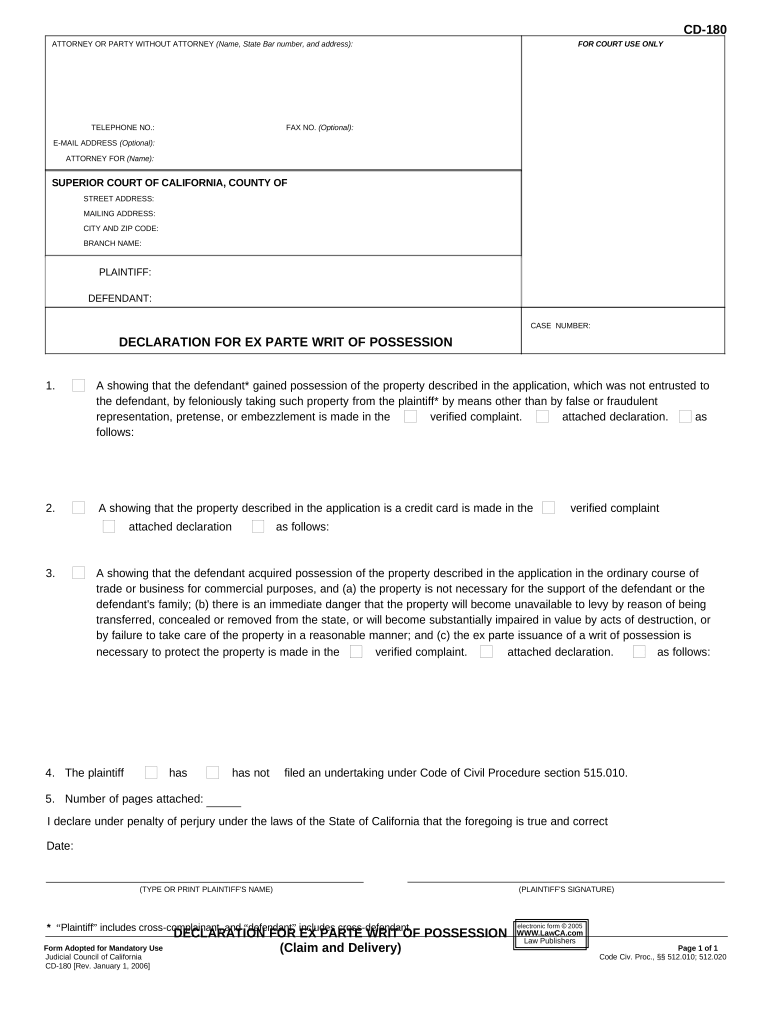
A Declaration Writ is a formal written statement submitted to a court or administrative body that sets out facts, legal positions, or a request for declaratory relief. It may function like an affidavit or pleading depending on local practice: it presents factual assertions under penalty of perjury, identifies the parties and relief sought, and attaches supporting exhibits. The writ establishes a record for the court and other parties, frames legal issues for resolution, and typically triggers case-processing steps such as filing, service, and scheduling.

Why the Declaration Writ matters for dispute resolution

A clear Declaration Writ focuses issues, creates a formal record of facts and positions, and begins procedural steps toward a declaratory or remedial judgment. It can reduce downstream disputes by documenting assertions under oath and by attaching contemporaneous evidence.

Why the Declaration Writ matters for dispute resolution

Typical users and stakeholders

The Declaration Writ is commonly prepared by attorneys, corporate counsel, and individuals who need formal adjudication or a recorded statement of facts.

  • Civil litigators preparing declaratory judgment or summary relief filings.
  • In-house counsel protecting corporate rights or clarifying contract disputes.
  • Individuals or small businesses initiating a formal legal determination.

Who typically completes and signs the writ

Sarah Mendoza, Litigation Counsel

A litigation attorney preparing a Declaration Writ will assemble facts, reference governing law, attach exhibits, and certify the statement under penalty of perjury so the court can evaluate the legal claim efficiently.

Mark Reynolds, Small Business Owner

A business owner uses a Declaration Writ to document contract breaches and request declaratory relief; the owner must ensure factual accuracy and coordinate service of process through local rules.

Core components to include in a professional Declaration Writ

A complete Declaration Writ follows a standard structure so courts and recipients can quickly find essential elements and supporting material.

Caption

Court name, case number (if assigned), and full party names should appear in the document header.
Identification

Full legal names, business entities, addresses, and roles (declarant, opposing party, petitioner, respondent) are required for clarity.

Statement of Facts

Chronological, numbered factual assertions with dates, locations, and supporting detail; avoid argumentative language in this section.

Legal Basis

Brief citation of statutory or common law authority supporting the request or declaratory relief being sought.

Relief Requested

A concise statement of the remedy, declaratory language, or specific orders being asked from the court.

Signature & Verification

Declarant signature, printed name, date, and a verification clause or notarial acknowledgement where required.

Step-by-step: drafting and filing the Declaration Writ

Follow these sequential steps to prepare, execute, and submit a Declaration Writ that meets procedural expectations.

  • 01
    Gather Evidence: Collect documents, dates, and witness information that support each factual assertion.
  • 02
    Draft Writ: Compose numbered factual paragraphs and identify legal bases for relief requested.
  • 03
    Attach Exhibits: Label and append supporting exhibits; cross-reference them within the body paragraphs.
  • 04
    File and Serve: Submit per court rules and effect service on opposing parties according to local procedure.

Typical processing flow after submission

After filing, the writ follows predictable administrative steps; understanding them helps manage timelines.

  • Clerk Acceptance: Court clerk reviews filing for form and fee compliance before docketing.
  • Service: Proof of service must be completed per local rules and filed with the court.
  • Response: Opposing parties typically file a written response or motion within the local deadline.
  • Scheduling: Court may set a hearing or status conference based on case type and calendar availability.

How to configure an electronic workflow for the Declaration Writ

Set up an e-submission workflow that maps parties, authentication, and document retention before sending for signature.

Field Configuration
Signer Order Specify declarant, counterparty, then witness/notary where applicable.
Authentication Use email + SMS code or stronger ID verification for high-assurance signers.
Retention Setting Enable audit trail and long-term storage for court exhibits.
Notifications Enable automatic reminders and completion receipts to all parties.

Digital signing considerations and supported formats

Use an eSignature platform that preserves an auditable signing trail and supports common legal formats.

  • Document Formats: PDF and DOCX are standard; HTML and Excel may be supported for templates.
  • Integrations: Look for connectors to Google Workspace, Microsoft 365, NetSuite, and document storage platforms.
  • Audit and Security: Ensure TLS/AES encryption and an immutable audit trail for e-signed records.

Typical eSignature pricing and capability comparison

Basic plan pricing and common feature availability across vendors; signNow is listed first per standard comparison format.

signNow DocuSign Adobe Sign PandaDoc HelloSign
Starting Price $8/user/mo $15/user/mo $14/user/mo $19/user/mo $15/user/mo
Free Trial 7-day free trial Varies Varies Varies Varies
Bulk Send Yes (Business Premium) Varies Varies Varies Varies
Audit Trail Yes Yes Yes Yes Yes
HIPAA Compliant Yes Yes Yes No No

Security and compliance details relevant to the Declaration Writ

Encryption: AES-256 at rest
Transport Security: TLS 1.2 / 1.3
Audit Trails: Tamper-evident signing records
ESIGN / UETA: Compliant for electronic signatures
HIPAA Support: BAA available where required
21 CFR Part 11: Support for regulated workflows

Risks and legal consequences of incorrect or false declarations

Perjury Risk: Criminal exposure for false sworn statements
Dismissal: Court may strike or dismiss defective filings
Sanctions: Cost or fee sanctions for frivolous or late filings
Evidence Exclusion: Improper exhibits may be rejected by the court
Service Defects: Improper service can delay or void proceedings
Tax/Regulatory Harm: Incorrect facts can trigger regulatory review

Common preparation errors to avoid

  • Using informal language or argumentative phrasing in factual paragraphs instead of plain, numbered assertions.
  • Failing to attach or properly label exhibits, which prevents the court from easily verifying assertions.
  • Entering inaccurate party names or outdated addresses that cause service or jurisdictional problems.
  • Omitting verification language or required notarial acknowledgements where local rules mandate them.

Practical scenarios showing how a Declaration Writ is used

These condensed examples illustrate typical fact patterns and the role of the Declaration Writ in resolving discrete legal issues.

Case Study 1

A tenant documents repeated lease violations with dated photos and communications

  • Declarant attaches exhibits and certifies under penalty of perjury
  • The writ established a record that supported expedited relief and clarified the contested facts for the judge.

Case Study 2

A vendor files a Declaration Writ seeking a declaratory ruling on contract interpretation

  • Declarant cites contract clauses and invoices
  • The court used the writ and exhibits to frame the parties' dispute and schedule a dispositive hearing.

Practical tips for accurate, efficient completion

Follow these drafting and execution practices to reduce risk and speed processing.

Numbered factual statements
Number each fact for easy reference, keep paragraphs short, and avoid combining unrelated facts in a single paragraph.
Consistent exhibit labeling
Label exhibits sequentially (Exhibit A, B) and reference them in the exact paragraph where they support a fact.
Confirm signer identity
Ensure the declarant's legal name matches ID and records; mismatched names can complicate verification or service.
Use auditable e-signatures
For permitted electronic signing, choose a platform that captures timestamp, IP, and authentication evidence for the court record.

Typical timelines and deadlines to watch

Key dates depend on local rules, service deadlines, and whether the writ is filed in civil court or an administrative tribunal.

Filing Deadline:

Observe statute of limitations and local filing windows; missing deadlines can bar relief.

Response Period:

Opposing parties often have a short window (e.g., 20–30 days) to answer or move to dismiss.

Service Proof:

File proof of service promptly to avoid administrative rejection.

Hearing Scheduling:

Courts typically set hearings within weeks to months depending on docket load.

Appeal Window:

Appeal timeframes vary by court; calendar the post-decision deadlines carefully.

Key milestones in the Declaration Writ lifecycle

Track these numbered milestones from drafting through final disposition to manage tasks and expectations.

01

Draft Completion

Finalize factual paragraphs, exhibits, and verification language before internal review.

02

Filing with Court

Submit the writ following the clerk’s formatting and fee requirements and obtain a stamped copy.

03

Service of Process

Serve opposing parties and file proof of service according to local rules.

04

Judicial Decision

Court issues an order, judgment, or schedules further proceedings after reviewing submissions.

Frequently asked questions about Declaration Writs

Answers to common procedural and execution questions to help avoid delays and preserve enforceability.


Need help? Contact support

be ready to get more
Join over 28 million airSlate SignNow users