Parties
Names and roles of trustor (borrower), beneficiary (lender), and trustee with complete contact details.
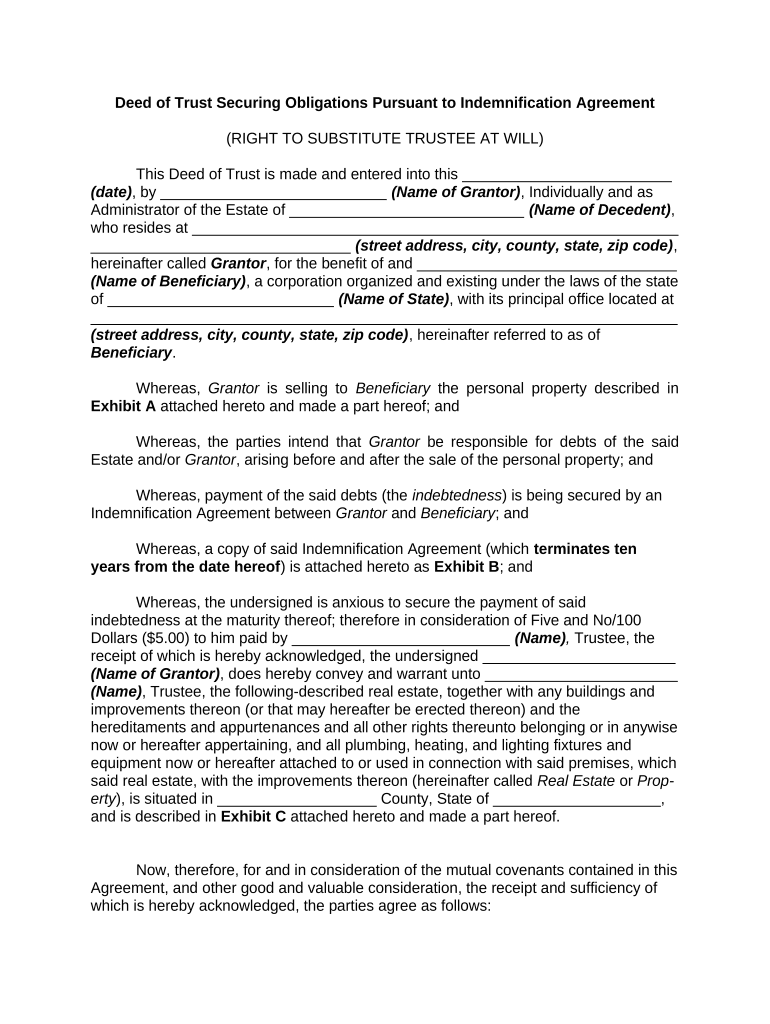
A clear, correctly executed Deed of Trust protects lender security interests, clarifies parties’ rights, and preserves priority against competing liens. Proper execution and timely recording reduce title risk, speed dispute resolution, and support reconveyance after payoff.

Typical users include lenders, title companies, closing attorneys, and real estate brokers who manage secured lending transactions.
Names and roles of trustor (borrower), beneficiary (lender), and trustee with complete contact details.
Full recorded property description (lot, block, survey or metes and bounds). Short or informal addresses are insufficient for recording.
Reference to the secured note, including date, principal, interest rate, and payment terms that create the underlying debt obligation.
Statement of authority for non-judicial foreclosure, sale procedures, and reconveyance upon full payment.
Space for county recorder stamps, document number, and recording date to establish public notice and priority.
Signature and printed name lines for all signers plus notary acknowledgement and witness lines where required by state law.
| Field | Configuration |
|---|---|
| Signer Order | Trustor then trustee then beneficiary |
| Authentication | Email + SMS OTP or stronger KBA where required |
| Notary / RON | Enable RON session capture if state permits |
| Delivery | Automatic distribution of recorded PDF to all parties |
Choose a platform that supports robust authentication, audit trails, PDF/A export, and optional RON or in-person notarization workflows.
Sign on agreed closing date; affects priority against subsequent instruments.
Record immediately after closing to protect lien priority and avoid intervening claims.
Request trustee reconveyance promptly after final payment to clear title.
State law varies; adhere to statutory notice and cure periods before sale.
Monitor property tax deadlines for assessments or delinquency that affect lien priority.
Parties execute the Deed of Trust and related loan documents.
A notary or RON provider completes acknowledgements and attaches required certificates.
Document is filed with county recorder to establish public notice and priority.
Upon payoff, trustee issues reconveyance to remove the lien from title records.
A regional broker used digital workflows to execute Deeds of Trust at closing to avoid delays.
A national lender standardized Deed of Trust templates across offices to ensure consistent trustee powers.
| signNow | DocuSign | Adobe Sign | PandaDoc | HelloSign | |
|---|---|---|---|---|---|
| Starting Price | $8/user/mo | $15/user/mo | $14/user/mo | $19/user/mo | $15/user/mo |
| Free Trial | 7-day free trial | No | No | Yes, limited | Yes, limited |
| Bulk Send | Yes | Yes | Yes | Yes | No |
| Audit Trail | Yes | Yes | Yes | Yes | Yes |
| HIPAA Compliant | Yes | Yes | Yes | No | No |