Case Caption
Court name, docket number, parties' names, and claim reference so the warrant ties precisely to the underlying judgment or statutory cause of action.
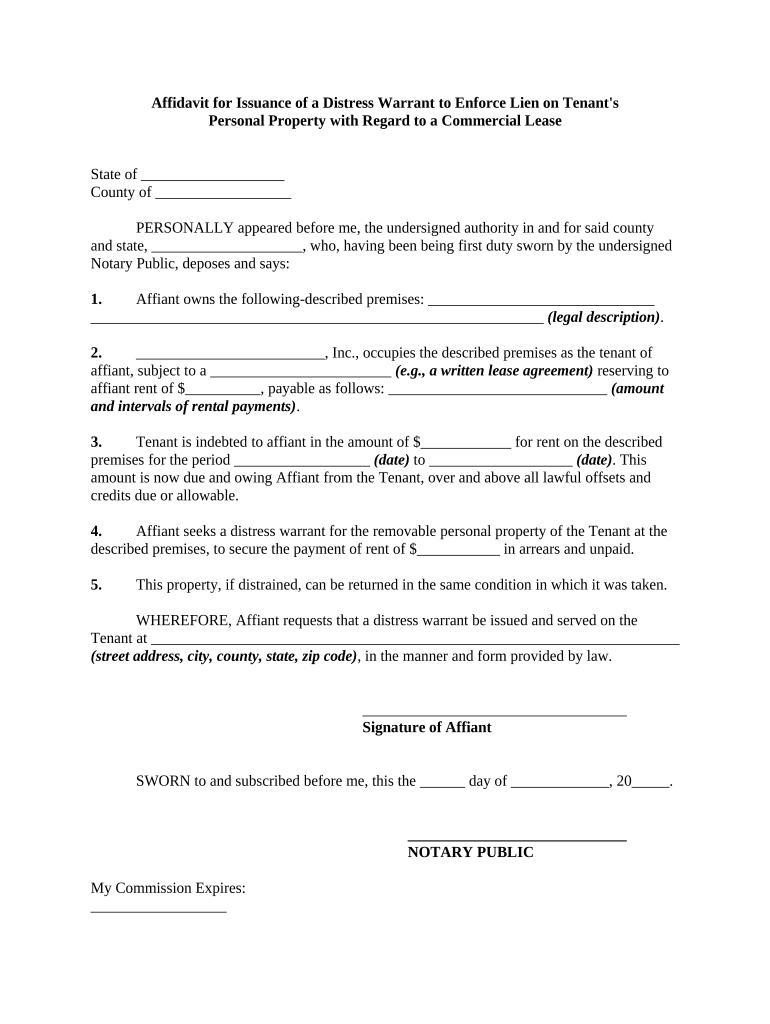
A correctly prepared Distress Warrant protects enforcement actions from procedural challenge, clarifies authority for seizure, and documents chain of custody for seized assets. Accuracy reduces the risk of liability, invalidation, or unnecessary delay in recovery.

Typical users include claimants, attorneys, court clerks, sheriffs, and enforcement officers responsible for executing writs.
Each participant must verify identity, authority to act, and statutory prerequisites before execution to ensure enforceability.
A licensed attorney representing the creditor prepares supporting pleadings, ensures statutory notice requirements are met, and files the Distress Warrant. The attorney must confirm the underlying judgment or statutory basis and coordinate service with the appropriate law enforcement agency.
A sheriff, marshal, or authorized agent executes the warrant, seizes property, documents chain of custody, and returns an inventory to the court. The officer must follow statutory procedures to avoid claims of unlawful seizure.
Court name, docket number, parties' names, and claim reference so the warrant ties precisely to the underlying judgment or statutory cause of action.
Citation to the statute or court order authorizing distraint, plus the judge's signature or clerk stamp that validates the warrant for enforcement.
Full legal name, known aliases, and last known address for accurate identification and service to prevent wrongful seizure claims.
Clear, specific description of targeted assets (serial numbers, VINs, account identifiers) sufficient to locate and identify seized items.
Designated enforcement officer, authorized methods of seizure, limits on entry, and any required notice to occupants or third parties.
Deadline for officer's return to court, inventory of seized goods, and steps for sale or disposition consistent with governing law.
| Field | Configuration |
|---|---|
| Authentication | Email + optional SMS code for signer verification |
| Notarization | Enable RON or local notary checkbox where allowed |
| Template | Save as reusable template with conditional property fields |
| Routing order | Sequential routing: drafter → attorney → court filing |
Use an eSignature and e-filing platform that supports evidence-rich signing, secure storage, and RON where allowed.
Choose configuration that preserves audit trails (timestamps, IP), retains copies for statutory retention, and integrates with court e-filing or enforcement workflows.
Execute warrant as soon as issued when statute requires prompt seizure
Return inventory and report to court within required days of execution
Provide statutory notice to lienholders or occupants per local rules
Follow statutory waiting periods before disposition or public sale
Debtor may file objections within court-prescribed time frames
Court issues warrant after reviewing supporting materials.
Officer locates and seizes identified property per instructions.
Officer files inventory and chain-of-custody documentation with court.
Property sale or release occurs following statutory procedures.
A creditor secured a warrant after judgment was entered and provided a detailed property VIN list to the sheriff.
A property manager used a Distress Warrant to recover unpaid storage fees following notice to the tenant.
| Document Type | Distress Warrant | Writ of Execution |
|---|---|---|
| Primary Use | seizure of goods | levy on assets |
| Requires Prior Judgment | often yes | |
| Typical Authority | statute or court order | court order |
| Common Return | inventory and sale | return and sale |
| signNow | DocuSign | Adobe Sign | PandaDoc | HelloSign | |
|---|---|---|---|---|---|
| Starting Price | $8/user/mo | $15/user/mo | $14/user/mo | $19/user/mo | $15/user/mo |
| Free Trial | 7-day free trial | Varies | Varies | Varies | Varies |
| Bulk Send | Yes | Yes | Yes | Yes | No |
| Audit Trail | Yes | Yes | Yes | Yes | Yes |
| HIPAA Compliant | Yes | Yes | Yes | No | No |