Parties
Full legal names and entity types for seller and factor, including state of formation and contact information.
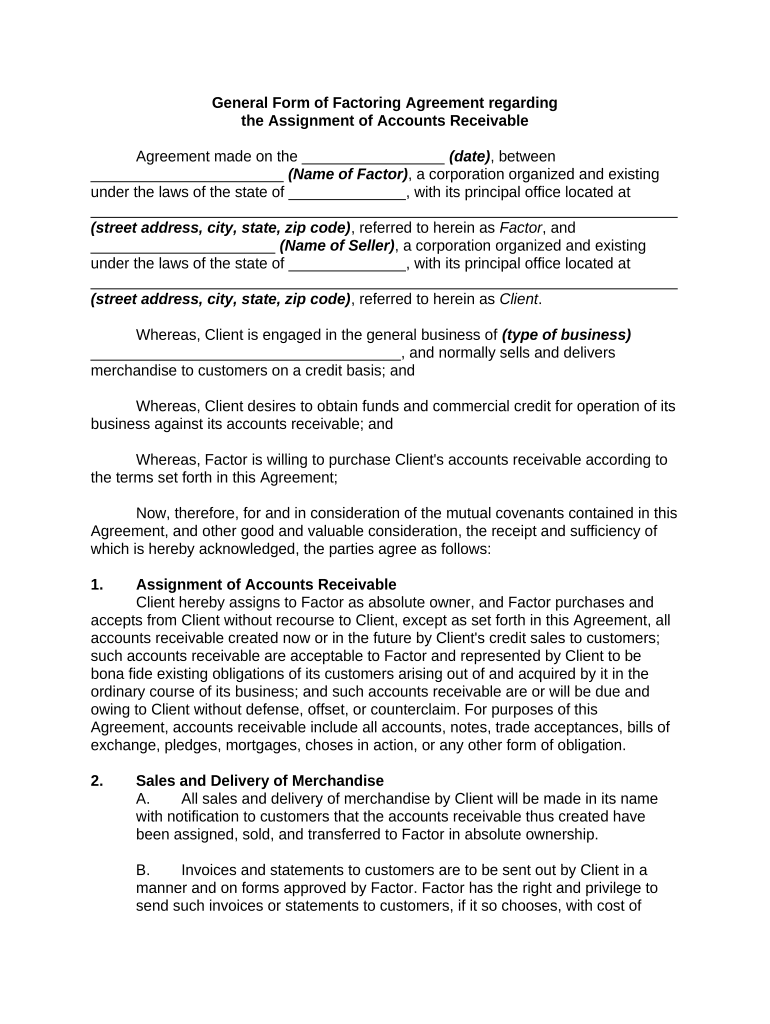
A well-drafted Factoring Agreement reduces ambiguity about cash advance terms, fee structures, and risk allocation between seller and factor, protecting both parties and improving predictability in collections and cash flow.

Factoring Agreements are common when businesses need working capital quickly and prefer converting receivables into immediate cash rather than borrowing.
Typical signers include an authorized officer of the seller and an authorized representative of the factor; signature authority should be documented in company records.
Full legal names and entity types for seller and factor, including state of formation and contact information.
Clear defined terms for Receivables, Advances, Reserve, Default, Purchased Accounts, and Related Parties.
How receivables are sold (assignment vs absolute sale), timing of advances, and calculation of fees and reserves.
Allocation of risk for uncollectible accounts: recourse, limited recourse, or non‑recourse provisions.
UCC‑1 filing requirements, description of collateral, and procedures to perfect the factor’s interest.
Notice procedures, cure periods, events of default, and remedies including acceleration and setoff.
| Field | Configuration |
|---|---|
| Signature Block | Assign roles and require dates for each signer |
| Supporting Docs | Require invoice upload and ID verification |
| Conditional Fields | Show fee details only if recourse is selected |
| UCC Filing Hook | Trigger export for UCC‑1 drafting and filing |
Use secure channels and retain cryptographic or audit evidence of signing when exchanging factoring agreements electronically.
Integrations with CRM, ERP, or accounting systems help automate invoice transfer, reconciliation, and reporting while preserving chain of custody.
Seller must submit invoices within the contract period, commonly 30 days.
Advances often issued within 24–72 hours after invoice acceptance.
Reserve funds released after collections, typically 30–90 days.
Debtor disputes often require notice within 10–30 days.
UCC‑1 filings expire after five years unless continued.
Agree the commercial terms and collate required documents.
Sign the agreement and exchange executed copies.
File financing statement to perfect the factor's security interest.
Submit invoices and receive advances per schedule.
| signNow | DocuSign | Adobe Sign | PandaDoc | HelloSign | |
|---|---|---|---|---|---|
| Starting Price | $8/user/mo | $15/user/mo | $14/user/mo | $19/user/mo | $15/user/mo |
| Free Trial | 7-day free trial | Varies by vendor | Varies by vendor | Varies by vendor | Varies by vendor |
| Bulk Send | Yes | Yes | Yes | Yes | Varies by vendor |
| Audit Trail | Yes | Yes | Yes | Yes | Yes |
| HIPAA Compliant | Yes | Yes | Yes | No | No |
| Envelope Cap | No cap | 100 envelopes/user/year | Varies by plan | Varies by plan | Varies by plan |
A mid‑size distributor sells receivables to improve cash flow after seasonal spikes.
A clinic factors insurance receivables to cover payroll during claims processing delays.