Caption
Court name, county, case number, and caption identifying petitioner and respondent. This aligns the acknowledgment with the active court record and prevents filing errors.
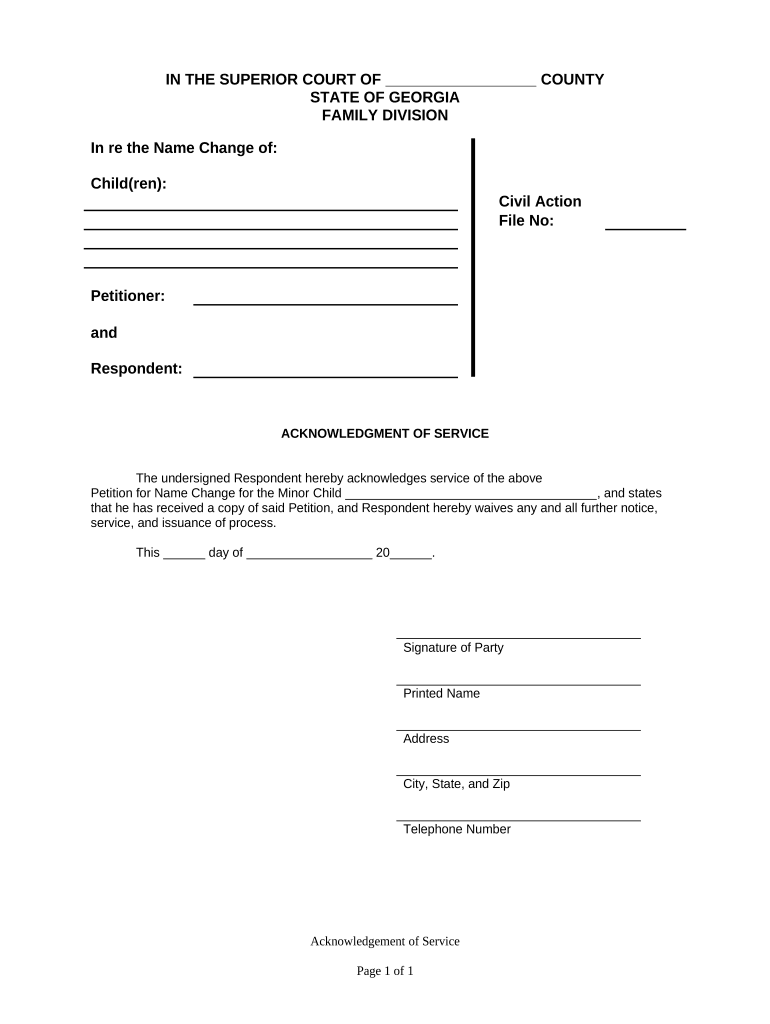
An accurate acknowledgment of service provides clear proof that the respondent received notice, streamlines court processing, and reduces the risk of delays or contested service hearings. It protects the petitioner by documenting service events and can satisfy local filing procedures when correctly completed and, if required, notarized.

The following roles commonly complete, sign, or accept the Georgia Acknowledgment of Service for Name Change.
Each user should verify county-specific form preferences and whether notarization or additional proof is required before filing.
The individual who filed the name change petition or their attorney. They prepare the acknowledgment form, confirm case details, and submit proof of service to the court for case progression and docketing.
The person served with the petition. By signing the acknowledgment, the respondent confirms receipt; this signature can avoid formal service hearings and expedite court scheduling when the acknowledgment meets procedural requirements.
Court name, county, case number, and caption identifying petitioner and respondent. This aligns the acknowledgment with the active court record and prevents filing errors.
Clear language that the respondent received a copy of the petition, listing the specific documents delivered and the method of delivery used for service.
Precise service date and chosen method (personal delivery, mail, certified mail, or other). Accurate dating affects response deadlines and court scheduling.
Full legal name and contact address of the respondent exactly as used on the petition to avoid identity confusion during processing.
Respondent signature and date. If the respondent signs electronically, the method of authentication should be recorded to show intent and attribution.
When required by local rules, a notary acknowledgment or witness signature to validate the physical signature and to demonstrate proper execution.
| Field | Configuration |
|---|---|
| Authentication Method | Email verification with optional SMS code for signer attribution. |
| Signature Type | Allow drawn or typed signatures; capture audit trail details. |
| Notary Support | Enable RON or schedule in-person notarization per county rules. |
| Routing Order | Petitioner prepares → respondent signs → petitioner files. |
Ensure the platform you use supports legal-grade audit trails, accepted file formats, and required authentication.
Confirm that your chosen platform preserves timestamps, signer metadata, and a tamper-evident copy suitable for printing or electronic filing with the court.
The official date of service starts response timelines.
Often 30 days to file an answer or object in civil matters.
Respondent should return signed acknowledgment promptly after receipt.
Petitioner files acknowledgment to show proper notice to court.
Court sets hearings after proof of service is accepted.
Draft and verify petition details before service.
Deliver documents and record service date.
Respondent signs and returns the acknowledgment promptly.
Petitioner submits acknowledgment as evidence of service.
PDF/A or standard PDF preserves signatures and audit metadata for printing and court submission.
Include a copy of the petition, proof of service receipts, and any certified mail tracking records.
Retain signed documents in encrypted storage with access controls for audit readiness.
Preserve a signing certificate with IP, time stamps, and authentication details.
A property management firm used an online acknowledgment to update tenant records quickly after a name change notice was served.
A healthcare provider needed accurate name-change acknowledgments for patient records during administrative updates.
| Document | Notarization Required | Court Filing Required |
|---|---|---|
| Acknowledgment of Service | often yes | |
| Affidavit of Service | ||
| Waiver of Service | ||
| Certificate of Service |