Establishing secure connection…Loading editor…Preparing document…

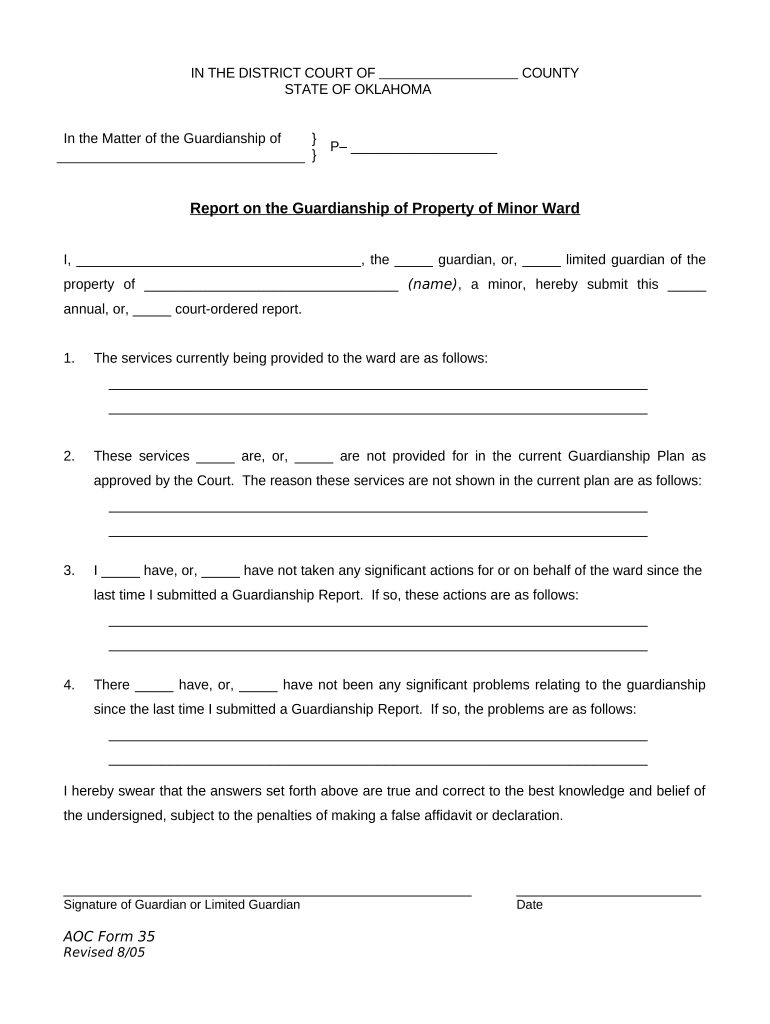
Oklahoma Report on Guardianship of Property of Minor Ward

This template is fully customizable. Edit the text, fill out the fields, and send it for signature. Give it a try!
Oklahoma Report on Guardianship of Property of Minor Ward

What the Oklahoma Report on Guardianship of Property of Minor Ward Is

The Oklahoma Report on Guardianship of Property of Minor Ward is a court-directed accounting and asset inventory prepared by a guardian who manages a minor's estate. It documents the ward's identifying data, the guardian's authority, a detailed inventory of assets and liabilities, receipts and disbursements during the reporting period, and any proposed distributions or investments. Courts use the report to assess fiduciary performance, ensure proper stewardship, and determine whether further orders or bond adjustments are needed. Accurate reporting supports fiduciary transparency and helps the court protect the minor's property interests.

Why this Report Matters for Guardians and the Court

Filing a complete, timely report demonstrates the guardian’s compliance with court orders, documents the condition and disposition of ward property, and reduces the risk of disputes or court enforcement actions. It creates an official record for future guardianship actions and helps preserve the minor’s financial rights.

Why this Report Matters for Guardians and the Court

Who Prepares and Relies on This Report

Guardians, probate attorneys, and court clerks commonly prepare or review the guardianship property report to meet statutory and judicial requirements.

  • Court-appointed guardians who manage the minor’s assets and must account to the court regularly.
  • Probate or guardianship attorneys preparing the inventory, accounting, and supporting schedules for filing.
  • Financial institutions and custodians that require documented authority and court orders before releasing funds or assets.

Accurate completion benefits the guardian, protects the ward’s property, and provides the court with the information needed for oversight and decision-making.

Representative Users and Professional Roles

Guardianship Guardian

An individual appointed by the court to manage a minor’s property and financial affairs. The guardian compiles asset inventories, tracks income and expenses, and prepares periodic reports to demonstrate fiduciary duty and compliance with court orders.

Probate Attorney

An attorney who advises guardians on form completion, statutory deadlines, and evidentiary support. The attorney reviews valuations, prepares sworn statements, and files the report with the court to reduce risk of challenges or accounting objections.

Key Compliance and Security Considerations

Encryption: TLS 1.2/1.3 in transit; AES-256 at rest
Access Controls: Role-based permissions and SSO options
Audit Trail: Timestamped action logs for each signer
HIPAA: BAA available when PHI involved
ESIGN / UETA: Electronic signatures legally supported
Document Integrity: Tamper-evident signed PDFs maintained

Consequences of Incomplete or Incorrect Reports

Court Sanctions: Monetary fines or directives
Surcharge Liability: Personal financial liability for losses
Removal Risk: Guardian may be removed from role
Account Rejection: Court may reject or require redo
Criminal Exposure: Possible charges for fraud or embezzlement
Delay in Benefits: Holds on distributions or claims

Common Preparation Pitfalls to Avoid

  • Incomplete asset listings: missing bank accounts, custodial accounts, or insurance policies often trigger court follow-up and delays.
  • Incorrect valuations: failing to provide supporting documentation for appraisals or market values invites auditor or court questions.
  • Missing receipts and vouchers: lack of proof for expenditures undermines the guardian’s accounting and can create liability exposure.
  • Late submissions: untimely filings cause administrative sanctions and may require emergency court appearances to correct compliance gaps.

Step-by-Step: Preparing the Report

Follow a clear sequence to gather records, complete the inventory, calculate receipts and disbursements, and present the accounting for court review.

  • 01
    Gather Records: Collect bank statements, investment reports, and receipts for the reporting period.
  • 02
    Inventory Assets: List each asset with description, value, and supporting documentation.
  • 03
    Prepare Accounting: Detail income, expenses, disbursements, and transfers in chronological order.
  • 04
    File with Court: Sign, notarize if required, and file or e-file per local court rules.

How the Filing and Review Flow Typically Works

A standard administrative flow helps guardians submit a complete report and allows the court and interested parties to review it efficiently.

  • Prepare Report: Assemble inventory, accounting, and supporting attachments.
  • Authenticate: Sign and notarize if the court requires a notarized verification.
  • Submit: File with the county probate or district clerk; follow e-filing or paper rules.
  • Court Review: Judge or clerk reviews, may schedule a hearing or request clarifications.

Essential Sections to Include in a Professional Report

Ensure your report is structured, verifiable, and aligned with local court expectations by including these core sections and exhibits.

Ward Information

Full name, date of birth, guardianship case number, and current residence to identify the minor and the proceedings clearly.
Guardian Details

Guardian name, contact information, appointment date, bond details, and a brief statement of authority and responsibility.

Inventory of Property

Detailed listing of real property, bank accounts, investments, personal property, and estimated or appraised values with dates.

Receipts and Disbursements

Chronological accounting of income, expenditures, fees, and transfers during the reporting period with supporting receipts.

Proposed Actions

Any recommended sales, investments, distributions, or bond changes, with justification and risk considerations.

Exhibits and Backup

Copies of statements, appraisals, invoices, receipts, and any affidavits supporting values or transactions cited.

Digital Workflow Settings for Completing and Submitting the Report

Configure your digital form and signer flow to capture required signatures, date stamps, and optional notarization evidence before filing.

Field Configuration
Signature Fields Guardian sign and date; optional attorney signature
Notary Block Place notary acknowledgement where local rules require it
Attachment Zone Enable upload for bank statements and receipts
Audit Options Enable full audit trail and signer authentication methods

Technical Requirements for Electronic Completion and Filing

Use a platform that supports PDF and DOCX, audit trails, secure storage, and integrations with cloud repositories to streamline assembly and submission.

  • File Formats: PDF and DOCX supported
  • Integrations: Salesforce, NetSuite, Google Workspace
  • Authentication: Email, SMS, or advanced auth

Ensure the chosen platform can produce tamper-evident signed PDFs, preserve an audit trail for each signer, and export records for local court filing or long-term retention.

Timing and Typical Court Expectations

Deadlines for the guardianship property report vary by court; review the appointing order and local rules for specific dates and intervals.

Initial Inventory Window:

Courts commonly require an initial inventory soon after appointment; check the order for the exact timeframe.

Periodic Accounting Interval:

Many courts order annual or biennial accountings; frequency is set by the court or statute.

Bond Review Timing:

Reports often trigger bond review to ensure bond amount remains adequate against estate value.

Hearing Scheduling:

A filed report may prompt a court hearing; allow time for notice to interested parties.

Local Rule Variations:

Procedures differ by county—confirm filing windows with the clerk before submission.

Key Milestones from Appointment to Final Accounting

A typical lifecycle moves from appointment through ongoing accountings to final settlement; each stage has distinct deliverables and court actions.

01

Appointment

Court issues letters of guardianship and any bond instructions.

02

Initial Inventory

Guardian files a complete inventory of assets and liabilities with supporting documents.

03

Periodic Accountings

Regular reports covering receipts, disbursements, and activity for the reporting period are filed.

04

Final Accounting

When guardianship ends, a final accounting and proposed distribution are presented to the court.

eSignature Vendor Comparison for Executing Guardianship Reports

Comparison of common vendor criteria for organizations that prepare and execute frequent guardianship accountings; signNow is listed first per vendor convention.

signNow DocuSign Adobe Sign PandaDoc HelloSign
Starting Price $8/user/mo $15/user/mo $14/user/mo $19/user/mo $15/user/mo
Free Trial 7-day free trial No No Yes, limited Yes, limited
Bulk Send Yes Yes Yes Yes No
Audit Trail Yes Yes Yes Yes Yes
HIPAA Compliant Yes Yes Yes No No
Envelope Cap No envelope cap 100 envelopes/user/year Varies by plan Varies by plan Varies by plan

Frequently Asked Questions About Filing the Report

Answers to common questions about completing, authenticating, and submitting the Oklahoma Report on Guardianship of Property of Minor Ward.


Need help? Contact support

be ready to get more
Join over 28 million airSlate SignNow users