Establishing secure connection…Loading editor…Preparing document…

Letter of Intent to Seek Additional Employment

This template is fully customizable. Edit the text, fill out the fields, and send it for signature. Give it a try!
Letter of Intent to Seek Additional Employment

What this Letter of Intent to Seek Additional Employment Is

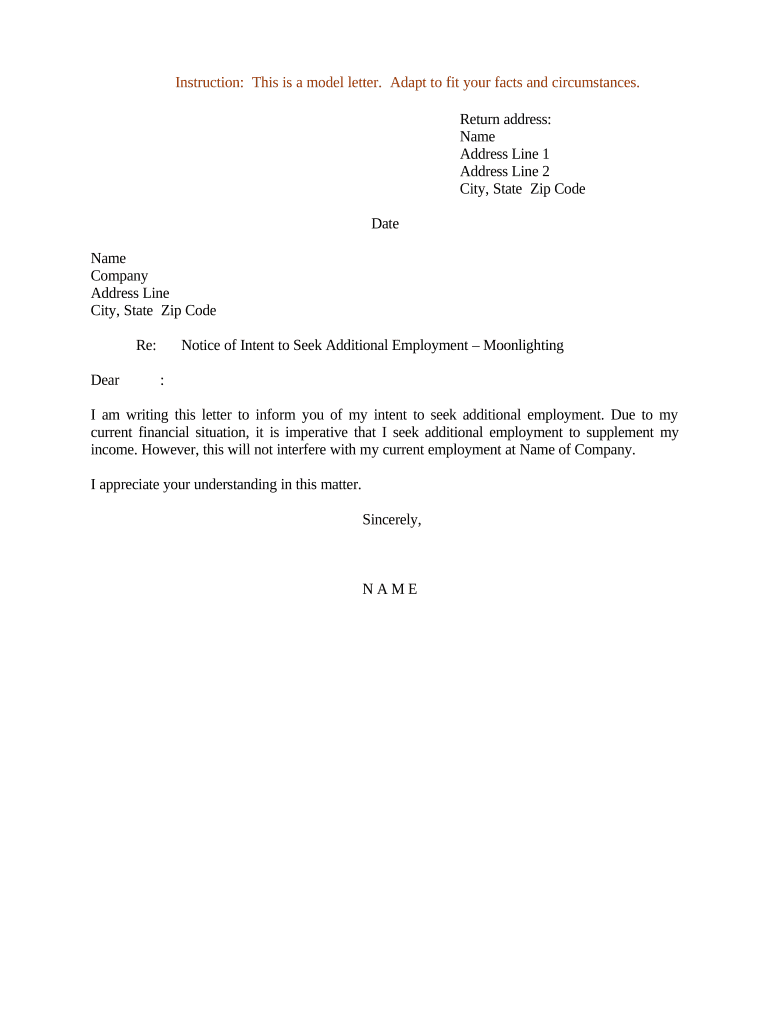
A Letter of Intent to Seek Additional Employment is a written notice an employee provides to a current employer when pursuing paid work outside their primary job. The letter documents the secondary role, expected hours, start date, and any potential scheduling conflicts or conflicts of interest. Employers often require such notices under internal policies or collective bargaining agreements to evaluate interference with duties, safety, confidentiality, or noncompete clauses. While generally an internal employment record, the letter creates an auditable record that can be retained electronically and signed under ESIGN (15 U.S.C. §7001) or UETA where applicable.

Why a Clear Notice Helps Both Employee and Employer

Providing a clear Letter of Intent to Seek Additional Employment promotes transparency, helps avoid schedule conflicts and policy violations, and creates a dated record that supports later HR decisions or disputes. It also allows employers to review safety, confidentiality, and overtime implications under applicable workplace rules.

Why a Clear Notice Helps Both Employee and Employer

Who Typically Prepares or Reviews This Letter

This letter is used by individual employees and reviewed by HR and managers when secondary work might affect job performance or compliance.

  • Employees seeking part-time or freelance work while employed full time; they notify HR and supervisors.
  • HR professionals and compliance officers who assess conflicts, schedule impact, and policy alignment.
  • Supervisors or department heads who evaluate operational impact and approve or request modifications.

Step-by-step: How to Prepare and Submit the Letter

Follow these steps to ensure the Letter of Intent to Seek Additional Employment is complete, properly authorized, and retained for HR records.

  • 01
    Gather details: Collect position title, hours, employer name, and start date.
  • 02
    Check policy: Review employment agreement, handbook, and noncompete clauses.
  • 03
    Draft letter: State intent, duties, hours, conflict mitigation, and contact info.
  • 04
    Submit & retain: Send to HR, request written response, keep signed copy.

Frequently asked questions about the Letter of Intent to Seek Additional Employment

Answers to common questions about requirements, electronic signing, approvals, and what happens if an employer objects.


Need help? Contact support

Essential sections to include in the letter

A professional Letter of Intent to Seek Additional Employment is concise, factual, and structured so HR can quickly assess impact and approve or request clarifications.

Header

Date, employee name, position, department, and recipient (HR or supervisor) to ensure correct routing and record association.
Statement of intent

A clear sentence that you intend to accept or seek additional employment, specifying whether it is concurrent or temporary.

Secondary employer details

Name, address, contact person, and a brief description of duties to assist conflict and schedule assessments.

Schedule and hours

Specific days and number of hours per week, proposed start date, and any end date or review date to flag overtime or availability issues.

Conflict mitigation

Describe steps to avoid conflicts (no work during scheduled shifts, confidentiality safeguards, no use of employer resources).

Acknowledgment

Signature, printed name, and date; include a line for HR acknowledgment or approval and date to record employer response.

Security and compliance considerations for electronic submissions

In-transit encryption: TLS 1.2/1.3
At-rest encryption: AES-256
Audit trail: Timestamps, IP, action log
HIPAA readiness: BAA required for PHI
ESIGN/UETA compliance: Acceptance of e-signatures
21 CFR support: Available for regulated records

Risks and potential consequences of incorrect or missing notices

Disciplinary action: Policy breach may lead to warnings or termination
Contract breach: Violating noncompete or conflict clauses
Scheduling conflicts: Missed shifts or overtime disputes
Confidentiality risk: Unauthorized disclosure of employer data
Tax implications: Unreported income or withholding issues
Recordkeeping gaps: Lack of dated documentation for disputes

Common preparation errors to avoid

  • Failing to state specific hours and start date, which prevents HR from assessing overtime or scheduling conflicts.
  • Neglecting to reference company policy or employment agreement language, leaving reviewers unclear about obligations or restrictions.
  • Omitting contact details for the secondary employer, which slows verification and conflict checks.
  • Using vague duty descriptions such as 'consulting' without clarifying that no employer resources or confidential information will be used.

Typical review and approval flow for the letter

A consistent routing and signing process speeds review and creates a retained record for HR and the employee.

  • Submit to HR: Employee sends letter to HR and supervisor for intake.
  • Initial review: HR checks employment agreement and policy for conflicts.
  • Manager assessment: Supervisor assesses operational impact and suggests changes.
  • Final acknowledgment: HR records approval or denial and returns signed copy.

Configuring an online workflow for this letter

When using an eSignature platform, configure fields and routing to mirror your internal approval process and preserve compliance artifacts.

Field Configuration
Signature block Require full name, signature, and date
Routing order Employee → Supervisor → HR
Authentication Email link with optional SMS code
Retention Auto-save PDF and audit trail for records

Technical requirements for secure electronic handling

Ensure the platform you use supports standard document formats, authentication, and audit trails before e-submitting the letter.

  • File formats: PDF and DOCX supported
  • Integrations: Salesforce, Microsoft 365, NetSuite
  • Authentication: Email, SMS code, or SSO

Typical timelines and response expectations

Timelines vary by employer; these are common internal deadlines and review windows to plan around.

Employee submission timing:

Submit before beginning secondary work or as soon as intent is known

Employer response window:

HR typically responds within 5–10 business days

Urgent requests:

Expedited reviews may be completed within 48–72 hours

Record retention:

Keep signed copy in personnel file for the retention period

Revision requests:

Expect follow-up if additional mitigation steps are needed

Key milestones from notice to resolution

A simple milestone view helps manage expectations during review and approval of the letter.

01

Prepare Notice

Draft and verify all fields, attachments, and dates before submission.

02

Submit to HR

Send letter and supporting details through established channels or eSignature workflow.

03

Review Period

HR and managers evaluate conflicts, schedule, and policy compliance.

04

Approval or Response

Receive written approval, conditional approval, or denial and next steps.

Common eSignature vendor comparison for managing letters and HR forms

A concise vendor comparison highlighting starting price, trial availability, bulk send, audit trail, HIPAA support, and envelope limits for typical eSignature platforms.

signNow DocuSign Adobe Sign PandaDoc HelloSign
Starting Price $8/user/mo $15/user/mo $14/user/mo $19/user/mo $15/user/mo
Free Trial Yes, 7-day trial Varies Varies Varies Varies
Bulk Send Yes (Premium) Yes Yes Yes No
Audit Trail Yes Yes Yes Yes Yes
HIPAA Compliant Yes Yes Yes No No

Practical examples of how the letter is used

Realistic scenarios illustrate how employees and HR apply the Letter of Intent to Seek Additional Employment in common situations.

Case: Healthcare Provider

A nurse seeks part-time telehealth shifts outside hospital hours to supplement income and gain experience.

  • The nurse discloses hours and confirms no use of employer systems.
  • HR reviews licensing and HIPAA safeguards, documents approval with conditions limiting patient overlap and requiring separate device usage; the signed letter is saved in the personnel file.

Case: Real Estate Agent

A full-time staff member plans weekend real estate showings for a licensed brokerage.

  • The employee specifies days and confirms no client data sharing.
  • The manager reviews schedule impact, checks noncompete clauses, requests a mitigation plan, and records a conditional approval with a quarterly review.

Practical tips to make the notice effective and compliant

Follow these practical practices to reduce review time and strengthen the record for both employee and employer.

Review employer policy first
Read the employment agreement and handbook before drafting so the letter addresses specific policy concerns and avoids unnecessary back-and-forth.
Be specific about hours
Provide exact days, start/end times, and weekly hour estimates to enable accurate scheduling and overtime assessment.
Address confidentiality
State that you will not use employer systems or confidential information; propose safeguards if duties could touch sensitive data.
Keep an auditable copy
Use eSignature or save a dated PDF with an audit trail so both parties retain a verifiable record of submission and acknowledgment.
be ready to get more
Join over 28 million airSlate SignNow users