Establishing secure connection…Loading editor…Preparing document…

Louisiana Verification and Consent to Independent Administration

This template is fully customizable. Edit the text, fill out the fields, and send it for signature. Give it a try!
Louisiana Verification and Consent to Independent Administration

What this Louisiana Verification and Consent form does

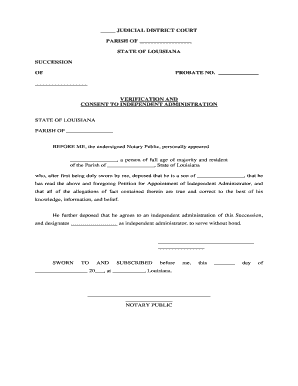
The Louisiana Verification and Consent to Independent Administration is a probate document used in Louisiana successions to confirm facts about the decedent and to record a person’s voluntary consent to allow an independent administrator to handle estate administration. It combines a factual verification of identity and assets with an explicit waiver or consent that permits independent administration under Louisiana Civil Code and Title 9 succession practice. The form helps courts determine whether formal administration procedures or independent administration authority are appropriate for the estate and creates a written record for the succession file.

Why this document matters in Louisiana successions

Using a written verification and consent clarifies parties’ intentions, supports a streamlined independent administration, and provides the court with signed evidence of agreement that can reduce contested probate steps and delay.

Why this document matters in Louisiana successions

Who typically completes this verification and consent

This form is commonly completed by individuals and professionals who are directly involved in a Louisiana succession process.

  • Estate representative or proposed administrator — Often files evidence of consent to independent administration on behalf of the estate.
  • Heirs and beneficiaries — Sign to confirm facts and to consent (or object) to independent administration.
  • Probate attorney or notary public — Prepares, verifies, and often files the document with the succession court.

Parties should confirm signatory authority and witness/notary requirements under Louisiana law before signing or filing.

Typical signers and their roles

Executor / Administrator

An appointed or proposed executor (administrator) signs to accept authority. In independent administration they confirm they will manage assets, pay debts, and distribute the estate according to law and written consent.

Beneficiary / Heir

Heirs or beneficiaries sign to verify their identity and to explicitly consent or reserve objections to independent administration, creating a record that the court can rely on during succession.

Essential verification items to include

Full legal name: As on ID
Date of birth: MM/DD/YYYY
Parish of residence: Parish name
Relationship to decedent: Heir/beneficiary
Signature date: MM/DD/YYYY
Notary acknowledgment: Notary details

Key legal risks of incorrect or incomplete forms

Probate delay: Court may delay succession
Challenge risk: Higher likelihood of contested probate
Invalid consent: Consent could be voided
Financial exposure: Administrator may face liability
Record rejection: Clerk may refuse filing
Witness issues: Insufficient witnesses invalidates signature

Common preparation mistakes to avoid

  • Leaving identification fields incomplete or using nicknames instead of the signer’s legal name causes authentication problems at filing.
  • Failing to obtain the required number of witnesses or an appropriate notary acknowledgment under Louisiana law can invalidate the consent.
  • Using an outdated form or omitting a court-required caption or succession number delays clerk acceptance and processing.
  • Confusing consent to independent administration with appointment documents; consent does not itself appoint an administrator without court action.

How this form is used in practice

Real-world examples show how verification and consent reduce friction and create a clear record for the court and estate participants.

Law Firm Succession Intake

The attorney collects signed verification and consent from three heirs during initial intake to document agreement on independent administration.

  • This accelerates informal distribution.
  • The signed form is attached to the succession filing, reducing follow-up discovery and allowing the administrator to act sooner while minimizing contested proceedings.

Bank Releasing Assets

A bank requires a notarized verification and consent before releasing account funds to an independent administrator.

  • Bank uses the form as proof of consent.
  • With the notarized document on file, escrow releases and account transfers proceed with fewer internal holds, lowering processing time and administrative burden for all parties.

Step-by-step: completing the verification and consent

Follow these four steps to complete the form accurately and reduce the risk of filing rejection.

  • 01
    Identify parties: Enter full legal names and relationships
  • 02
    Provide facts: List decedent details and assets clearly
  • 03
    Sign and date: Sign in front of required witnesses or notary
  • 04
    File with clerk: Submit the original to the parish succession court

How the signed form moves through the probate process

These stages describe how courts and administrators typically use the verification and consent document during succession.

  • Preparation: Draft with caption, succession number, and facts
  • Execution: Signatures, witness attestation, notary acknowledgment
  • Filing: Original submitted to parish clerk of court
  • Reliance: Court and institutions accept consent as evidence

Core elements to include in a professional form

A complete Louisiana Verification and Consent to Independent Administration should contain precise legal and factual sections so courts and third parties can rely on the record.

Caption

Court caption with parish, case/succession number, decedent name, and party identification to ensure the document attaches to the correct succession file and clerk record.
Verification statement

A sworn or attested paragraph listing the signer’s factual knowledge about the decedent, dates, residence, and known assets to support the court’s factual record.

Consent language

Clear, unambiguous wording where the signer expressly grants consent to independent administration and acknowledges the consequences of such consent under Louisiana succession law.

Signature block

Signature line, printed name, date, and contact information for each signer; initials are insufficient unless the form expressly permits them.

Notary block

A notarial acknowledgment formatted to Louisiana standards showing date, notary name, commission details, and required seal for filing acceptance.

Witness attestation

If witnesses are required, include witness signature lines and printed names; Louisiana practice frequently pairs witness attestation with notarial acknowledgment.

Setting up an electronic workflow for this form

Configure your e-signature workflow to capture identity, notarization, witness fields, and an audit trail suitable for court submission.

Field Configuration
Signer authentication Email + SMS code or KBA
Notary handling Reserve a notary block for in-person or RON completion
Audit trail Capture IP, timestamp, and signer events
Document format PDF/A with embedded audit certificate

Technical considerations for eSubmission

Ensure any eSignature platform you use supports notarization workflows, state-compliant audit trails, and accepted file formats for court filing.

  • Integrations: Salesforce | NetSuite | Google Workspace
  • File formats: PDF, DOCX, HTML
  • Security: AES-256 at rest

Confirm with the parish clerk whether an electronic submission, scanned original, or the physical original is required for the specific succession matter.

How this form differs from similar probate documents

Compare verification and consent with related documents to select the correct instrument for your succession matter.

Criteria Verification & Consent Power of Attorney
Primary purpose consent to admin delegate personal affairs
Effective at death
Notarial need often required often required
Court filing filed in succession typically not filed

Comparing common eSignature providers for probate workflows

This pricing comparison shows typical starting prices and feature availability across vendors; signNow is listed first for clarity.

signNow DocuSign Adobe Sign PandaDoc HelloSign
Starting Price $8/user/mo $15/user/mo $14/user/mo $19/user/mo $15/user/mo
Free Trial 7-day free trial Varies by vendor Varies by vendor Varies by vendor Varies by vendor
Bulk Send Yes Yes Yes Yes No
Audit Trail Yes Yes Yes Yes Yes
HIPAA Compliant Yes Yes Yes No No
Envelope Cap No cap 100 envelopes/user/year Varies Varies Varies

Timelines and timing expectations

Key timing items help plan execution, notary scheduling, and court filing for a Louisiana succession matter.

Execution timing:

Execute promptly; date affects filing sequence

Notary scheduling:

Schedule in advance to align with witness availability

Filing window:

File with parish clerk when opening succession

Record retention:

Retain originals through administration and distribution

Tax reporting:

Follow IRS timing for estate tax returns when applicable

Frequently asked questions and troubleshooting

Answers to common questions about completing, signing, notarizing, and filing a Louisiana Verification and Consent to Independent Administration.


Need help? Contact support

be ready to get more
Join over 28 million airSlate SignNow users