Establishing secure connection…Loading editor…Preparing document…

Irrevocable Master Fee Protection Agreement

This template is fully customizable. Edit the text, fill out the fields, and send it for signature. Give it a try!
Irrevocable Master Fee Protection Agreement

What an Irrevocable Master Fee Protection Agreement Is

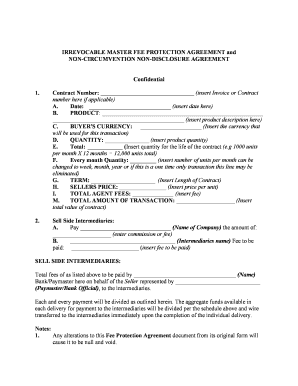
An Irrevocable Master Fee Protection Agreement is a contract used to document and protect a broker, introducer, or intermediary’s right to a fee or commission across multiple transactions or projects. It sets out the fee formula, payment triggers, conditions for payment, and establishes that the fee entitlement is non-revocable except by express written modification. Parties typically use this agreement to avoid future disputes about entitlement, timing, and allocation of commission when transactions close or milestones are met.

Why this Agreement Matters and Its Legal Standing

An Irrevocable Master Fee Protection Agreement clarifies fee entitlement, reduces disputes, and creates an evidentiary record of agreed payment terms. Properly drafted, it limits ambiguity about who is paid and when.

Why this Agreement Matters and Its Legal Standing

Who Commonly Uses This Agreement

Typical users include intermediaries who want a standing arrangement to secure fees across multiple transactions, plus counterparties that prefer a single master agreement to govern recurring deals.

  • Real estate brokers and agents documenting referral and procurement fees across listings and closings.
  • Investment banks, finders, and brokers formalizing compensation for introduced capital or financing transactions.
  • Law firms and corporate counsel negotiating fee allocation in M&A, asset sales, and multi-phase projects.

Core Components to Include in a Professional Agreement

A clear, complete agreement reduces ambiguity. Include discrete sections for parties, fee mechanics, payment triggers, and remedial measures so all stakeholders can administer the arrangement consistently.

Parties

Full legal names and entity types of payor, payee, and any agents; include state of organization and mailing addresses for notices.
Fee Structure

Specify precise fee amounts or percentages, whether fixed or variable, how to calculate gross or net basis, and any caps or floors.

Payment Triggers

Define the exact event that triggers payment (closing, funding, signing, invoice acceptance) and whether partial payments are permitted.

Irrevocability Clause

A sentence making the payee’s entitlement irrevocable except for written amendment, and describing any permitted setoffs.

Representations

Warranties from parties (authority to contract, no conflicting obligations) and indemnities for misrepresentation or double-payment claims.

Execution Details

Signature blocks, date lines, notarization or witness requirements, and choice-of-law and dispute-resolution provisions.

Step-by-Step: Completing the Agreement

Follow a consistent sequence to prepare, approve, and execute the agreement to reduce risk and ensure payment certainty.

  • 01
    Drafting: Assemble parties, fee language, triggers, exhibits, and calculation examples.
  • 02
    Internal Review: Have legal and finance confirm calculation method, tax treatment, and authority to contract.
  • 03
    Execution: Obtain all signatures, dates, and notary/witness steps specified in the document.
  • 04
    Distribution: Provide fully executed copies to payor, payee, counsel, and treasury for payment setup.

How to Configure an Online Signing Workflow

Establish signer order, authentication, and retention settings before sending the agreement to avoid rework and audit gaps.

Field Configuration
Signer Order Sequential | Approve in the specified order
Authentication Email plus SMS code | Increased identity assurance
Attachments Exhibits allowed | Lock after upload
Retention Archive as PDF/A | Store audit trail

Typical Routing and Submission Process

A simple, repeatable flow reduces delays: prepare the file, place fields, route to signers, then archive executed copies and notify treasury.

  • Prepare Document: Attach exhibits and populate fixed fields.
  • Place Signing Fields: Add signature, date, and initial fields where required.
  • Send to Signers: Use defined signer order and authentication.
  • Archive and Notify: Store executed PDF and inform payment team.

Digital Signing and Platform Considerations

Choose a platform that supports secure e-signatures, audit trails, and the file formats you use; verify HIPAA/industry needs where applicable.

  • Formats Supported: PDF, DOCX, and locked PDF/A export
  • Integrations: Salesforce, NetSuite, Microsoft 365, Box
  • Authentication: Email, SMS code, and optional KBA

Security and Compliance Controls to Maintain

Encryption: TLS 1.2/1.3 in transit, AES-256 at rest
HIPAA Support: HIPAA-compliant with BAA required
ESIGN / UETA: Meets ESIGN and UETA criteria
SOC 2: SOC 2 Type II certified
21 CFR Part 11: Compliant for regulated records
Audit Trail: Timestamps, IPs, action history

Common Preparation Errors to Avoid

  • Leaving the effective date blank or inconsistent across exhibits, which can create disputes about when obligations start.
  • Failing to identify the precise payment trigger (closing, funding, or acceptance), leading to ambiguity about when fees become payable.
  • Using vague fee language such as 'reasonable commission' without a calculation method, inviting later disagreement.
  • Not confirming authorized signatories or failing to include a corporate resolution for entity execution, delaying enforceability.

Potential Consequences of an Incorrect Agreement

Fee Forfeiture: May occur if entitlement is not clearly documented
Breach Claims: Subject to contract damages
Double Payment: Risk when multiple claimants exist
Tax Exposure: Backup withholding or reporting errors
Statute Limitations: Claims barred if not timely enforced
Enforceability Risk: Ambiguities reduce court enforceability

Key Deadlines and Timing Expectations

Track effective dates, payment triggers, tax reporting, and dispute windows to ensure timely compliance and payment.

Effective Date:

Enter as MM/DD/YYYY; governs obligations

Payment Trigger:

Payment due upon the contract-specified event

Tax Reporting:

1099-NEC to recipient and IRS due Jan 31

Dispute Window:

Commonly 30–60 days to object after notice

Record Requests:

Respond to audit or document requests promptly

Key Processing Milestones

A sequential milestone view helps teams coordinate drafting, approvals, execution, and payment release.

01

Negotiation Complete

Terms finalized and exhibits attached before signing

02

Execution

All parties sign and date the agreement

03

Record and Notify

Deliver executed copy to payment and legal teams

04

Payment Disbursement

Treasury releases funds per defined trigger

eSignature Vendor Comparison for Executing Fee Agreements

Compare platform pricing and core capabilities that matter for recurring fee agreements and secure recordkeeping; signNow is listed first per platform convention.

signNow DocuSign Adobe Sign PandaDoc HelloSign
Starting Price $8/user/mo $15/user/mo $14/user/mo $19/user/mo $15/user/mo
Free Trial 7-day free trial Varies Varies Varies Varies
Bulk Send Yes Yes Yes Yes No
Audit Trail Yes Yes Yes Yes Yes
HIPAA Compliant Yes Yes Yes No No

Representative Use Cases and Practical Examples

Two concise examples show how parties structure fee protection across different transaction types and outcomes.

Example — Real Estate Referral

A broker documents a 3% fee on sale price to be paid at closing

  • Payment triggers at escrow funding
  • The agreement names escrow agent notice procedures, preventing disputes and enabling direct escrow disbursement to the broker.

Example — Financing Introduction

A finder secures a committed lender and documents a flat finder’s fee payable on funding

  • Fee payable 'upon wired funds to borrower' to remove ambiguity
  • The master agreement includes calculation examples and a tax reporting clause for accurate 1099 handling.

Frequently Asked Questions and Practical Answers

Common questions on enforceability, notarization, revocation, tax reporting, and signer authority are answered below with practical guidance.


Need help? Contact support

be ready to get more
Join over 28 million airSlate SignNow users