Establishing secure connection…Loading editor…Preparing document…

Letter Requesting Attorney General's Opinion on Tax Consultant Agreement

This template is fully customizable. Edit the text, fill out the fields, and send it for signature. Give it a try!
Letter Requesting Attorney General's Opinion on Tax Consultant Agreement

What this letter is and when it is used

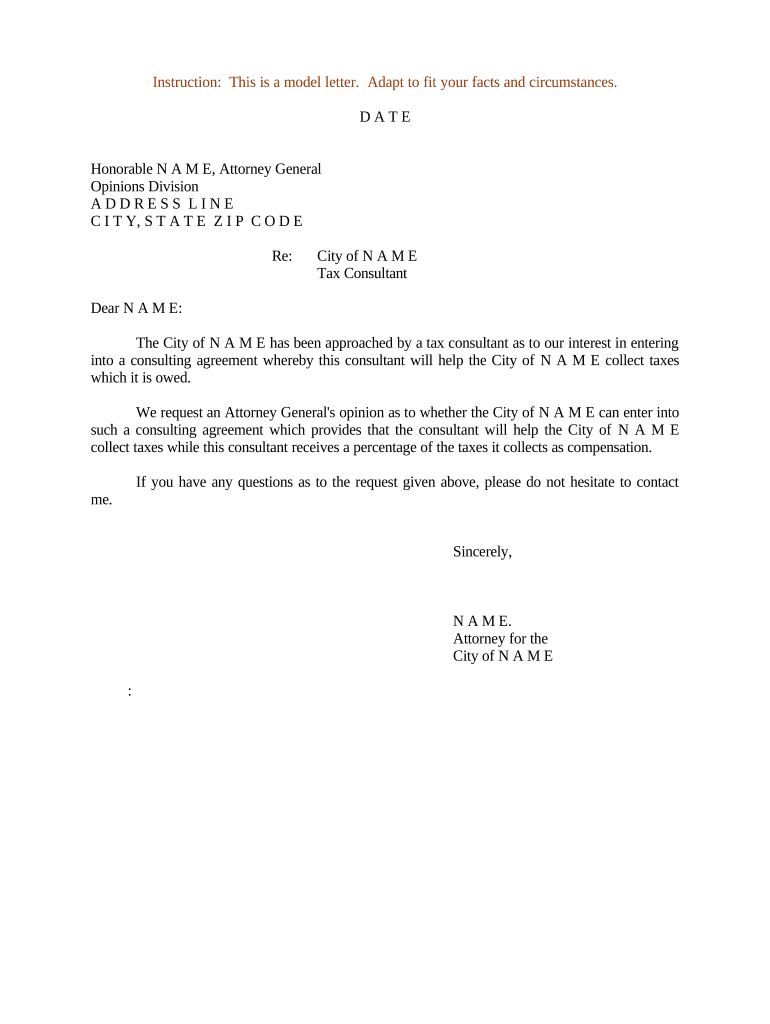
A Letter Requesting Attorney General's Opinion on a Tax Consultant Agreement is a formal written request sent to a state attorney general's office asking for an official interpretation or advisory opinion about the legal effect, enforceability, or public-policy implications of terms in a tax consultant agreement. It typically summarizes the agreement, poses discrete legal questions, and supplies relevant facts and supporting documents so the office can determine whether the arrangement complies with state law or public-interest standards. The letter is informational and seeks guidance; it does not by itself create binding adjudication between private parties.

Why you might request an AG opinion

Requesting an opinion clarifies state law exposure, reduces litigation risk, and documents that a party sought official guidance before acting; it can be especially valuable where statutes or regulations are ambiguous.

Why you might request an AG opinion

Typical users and contributors

Agencies, corporate counsel, tax professionals, and nonprofit compliance officers commonly prepare these letters when legal uncertainty affects public interest or statutory interpretation.

  • State agencies or municipal counsel seeking policy guidance
  • Corporate or nonprofit legal departments assessing compliance risk
  • Tax consultants or their clients requesting clarity before implementing fee structures

Who can sign and submit the request

Authorized Official

A senior official or attorney in the requesting entity (e.g., general counsel) typically signs the letter to attest to factual accuracy and to authorize the request; their signature creates the administrative record and confirms authority to represent the entity.

Tax Consultant

A licensed tax consultant or their authorized representative may sign if acting with client authorization and if the letter discloses the consultant's role and any potential conflicts of interest; include a statement of client consent when applicable.

Core components to include in the letter

A well-structured request combines concise facts, precise legal questions, and full documentation so the attorney general's office can evaluate the issues without follow-up for basic information.

Cover Statement

Identify the requesting party, the purpose of the request, and a one-paragraph summary of the question presented to frame the opinion sought and the scope of review.
Statement of Facts

Provide a clear chronological statement of material facts, parties to the tax consultant agreement, relevant transactions, and any prior correspondence or agency determinations that bear on the question.

Question Presented

List discrete, numbered legal questions the office should answer; each question should focus on a single legal issue to avoid conflating multiple statutory interpretations.

Legal Argument

Summarize applicable statutes, regulations, and controlling case law; cite specific provisions and explain how facts map to legal standards to help the office evaluate your position.

Attachments

Attach the full tax consultant agreement, relevant exhibits, prior opinions, regulatory filings, and any supporting financial or tax data referenced in the facts.

Requested Relief

State what specific guidance or formal opinion you are seeking and whether you request confidentiality or a public advisory opinion, noting potential public-disclosure consequences.

Step-by-step completion workflow

Follow a clear sequence to compile facts, assemble exhibits, and confirm authentication before submitting to the attorney general's office.

  • 01
    Gather Documents: Collect the executed agreement, invoices, correspondence, and related records.
  • 02
    Draft Request: Write a concise facts section and list numbered legal questions.
  • 03
    Internal Review: Have counsel or compliance review for privilege and accuracy.
  • 04
    Submit: Send via the office's accepted method and retain delivery proof.

Recommended digital workflow configuration

Set up an electronic path that preserves authenticity, provides an audit trail, and meets the attorney general office's submission requirements.

Field Configuration
Document Format PDF/A preferred for long-term reproducibility
Authentication Email verification plus optional SMS code
Routing Originator -> Legal Review -> Authorized Signer
Retention Store signed copy with audit trail for minimum retention period

Where and how to submit the request

Determine the attorney general's preferred intake method and follow the required submission protocol to ensure acceptance and proper docketing.

  • Official Mail: Send printed letter and exhibits with return receipt requested
  • Email Submission: Use the AG's published intake email if allowable and include attachments as PDF files
  • Online Portal: Upload documents via the agency's web portal if available
  • In-Person Delivery: Deliver to the office's public intake desk and obtain acceptance proof

Digital submission and eSignature considerations

Confirm the attorney general's acceptance of electronic submissions, and choose eSignature and storage platforms that produce audit trails and tamper-evident PDFs.

  • Authentication Levels: Email, SMS, or stronger KBA depending on office policy
  • Audit Trail: Include IP, timestamp, and action history
  • Integrations: Support for Microsoft 365, Google Workspace, NetSuite, and CRM systems

Typical timelines and processing expectations

Processing times and deadlines vary by state; plan for internal review and possible follow-up requests for additional materials.

Preparation Time:

Allow 1–4 weeks to gather facts and exhibits before submission

Acknowledgement Receipt:

Many offices acknowledge receipt within 7–14 days

Opinion Response Time:

Response times vary by state and caseload; expect weeks to months

Requests for Supplement:

The office may request additional materials, extending review time

Public Disclosure Window:

If opinion is public, anticipate processing time for redaction and posting

Key milestones from draft to opinion

Track submission events to monitor progress and maintain a defensible administrative record.

01

Draft Complete

Assemble facts, exhibits, and questions for review

02

Internal Approval

Obtain signatory authorization and legal sign-off

03

Submission

Deliver by accepted method and log proof

04

Office Review

Monitor acknowledgements, supplement requests, and final opinion posting

How a formal opinion request differs from an informal inquiry

Choose the appropriate submission type depending on whether you need an official, published opinion or preliminary guidance for internal decision making.

Criteria Formal request Informal inquiry
Formality high low
Processing Time longer shorter
Binding Nature advisory only non-binding
Required Attachments full exhibits summary materials

eSignature vendor comparison for submitting and signing the request

Basic pricing and capability comparisons can guide platform selection; signNow is listed first per the comparison format used here.

signNow DocuSign Adobe Sign PandaDoc HelloSign
Starting Price $8/user/mo $15/user/mo $14/user/mo $19/user/mo $15/user/mo
Free Trial 7-day trial Varies Varies Varies Varies
Bulk Send Yes Yes Yes Yes No
Audit Trail Yes Yes Yes Yes Yes
HIPAA Compliant Yes Yes Yes No No

Security and legal compliance elements to document

Encryption: TLS 1.2/1.3; AES-256
Authentication: Email, SMS, or stronger
Audit Trail: IP, timestamp, audit log
HIPAA: BAA required when PHI
ESIGN/UETA: Intent, consent, attribution
Retention: Tamper-evident storage

Key risks and consequences of errors

Incomplete Facts: May prompt refusal
Misstated Law: Leads to inaccurate guidance
Missing Attachments: Delay or rejection
Privilege Loss: Public opinion may waive confidentiality
Notary Errors: Invalid signatures
Late Submission: Missed administrative windows

Common pitfalls to avoid

  • Asking overly broad or hypothetically framed questions that the office cannot resolve without specific facts leads to non-responsive guidance and delays.
  • Failing to attach the complete executed agreement and exhibits forces follow-up requests and can result in the question being dismissed as incomplete.
  • Omitting a clear statement about whether you request confidentiality or a public opinion may lead to unintended public disclosure of sensitive information.
  • Relying on informal email exchanges without preserving certified delivery or audit trails can create evidentiary gaps in the administrative record.

Practical tips for an effective submission

Follow consistent drafting and review practices to improve clarity and reduce the chance of supplementary information requests.

Limit each question to a single issue
Frame questions narrowly so the attorney general's office can provide focused legal analysis without conflating multiple statutory interpretations or factual permutations.
Provide a clear chronology
A concise timeline of events makes it simpler for reviewers to map facts to legal elements and reduces iterative information requests.
Mark privileged material appropriately
Identify confidential attorney-client communications or privileged work product, but be aware that requesting a public opinion may waive privilege for included content.
Keep an audit trail
Retain delivery receipts, signed PDFs with audit logs, and any portal confirmations to document submission and preserve evidence of intent and attribution.

Illustrative scenarios of common requests

Two concise examples show how different fact patterns change the questions submitted and the supporting materials required.

Municipal Tax Incentive Review

A city finance director requests whether a consulting fee structure for tax incentive compliance violates state procurement law.

  • The question focuses on whether the fee is contingent on specific tax outcomes.
  • The submission includes the consultant agreement, invoices, prior procurement guidance, and a redacted client list so the office can evaluate public-policy and statutory procurement considerations.

Nonprofit Fee Arrangement

A nonprofit asks whether payments to a tax advisor for fundraising-related tax counsel create private inurement concerns.

  • The question isolates private benefit and compensation reasonableness.
  • The request attaches articles of incorporation, board minutes, the advisor agreement, and a statement of the organization's tax-exempt purpose to allow review of potential executive compensation or private benefit issues.

Frequently asked questions and quick answers

Answers address common procedural and legal questions about preparing and submitting a request for an attorney general's opinion.


Need help? Contact support

be ready to get more
Join over 28 million airSlate SignNow users