Salutation
Address the clinician by name and correct title to be respectful and precise.
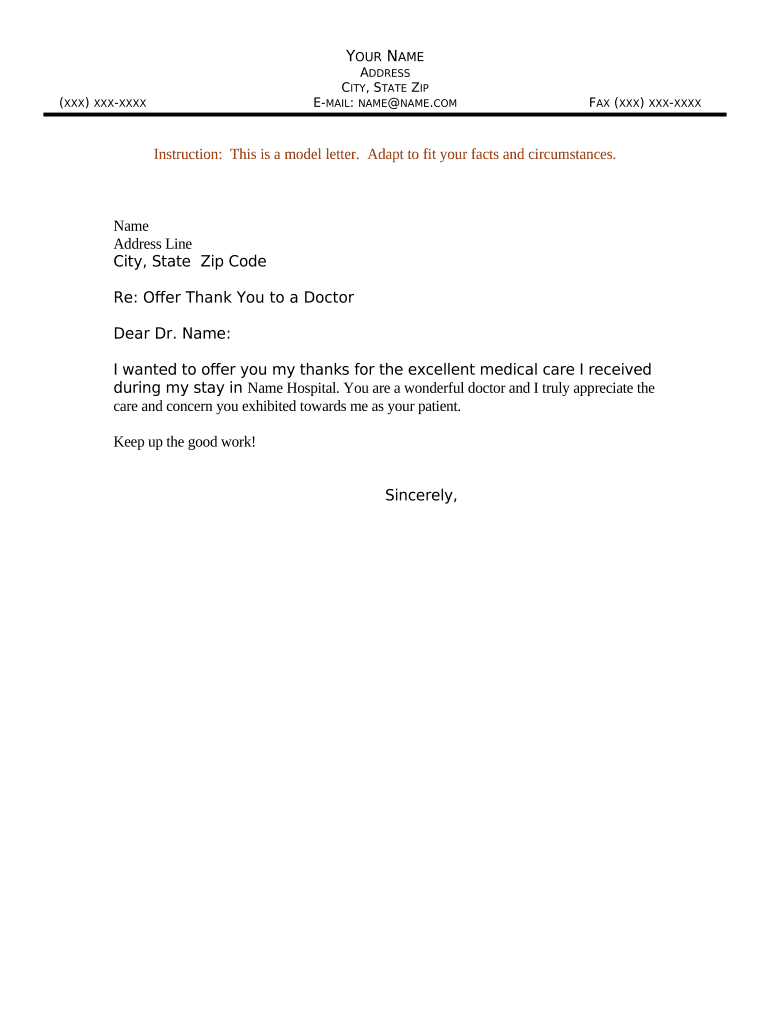
A concise thank-you letter acknowledges care, supports staff morale, and creates a written record of positive patient experience for clinic files or performance reviews. For patient-facing situations, maintain privacy and avoid including protected health information unless you have explicit consent for sharing.

Common authors and recipients include patients, family members, clinic administrators, and hospital patient-experience teams; the letter may be retained in a personnel file or patient record depending on content and privacy considerations.
Keep letters factual, concise, and free of detailed medical history unless the patient consents to include protected health information under HIPAA.
Address the clinician by name and correct title to be respectful and precise.
Identify yourself and the date or occasion of care so recipients can place your note.
Mention particular actions, explanations, or behaviors that mattered to you.
One or two sentences describing the encounter without disclosing sensitive PHI unless authorized.
Reiterate thanks and include a polite sign-off that reflects your relationship to the provider.
Typed name, handwritten signature for paper copies, and contact info if the clinic may follow up.
| Field | Configuration |
|---|---|
| Message Body | Make required; limit character count to avoid excessive PHI |
| Patient Consent | Add checkbox to confirm permission to include any clinical details |
| Recipient Verification | Require clinic email or secure portal address |
| Retention | Set automatic save to patient record or HR folder as appropriate |
Choose delivery channels that preserve confidentiality and provide an audit trail when necessary.
For electronic delivery, enable basic authentication and a retention policy; integrate with clinic systems if you need a durable record.
Send within 1–2 weeks to make gratitude timely and relevant.
Submit before scheduled performance review if you want it considered.
Attach within 30 days if the letter is to be included in the electronic health record.
Preserve if the letter becomes relevant to a complaint or legal process; consult counsel.
Retain per applicable retention schedules, especially if stored in personnel files.
Save as PDF for fixed-format records; use DOCX for editable copies. PDFs preserve layout and are suitable for archival.
Attach a copy of the appointment confirmation or a brief consent if the letter includes clinical details or is for public use.
Store in a secure clinic folder, personnel file, or patient portal depending on content and purpose.
Limit access to personnel folders or EHR entries to authorized staff to meet privacy obligations.
The patient or authorized family member should sign the letter. If a family member writes on behalf of the patient, indicate the relationship and, where required, include proof of authority.
A practice manager or patient-experience officer can receive and archive letters; they should not alter the author's message and must maintain confidentiality.
A patient notes the date of surgery and thanks the surgeon for clear explanations
A family member thanks a primary care team for coordinated care over months
| signNow | DocuSign | Adobe Sign | PandaDoc | HelloSign | |
|---|---|---|---|---|---|
| Starting Price | $8/user/mo | $15/user/mo | $14/user/mo | $19/user/mo | $15/user/mo |
| Free Trial | 7-day free trial | Varies | Varies | Varies | Varies |
| Bulk Send | Yes | Yes | Yes | Yes | No |
| Audit Trail | Yes | Yes | Yes | Yes | Yes |
| HIPAA Compliant | Yes | Yes | Yes | No | No |