Establishing secure connection…Loading editor…Preparing document…

Louisiana Detailed Descriptive List for Tutorship

This template is fully customizable. Edit the text, fill out the fields, and send it for signature. Give it a try!
Louisiana Detailed Descriptive List for Tutorship

What the Louisiana Detailed Descriptive List for Tutorship Is

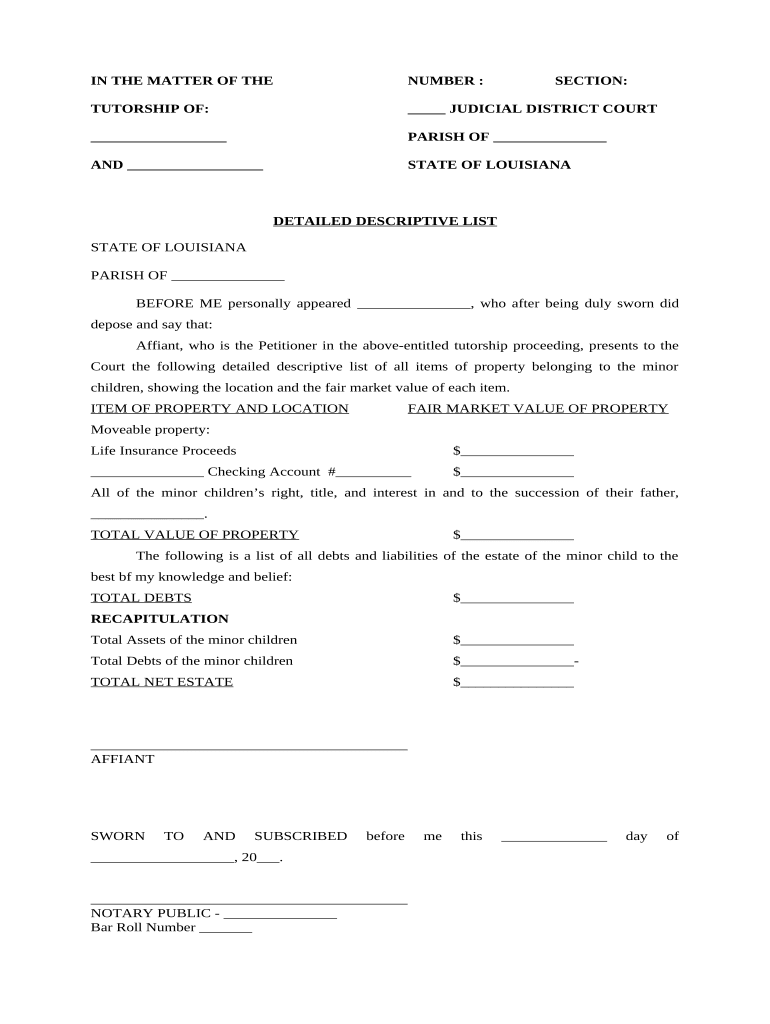
The Louisiana Detailed Descriptive List for Tutorship is a court-focused inventory prepared when a tutor or guardian is appointed for a minor or interdicted adult. It itemizes the ward's assets, liabilities, income sources, and property locations in a standardized format for the court record. Judges and court clerks use the list to evaluate bond amounts, authorize administration steps, and set accounting requirements. The list typically accompanies the initial tutorship petition or opening inventory and becomes part of the official case file under court supervision.

Why an Accurate Detailed Descriptive List Matters in Tutorship

A complete, accurate list reduces disputes, clarifies estate value for bond calculation, and demonstrates the tutor's transparency to the court and interested parties in Louisiana tutorship proceedings.

Why an Accurate Detailed Descriptive List Matters in Tutorship

Who Prepares and Relies on the List

Court-appointed tutors, guardians, estate attorneys, and clerks typically prepare or review the Detailed Descriptive List during initial tutorship proceedings.

  • Tutors and guardians responsible for managing a ward's assets and filing inventories with the court.
  • Estate or family law attorneys preparing petitions, inventories, and supporting documentation for court review.
  • Court clerks and judges who assess bond, oversee accounting, and approve inventory submissions.

Other stakeholders include accountants, banks, and third-party custodians asked to verify balances or provide statements for the inventory.

Security and Compliance Considerations

Encryption: TLS 1.2/1.3 in transit; AES-256 at rest
HIPAA: BAA required for PHI-containing lists
Audit Trail: Timestamps, IP addresses, and action log
Authentication: Email, SMS, KBA or advanced methods
Access Control: Role-based permissions and document roles
Certifications: SOC 2 Type II and ISO 27001 available

Consequences of Errors or Omissions

Court Sanctions: Fines or admonishment by court
Bond Adjustment: Higher bond or collateral requirement
Fiduciary Liability: Personal liability for losses
Probate Delays: Extended hearings and administrative delay
Tax Consequences: Unreported assets may trigger audits
Document Rejection: Clerk may reject incomplete submission

Common Preparation Challenges to Avoid

  • Incomplete asset descriptions that omit account numbers or precise locations create verification delays and can force supplemental filings with the court.
  • Using inconsistent names or outdated addresses between bank records and the list may trigger identity checks and require corrected inventories.
  • Failing to attach required supporting statements, appraisals, or account ledgers often leads to requests for additional documentation from the court.
  • Misclassifying jointly held property or community assets can result in disputes about ownership and improper distribution actions.

Step-by-Step: Completing and Filing the List

Follow this sequence to complete and file the Detailed Descriptive List accurately with the court.

  • 01
    Gather records: Collect bank statements, titles, appraisals, and account ledgers
  • 02
    Itemize assets: Describe each item, include value, location, and owner
  • 03
    Attach proofs: Include statements, appraisals, or affidavits as exhibits
  • 04
    File with court: Submit list with petition and certify under penalty

How the Preparation and Filing Workflow Operates

This flow describes who prepares, signs, and files the list and how the court and third parties receive it.

  • Prepare: Tutor compiles inventory and supporting documents
  • Review: Attorney or court reviewer checks completeness
  • Sign: Tutor signs; notary or witness added if required
  • File: Submit to clerk and serve interested parties

Essential Elements of a Professional Detailed Descriptive List

A professional Detailed Descriptive List combines clear asset descriptions, verifiable evidence, and a signing block that meets Louisiana court requirements for tutorship proceedings.

Asset Description

Provide a specific description for each item including account numbers, physical location, approximate market value, and any encumbrances to allow precise identification and audit by the tutor and the court.
Valuation

State the valuation method used — bank balance, recent appraisal, or certified estimate — and attach supporting appraisal reports or valuation statements where material value or dispute exists.

Ownership

Record legal ownership status (sole, joint, community, trust) and note co-owner names and contact details to clarify rights and responsibilities during tutorship administration.

Liabilities

List debts, mortgages, liens, and recurring obligations with creditor names and account references to ensure accurate net estate calculation for bond and accounting purposes.

Supporting Documents

Attach bank statements, vehicle titles, real property deeds, insurance policies, and recent bills; label exhibits clearly and reference them in the inventory for court review.

Signature Block

Include signature lines for the tutor, attorney, and notary or witnesses as required by Louisiana practice; add dates and printed names for attribution and verification.

Practical Tips to Reduce Errors and Delays

Adhering to best practices reduces errors and accelerates court acceptance of the inventory in tutorship cases.

Use current statements and appraisals
Gather documents dated within the last 60 days where possible; older valuations should include an explanatory note and justification to prevent valuation disputes at accounting.
Standardize descriptions and numbering
Assign exhibit numbers and consistent item identifiers to each asset; cross-reference these identifiers in supporting documents, bank statements, and court filings to streamline review.
Confirm ownership data with third parties
Secure written confirmations from banks, title companies, and custodians to corroborate balances and titles; include contact information for quick follow-up by the court or administrator.
Retain originals and certified copies
Keep original documents and provide certified copies to the court as required; originals remain with the tutor except where the court orders retention or custody by another party.

Key Filing and Reporting Deadlines to Track

Key dates influence when the list must be filed and when subsequent accountings are due under court schedule.

Initial Filing:

File with tutorship petition or within court-ordered timeframe

Inventory Update:

Update annually or when material changes occur

Accounting Deadlines:

Periodic accountings per court order, often yearly

Notary/Authentication:

Complete notarization or witness steps before filing

Document Retention:

Retain copies according to court and regulatory rules

eSignature Vendor Pricing and Feature Comparison

The table below compares typical starting prices and common plan capabilities for document signing platforms often used to complete and deliver tutorship inventories.

signNow DocuSign Adobe Sign PandaDoc HelloSign
Starting Price $8/user/mo $15/user/mo $14/user/mo $19/user/mo $15/user/mo
Free Trial Yes, 7-day trial Yes Yes Yes Yes
Bulk Send Yes Yes Yes Yes No
Audit Trail Yes Yes Yes Yes Yes
HIPAA Compliant Yes Yes Yes No No
Envelope Cap No cap 100 envelopes/user/year Varies by plan Varies by plan Varies by plan

Frequently Asked Questions and Troubleshooting

Answers to common procedural and technical questions about preparing, signing, and submitting the Detailed Descriptive List in Louisiana.


Need help? Contact support

be ready to get more
Join over 28 million airSlate SignNow users