Establishing secure connection…Loading editor…Preparing document…

Mutual Aid Contract

This template is fully customizable. Edit the text, fill out the fields, and send it for signature. Give it a try!
Mutual Aid Contract

What a Mutual Aid Contract Is and When It Applies

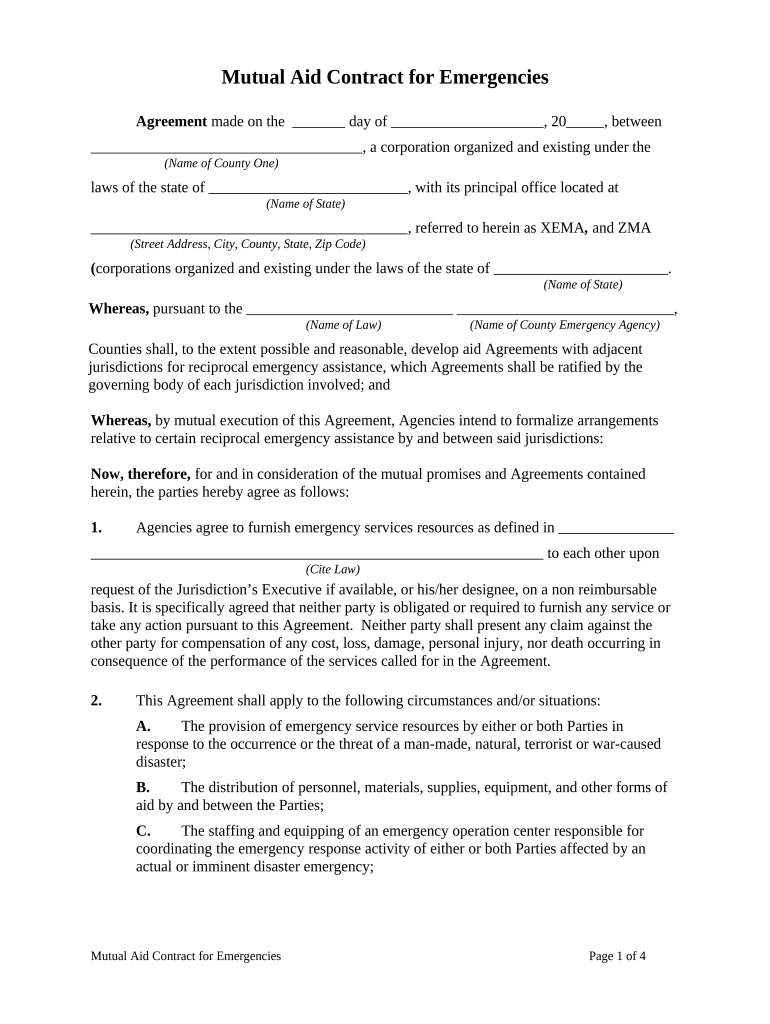
A Mutual Aid Contract is a written agreement between two or more organizations—often local governments, utilities, healthcare providers, or private vendors—that sets terms for sharing personnel, equipment, or services during emergencies or planned operations. The document defines activation procedures, scope of assistance, cost and reimbursement methods, insurance and indemnity obligations, termination rights, and the governing law. It identifies authorized signatories and recordkeeping requirements that support audits and grant reporting. Mutual Aid Contracts are used to coordinate timely response while clarifying financial and legal responsibilities between parties.

Why a Clear Mutual Aid Contract Matters

A well-drafted Mutual Aid Contract reduces deployment delays, clarifies who pays for what, narrows liability exposure, and documents authority for auditors and grant administrators.

Why a Clear Mutual Aid Contract Matters

Organizations That Commonly Rely on Mutual Aid Contracts

Local governments, utilities, emergency services, and private contractors commonly use Mutual Aid Contracts to formalize assistance arrangements.

  • Municipalities and counties coordinating disaster response and public works support during declared emergencies.
  • Utility companies arranging mutual restoration assistance and equipment sharing during outages.
  • Hospitals and healthcare coalitions planning surge staffing, transport, and alternate care site support.

Core Provisions Every Professional Mutual Aid Contract Should Include

The contract's main clauses create operational clarity and reduce post-event disagreements by allocating responsibilities, costs, and legal exposure among participating parties.

Activation

Define activation triggers, request procedures, required approvals, and expected response timelines to ensure consistent mobilization.
Scope

List services, personnel, equipment types, and geographic boundaries with measurable performance expectations and exclusions.

Costs

Specify rates, invoicing cadence, allowable expenses, payment timing, and record requirements to avoid billing disputes.

Liability

Allocate risk through indemnity language, insurance minimums, and procedures for worker injuries and third-party claims.

Termination

State termination rights, notice periods, and procedures for returning equipment and settling outstanding invoices.

Recordkeeping

Set required records, retention periods, and audit access to support reimbursements and grant compliance.

Step-by-Step: Preparing and Executing a Mutual Aid Contract

Follow these steps to prepare, complete, and execute a Mutual Aid Contract correctly and consistently.

  • 01
    Draft: Define scope, activation triggers, resources, reimbursement, liability, and duration.
  • 02
    Review: Have legal counsel and finance review terms and budget impacts.
  • 03
    Approve: Obtain required internal approvals and confirm signatory authority in writing.
  • 04
    Execute: Sign, notarize or RON if required, distribute fully executed copies.

Technical and Platform Considerations for Electronic Execution

Choose a platform that supports required file formats, provides strong signer authentication, and integrates with your records systems.

  • File Types: PDF, DOCX, and fillable forms supported.
  • Integrations: Salesforce, NetSuite, Google Workspace, Microsoft 365.
  • Authentication: Email, SMS, KBA, and 2FA options.

Key Security and Compliance Controls to Include

Encryption: TLS 1.2/1.3 in transit, AES-256 at rest.
Audit Trail: Complete timestamped logs and IP evidence.
Authentication: Support email, SMS, and advanced 2FA.
HIPAA: BAA required for PHI; restrict access.
Certifications: SOC 2, ISO 27001, PCI DSS certifications.
Retention: Tamper-evident storage and reproducible records.

Common Legal and Financial Risks to Address

Missing Signature: Agreement may be voidable.
Unauthorized Signer: Contracts unenforceable against organization.
Late Invoicing: Payment delays and interest accrual.
Insurance Gaps: Claims may be unpaid.
Regulatory Noncompliance: Grant reimbursements denied.
Data Breach: Legal penalties and reputational harm.

Time-Sensitive Elements to Include in the Contract

Key timing elements include activation notice windows, invoice deadlines, records requests, and any statute-based retention triggers.

Activation Notice Period:

Specify hours or days required for notice before deployment.

Invoice Submission Deadline:

State terms (e.g., 30 days) and required documentation.

Record Production:

Provide records within specified days for audits or reimbursement.

Insurance Notice:

Report claims within insurer's required timeframe.

Contract Review Cycle:

Schedule periodic reviews and update triggers annually.

Frequently Asked Questions About Mutual Aid Contracts

Practical answers for common issues about signatures, notarization, amendments, authority, and dispute steps.


Need help? Contact support

Comparing Common eSignature Options for Mutual Aid Contract Workflows

Pricing and feature differences among major eSignature providers can affect cost, compliance, and high-volume execution for Mutual Aid Contracts.

signNow DocuSign Adobe Sign PandaDoc HelloSign
Starting Price $8/user/mo $15/user/mo $14/user/mo $19/user/mo $15/user/mo
Free Trial Yes, 7-day free trial Varies Varies Yes, limited Yes, limited
Bulk Send Yes (Business Premium) Available on higher tiers Available on higher tiers Available No
Audit Trail Yes Yes Yes Yes Yes
HIPAA Compliant Yes Yes Yes No No
Envelope Cap No envelope cap 100 envelopes/user/year Varies by plan Varies by plan Varies by plan
be ready to get more
Join over 28 million airSlate SignNow users