Prepared by U.S. Legal Forms, Inc.
Copyright 2016 - U.S. Legal Forms, Inc.
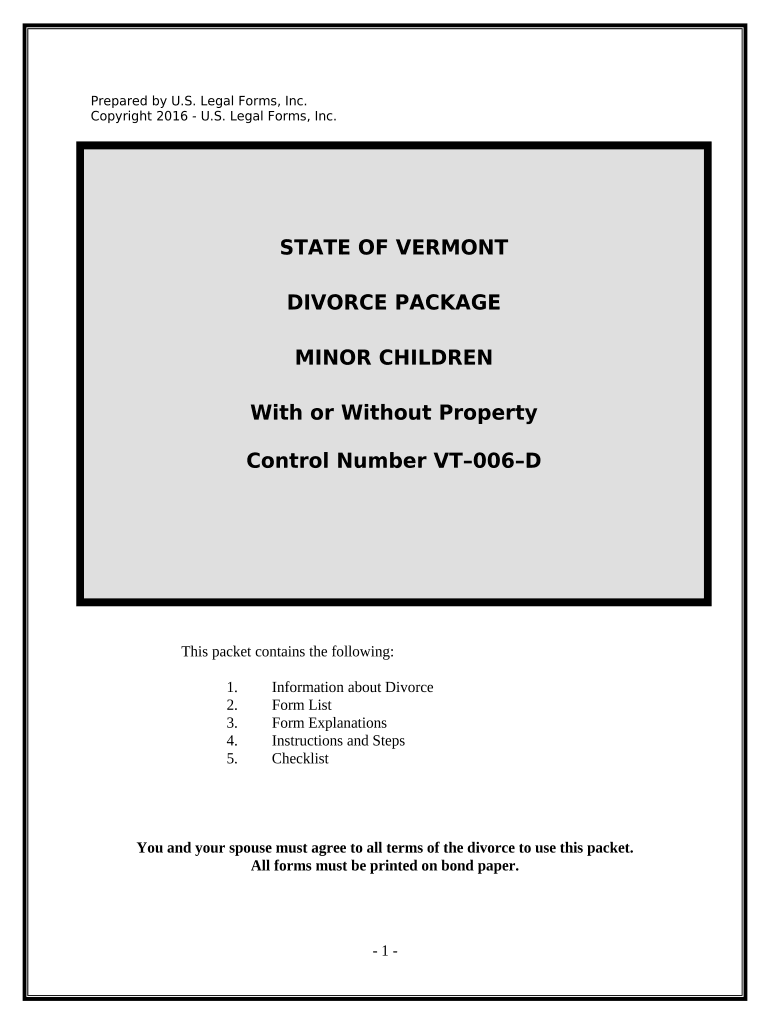
STATE OF VERMONT
DIVORCE PACKAGE
MINOR CHILDREN
With or Without Property
Control Number VT–006–D
This packet contains the following:
1. Information about Divorce
2. Form List
3. Form Explanations
4. Instructions and Steps
5. Checklist
You and your spouse must agree to all terms of the divorce to use this packet.
All forms must be printed on bond paper.
- 1 -
INFORMATION ABOUT DIVORCE
1. WHO MAY USE THESE FORMS: This packet is designed for the sole purpose of
obtaining an uncontested divorce. This packet is only of use to you if you and your
spouse are willing to agree to all the terms and conditions of your divorce. You must
communicate with your spouse and keep him or her advised as to each step in the
process. If you cannot agree, you will become involved in a contested divorce, which is
beyond the scope of this packet. To use this divorce package to file for divorce in
Vermont, all of the following must be true:
(a) You or your spouse must have been a resident of Vermont for at least six
months prior to the filing of the divorce action.
(b) You and your spouse must agree to all of the terms in the division of
assets/property in the Separation and Property Settlement Agreement .
(c) There are minor children of the marriage.
(d) You and your spouse have lived apart for six consecutive months and the
resumption of marital relations is not reasonably probable.
2. THE BASICS: In a typical divorce, you must satisfy two basic requirements before you
can file for divorce. Those requirements include the residency requirements and
appropriate grounds for divorce . These requirements are discussed in detail in their
respective sections, below.
In addition, you must agree with your spouse to become divorced, and agree to all the
terms of the dissolution of marriage in filling out the forms, including property division.
You will complete and file the forms (see detailed instructions, below) in the Superior
Court (Family Court Division) for the county in which you or your spouse resides.
15 VSA § 593.
3. RESIDENCY REQUIREMENTS: A complaint for divorce or annulment of marriage
may be brought if either party to the marriage has resided within the state for a period of
six months or more , but a divorce shall not be decreed for any cause, unless the plaintiff
or the defendant has resided in the state one year next preceding the date of final
hearing . Temporary absence from the state because of illness, employment without the
state, service as a member of the armed forces of the United States, or other legitimate
and bona fide cause, shall not affect the six months' period or the one year period
specified in the preceding sentence, provided the person has otherwise retained residence
in this state. 15 VSA § 592
Complaints for divorce shall be brought in the county in which the parties or one of them
resides. 15 VSA § 593
- 2 -
4. GROUNDS FOR DIVORCE: To obtain a no-fault divorce in Vermont, the spouses
must have lived apart from each other for six consecutive months, and the court must
conclude that the resumption of marital relations is not reasonably probable. The court
will conclude that resumption is not probable unless one of the spouses objects. 15 VSA
§ 551.
5. WAITING PERIODS: Except under extraordinary circumstances, no divorce action
shall be heard on its merits until after the expiration of six months from the date of
service, if the custody of a child or children of either party is involved.
A decree of divorce shall become absolute at the expiration of three months (the “nisi
period”) from the entry thereof but, in its discretion, the court may fix an earlier date
upon which the decree shall become absolute. If one of the parties dies prior to the
expiration of the “nisi period,” the decree shall be deemed absolute immediately prior to
death. 15 VSA § 554
6. LEGAL SEPARATION: A legal separation, forever or for a limited time, may be
granted for any of the causes for which an absolute divorce may be granted. A legal
separation is different than a divorce. A legal separation is a court determination of the
rights and responsibilities of a husband and wife arising out of the marital relationship. A
decree of legal separation does not terminate the marital status of the parties, and the
parties are not free to marry again. 15 VSA § 555.
ATTENTION: This divorce package DOES NOT include forms for a legal
separation.
7. ALIMONY/ SPOUSAL MAINTENANCE: Because this is an agreed divorce, you will
decide issues of alimony, also known as "spousal maintenance" – the periodic payment of
money from one spouse to the other on a temporary or permanent basis. The forms in
this no-fault divorce package assume that no alimony will be paid and none will be
sought – but you may add provisions for alimony if you desire.
In a contested case, the court may order either spouse to make maintenance payments,
either rehabilitative or permanent in nature, to the other spouse if it finds that the spouse
seeking maintenance:
a. Lacks sufficient income, property, or both, to provide for his or her
reasonable needs, and
b. Is unable to support himself or herself through appropriate employment at
the standard of living established during the marriage or is the custodian of
a child of the parties.
- 3 -
The maintenance order shall be in such amounts and for such periods of time as the court
deems just, after considering all relevant factors including, but not limited to:
i. The financial resources of the party seeking maintenance, the property
apportioned to the party, the party's ability to meet his or her needs
independently, and the extent to which a provision for support of a child
living with the party contains a sum for that party as custodian;
ii. The time and expense necessary to acquire sufficient education or training
to enable the party seeking maintenance to find appropriate employment;
iii. The standard of living established during the marriage;
iv. The duration of the marriage;
v. The age and the physical and emotional condition of each spouse;
vi. The ability of the spouse from whom maintenance is sought to meet his or
her reasonable needs while meeting those of the spouse seeking
maintenance; and
vii. Inflation with relation to the cost of living. 15 VSA. § 752
A contested divorce is beyond the scope of this divorce package. You should consult a
local attorney regarding the possibilities concerning alimony if you have questions or
foresee conflict regarding this issue.
8. DISTRIBUTION OF PROPERTY: In a divorce, the property such as land, house,
buildings, and items of personal property owned by the couple is divided between the
parties. Debts owed are also allocated to one party or the other, or both. This is
accomplished by means of a Separation and Property Settlement Agreement. You and
your spouse must agree to the property and debt division and memorialize your
agreement in the Separation and Property Settlement Agreement , which will be
incorporated by reference into the Final Order of Divorce that ultimately ends your
marriage. You may agree to divide the property any way you like, as long as basic
fairness is maintained, and you both agree. If you cannot agree on any item of this
division, the proceedings will transform into a contested divorce . A contested divorce is
beyond the scope of this packet.
In a contested case, the court shall settle the rights of the parties to their property, by
including in its judgment provisions which equitably divide and assign the property. All
property owned by either or both of the parties, however and whenever acquired, shall be
subject to the jurisdiction of the court. Title to the property, whether in the names of the
husband, the wife, either parties, or a nominee, shall be immaterial, except where
equitable distribution can be made without disturbing separate property.
- 4 -
In making a property settlement, the court may consider all relevant factors, including but
not limited to:
(a) The length of the marriage;
(b) The age and health of the parties;
(c) The occupation, source and amount of income of each of the parties;
(d) Vocational skills and employability;
(e) The contribution by one spouse to the education, training, or increased
earning power of the other;
(f) The value of all property interests, liabilities, and needs of each party;
(g) Whether the property settlement is in lieu of or in addition to maintenance;
(h) The opportunity of each for future acquisition of capital assets and
income;
(i) The desirability of awarding the family home or the right to live there for
reasonable periods to the spouse having custody of the children;
(j) The party through whom the property was acquired; and
(k) The contribution of each spouse in the acquisition, preservation, and
depreciation or appreciation in value of the respective estates, including
the nonmonetary contribution of a spouse as a homemaker;
(l) The respective merits of the parties. 15 VSA. § 751
9. PARENT EDUCATION PROGRAM: The Court may order the parties to a divorce
action to attend an educational program designed to educate the parents on the effects of
divorce upon children.
10. PARENTAL RIGHTS AND RESPONSIBILITIES: The court may order parental
rights and responsibilities to be divided or shared between the parents on such terms and
conditions as serve the best interests of the child. When the parents cannot agree to divide
or share parental rights and responsibilities, the court shall award parental rights and
responsibilities primarily or solely to one parent. In making an order awarding parental
rights and responsibilities, the court shall be guided by the best interests of the child, and
shall consider at least the following factors:
(a) The relationship of the child with each parent and the ability and
disposition of each parent to provide the child with love, affection and
guidance;
(b) The ability and disposition of each parent to assure that the child
receives adequate food, clothing, medical care, other material needs and a
safe environment;
(c) The ability and disposition of each parent to meet the child's present and
future developmental needs;
(d) The quality of the child's adjustment to the child's present housing,
school and community and the potential effect of any change;
- 5 -
(e) The ability and disposition of each parent to foster a positive relationship
and frequent and continuing contact with the other parent, including
physical contact, except where contact will result in harm to the child or to
a parent;
(f) The quality of the child's relationship with the primary care provider, if
appropriate given the child's age and development;
(g) The relationship of the child with any other person who may
significantly affect the child;
(h) The ability and disposition of the parents to communicate, cooperate
with each other, and make joint decisions concerning the children where
parental rights and responsibilities are to be shared or divided.
(i) In addition, the court shall consider evidence of abuse, and the impact of
the abuse on the child and on the relationship between the child and the
abusing parent.
The court shall not apply a preference for one parent over the other because of the sex of
the child, the sex of a parent or the financial resources of a parent. 15 VSA § 665
Any agreement between the parents which divides or shares parental rights and
responsibilities shall be presumed to be in the best interests of the child. An agreement
between the parties which is a complete agreement on parental rights and responsibilities
shall include provisions that address at least the following:
(a) Physical living arrangements;
(b) Parent child contact;
(c) Education of the minor child;
(d) Medical, dental and health care;
(e) Travel arrangements;
(f) Procedures for communicating about the child's welfare; and
(g) If parental rights and responsibilities are to be shared or divided, a
procedure for resolving disputes. Such procedures may include but shall
not be limited to mediation and binding arbitration.
If the court finds that an agreement between the parents is not in the best interests of the
child or if the court finds that an agreement was not reached voluntarily the court shall
refuse to approve the agreement. 15 VSA § 666
11. PARENT CHILD CONTACT: The legislature finds and declares as public policy that
after parents have separated or dissolved their marriage it is in the best interests of their
minor child to have the opportunity for maximum continuing physical and emotional
contact with both parents, unless direct physical harm or significant emotional harm to
the child or a parent is likely to result from such contact. 15 VSA § 650
- 6 -
12. CHILD SUPPORT: The legislature finds and declares as public policy that parents
have the responsibility to provide child support and that child support orders should
reflect the true costs of raising children and approximate insofar as possible the standard
of living the child would have enjoyed had the marriage not been dissolved. 15 VSA §
650
Guidelines for child support have been established which reflects the percent of
combined available income which parents living in the same household in Vermont
ordinarily spend on their children. The amounts of child support determined under the
guideline shall be presumed to be the total support obligation of parents. 15 VSA § 654
Except in situations where there is shared or split physical custody, the total child support
obligation shall be divided between the parents in proportion to their respective available
incomes and the noncustodial parent shall be ordered to pay, in money, his or her share of
the total support obligation to the custodial parent. The custodial parent shall be
presumed to spend his or her share directly on the child. 15 VSA § 656
The total support obligation shall be presumed to be the amount of child support needed.
Upon request of a party, the court shall consider the following factors in respect to both
parents. If, after consideration of these factors, the court finds that application of the
guidelines is unfair to the child or to any of the parties, the court may adjust the amount
of child support:
(a) The financial resources of the child.
(b) The financial resources of the custodial parent.
(c) The standard of living the child would have enjoyed had the marital
relationship not been discontinued.
(d) The physical and emotional condition of the child.
(e) The educational needs of the child.
(f) The financial resources and needs of the noncustodial parent.
(g) Inflation.
(h) The costs of meeting the educational needs of either parent, if the costs are
incurred for the purpose of increasing the earning capacity of the parent.
(i) Extraordinary travel and other travel-related expenses incurred in
exercising the right to parent-child contact.
(j) Any other factors the court finds relevant.
If the parties agree, the court may include in the child support order an additional amount
designated for the purpose of providing for postsecondary education. 15 VSA § 659
13. NAME CHANGE: Upon granting a divorce to a woman, unless good cause is shown to
the contrary, the court may allow her to resume her maiden name or the name of a former
husband. 15 VSA § 558
- 7 -
The court may change the names of the minor children of divorced parents when
application for that purpose is made in the complaint for divorce. 15 VSA § 559
- 8 -
FORMS LIST
This packet utilizes the following forms:
1. Cover Sheet ( VT-OF-800 )
2. Summons, Complaint for Divorce, Notice of Appearance and Affidavit
of Child Custody ( VT-OF-836 )
3. Child Support Order ( VT-OF-802 )
4. Health Department Vermont Record of Divorce or Annulment ( VT-
OF-838 )
5. Affidavit of Military Service ( VT-OF-231 )
6. Notice and Acknowledgement of Receipt of Summons and Complaint
( VT-OF-820 )
7. Answer to Divorce Complaint and Notice of Appearance ( VT-OF-
837 )
8. Affidavit of Income and Assets ( VT-OF-813 )
9. * Child Support Worksheet
10. Separation and Property Settlement Agreement ( VT-DO-11A )
11. Parental Rights and Responsibilities Agreement ( VT-OF-825 )
12. Confidential Information Form ( VT-OF-849 )
* This form must be obtained from the Clerk of Court in the County of filing . There may
be additional county-specific forms required for filing. Contact the Clerk of Court in the
County of filing to determine whether additional forms are necessary.
- 9 -
FORM EXPLANATIONS
All forms utilized by this package are identified below. You must sign all documents with a
space for signature of a Notary Public in front of a Notary Public.
1. Cover Sheet (VT-OF-800) – An official information document for the
court’s files. When you go to the court to file your documents, ask the court clerk if there
is an updated or county-specific form.
2. Summons, Complaint for Divorce, Notice of Appearance, and
Affidavit of Child Custody (VT-OF-836) – This four-part document includes the
Summons (the official notification to your spouse that the divorce suit has been filed), the
Complaint for Divorce (the document in which you are asking the court to grant your
divorce), and your Notice of Appearance (whereby you present yourself to the court and
submit your mailing address), an your Affidavit of Child Custody (whereby you provide
information to the Court regarding minor children of the marriage).
3. Child Support Order (VT-OF-802) – This document is used by the
Court to detail the specific findings regarding the amount of child support to be paid and
the terms of the award.
4. Health Department Vermont Record of Divorce or Annulment (VT-OF-838) – This
document is used for record keeping purposes only.
5. Affidavit of Military Service (VT-OF-231) – This document is used to provide the
Court with information regarding the military status of a party.
6. Notice and Acknowledgement of Receipt of Summons and Complaint (VT-OF-820)
– This document is used to certify to the Court that the Defendant received a copy of the
Complaint and Summons filed in an action for divorce.
7. Answer to Divorce Complaint and Notice of Appearance (VT-OF-837) – This form is
used by the Defendant to enter an appearance in an action for divorce and to respond to
the allegations contained in the Complaint.
8. Affidavit of Income and Assets (VT-OF-813) – This form is used to provide the Court
with a detailed report of all income and assets of the parties.
- 10 -
9. * Child Support Worksheet – This form is used to calculate the correct amount of child
support to be paid in a divorce action involving minor children. This document is
available from the Clerk of Court.
10. Separation and Property Settlement Agreement (VT-DO-11A) – This form is used to
detail the agreements reached between the parties regarding such things as the division of
assets and debts of the marriage, child support and custody issues. This agreement, if
approved by the judge, will be incorporated into the Final Divorce Order in your case.
11. Parental Rights and Responsibilities Agreement (VT-OF-825) – This form is a
stipulated agreement by the parties regarding custody, visitation, and other necessary
arrangements for care of the minor children of the parties.
12. Confidential Information Form (VT-OF-849) – This form is used to provide necessary
but confidential information, particularly social security numbers, to the court such that it
is not revealed as part of the public record of the case.
Note: * These forms must be obtained from the Clerk of Court in the County of filing . There
may be additional county-specific forms required for filing. Contact the Clerk of Court
in the County of filing to determine whether additional forms are necessary.
- 11 -
INSTRUCTIONS AND STEPS
Note: If a form con tains a space for the signature of a Notary Public, it must be signed by you
(and if necessary by your spouse) in front of a Notary Public, who must notarize the document.
Prepare an original and several copies of each of your completed documents. Your spouse
should have a copy of everything you file, stamped “filed” by the clerk. You should keep copies
and the court must have originals.
STEP 1: The filing party should complete the following forms:
Cover Sheet (VT-OF-800)
Summons, Complaint for Divorce, Notice of Appearance and Affidavit of
Child Custody (VT- OF-836)
Health Department Vermont Record of Divorce or Annulment (VT-OF-
838)
Affidavit of Military Service (VT-OF-231)
Confidential Information Form (VT-OF-849)
( * These forms must be obtained from the Clerk of Court in the County of filing.)
STEP 2: Once completed, make several copies (at least three) of all forms and then the
above-listed forms should be filed with the Clerk of Court in the County of filing.
Have any extra copies not needed by the court stamped “Filed” by the clerk. You
and your spouse should keep these stamped “Filed” copies for your records and
for future use in the case. A filing fee is paid at this time. You must call ahead to
determine the amount of the filing fee and accepted methods of payment.
STEP 3: Your spouse must next be served with copies of the above-filed documents.
Deliver a stamped “Filed” copy of all filed documents in the case, along with a
Notice and Acknowledgement of Receipt of Summons and Complaint (VT- OF-
820), Answer to Divorce Complaint and Notice of Appearance (VT- OF-837) .
Instruct your spouse to complete both documents and return them to the Clerk of
Court for filing. It is important to remember that your spouse must agree with all
of the allegations contained in the Complaint for Divorce , or the matter becomes a
contested divorce, which is beyond the scope of this package. If you collaborated
with your spouse in the development of the Complaint, this should not be a
problem.
After completion, your spouse may mail these forms directly to or hand-deliver
them to the court (or return them to you for copying and subsequent filing). In any
event, be sure that all necessary copies are made for both parties and stamped
”Filed” by the court. If these documents are mailed in rather than hand-delivered,
a self-addressed, postage-paid envelope must be included for the court to return
any “stamped ‘filed’” copies of documents.
- 12 -
STEP 4: In cooperation with your spouse, each party should complete and file with the
Clerk of Court the following:
* Child Support Worksheet
Affidavit of Income and Assets (VT-OF-813) (one completed by each
party)
Parental Rights and Responsibilities Agreement (VT-OF-825)
Proposed Child Support Order (VT-OF-802)
( * This form must be obtained from the Clerk of Court in the County of filing.)
In order to fill out the Affidavit of Income and Assets , you and your spouse must
exchange tax returns for the last two years (with all attachments) and file a written
certification with the court that you have exchanged these tax returns (ask the
clerk if there is a form for filing this certification). The first three forms ( Child
Support Worksheet, Affidavit of Income, and Parental Rights and Responsibilities
Agreement) should be completed and filed individually first and stamped “Filed”
copies of each document obtained. Attach a stamped “Filed” copy of the three
documents as exhibits to the Proposed Child Support Order , and file this
completed document. Do not forget to obtain a stamped filed copy of the
proposed order (with the attachments) for your and your spouse’s records.
Also, while at the clerk’s office, pick up a document that the clerk will provide for
you (to save time, you may want to obtain this document in advance of your
initial filing of documents):
1. Proposed Final Order of Divorce
STEP 5: The parties should next jointly complete the Separation and Property Settlement
Agreement (VT-DO-11A) , making certain to agree to all of the terms contained
therein, as they will be incorporated into the terms of the Final Divorce Order .
Once completed, the separation agreement should also be filed with the Clerk of
Court.
A stamped “Filed” copy of your Separation and Property Settlement Agreement
( VT-DO-11A ) and a stamped “Filed” copy of your Parental Rights and
Responsibilities Agreement (VT-OF-825) should then be attached to the Proposed
Final Order of Divorce form that you previously obtained from the Clerk. File
this completed document (with the Separation and Property Settlement
Agreement and the Parental Rights and Responsibilities Agreement attached).
STEP 6: The Clerk of Court should next be contacted to inquire whether the parties are
required to attend a Parent Education Program . If so, each party should make
- 13 -
arrangements to attend the program and submit any Certificate of Completion to
the Court as evidence of attendance.
STEP 7: After the required waiting period has elapsed, obtain a date for your “uncontested
divorce hearing” from the clerk or court administrator. Both spouses should
attend this hearing. Bring all of your documents to the hearing. The plaintiff
spouse will have to answer some brief questions from the Judge to confirm the
information in the filed documents. If all is in order, the Judge will sign the Final
Order of Divorce . You and your spouse must take the signed Final Order of
Divorce and FILE with the court clerk. At that time, request an Acceptance of
Service of Final Order of Divorce from the clerk, who will provide you with the
form. Both you and your spouse must sign one of these forms, and FILE with the
clerk.
STEP 8: The divorce will not become final and official until the “nisi period” has ended.
The “nisi period” is three months long, and gives the parties a chance to change
their minds about the divorce. At the conclusion of the nisi period, the divorce
will become final.
- 14 -
CHECKLIST
The filing party completes the following forms:
Cover Sheet (VT-OF-800)
Summons, Complaint for Divorce, Notice of Appearance and Affidavit of
Child Custody (VT- OF-836)
Health Department Vermont Record of Divorce or Annulment (VT-OF-
838)
Affidavit of Military Service (VT-OF-231)
Confidential Information Form (VT-OF-849)
Above-listed forms filed with Clerk of Court. Filing fee paid.
Spouse served with copies of above-filed documents, along with a Notice and
Acknowledgement of Receipt of Summons and Complaint (VT- OF- 820) and an
Answer to Divorce Complaint and Notice of Appearance (VT- OF- 837) . Spouse
instructed to complete both documents and return to Clerk for filing.
Tax returns (with attachments) from the past two years exchanged by you and your
spouse, and a certification of the exchange is filed with the court.
In cooperation with spouse, complete and file with Clerk the following:
* Child Support Worksheet
Affidavit of Income and Assets (VT-OF-813) (one completed by each
party)
Parental Rights and Responsibilities Agreement (VT-OF-825)
Proposed Child Support Order (VT-OF-802)
( * This form must be obtained from the Clerk of Court in the County of filing.)
The parties jointly complete and file with the Clerk a Separation and Property
Settlement Agreement (VT-DO-11A) , making certain to agree to all terms contained
therein.
- 15 -
The parties jointly complete and file with the Clerk a Proposed Final Order of
Divorce (obtained from Clerk), complete with a stamped “Filed” Separation and
Property Settlement Agreement (VT-DO-11A) and a stamped “Filed” Parental
Rights and Responsibilities Agreement (VT-OF-825) attached .
If necessary, both parties attend a Parent Education Program and submit any
Certificate of Completion to Court as evidence of attendance
After required waiting period elapses, date obtained for “uncontested divorce
hearing”. Both spouses attend hearing. Judge signs Final Order of Divorce . You
and spouse take signed Final Order of Divorce and FILE with clerk. Both you
and your spouse receive from clerk Acceptance of Service of Final Order of
Divorce , and FILE with the clerk.
After the three month “nisi period,” your divorce becomes final.
- 16 -
NOTE ABOUT COMPLETING THE FORMS
The forms in this packet may contain “form fields” created using Microsoft Word and Adobe
Acrobat. “Form fields” facilitate completion of the forms using your computer. They do not
limit you ability to print the form “in blank” and complete with a typewriter or by hand.
If you do not see the gray shaded form fields, go the View menu, click on Toolbars, and then
select Forms. This will open the forms toolbar. Look for the button on the forms toolbar that
resembles a shaded letter “a”. Click in this button and the form fields will be visible. If they do
not become visible, then they were not included in this form package.
If you need to make any changes in the body of the form, it is necessary for you “unlock” or
“unprotect” the form. IF YOU INTEND TO MAKE CHANGES TO THE CONTENT, DO
SO BEFORE YOU BEGIN TO FILL IN THE FIELDS. IF YOU UNLOCK THE
DOCUMENT AFTER YOU HAVE BEGUN TO COMPLETE THE FIELDS, WHEN
YOU RELOCK, ALL INFORMATION YOU ENTERED WILL BE LOST. To unlock
click on “Tools” in the Menu bar and then selecting “unprotect document”. You may then be
prompted to enter a password. If so, the password is “uslf”. That is uslf in lower case letters
without the quotation marks . After you make the changes relock the document before you
begin to complete the fields.
After any required changes and re-protecting the document, click on the first form field and enter
the required information. You will be able to navigate through the document from form field to
form field using your tab key. Tab to a form field and insert your data. If you experience
problems, please let us know.
- 17 -
LAW SUMMARY
You may access the law summary for your State by using the link below:
http://secure.uslegalforms.com/lawsummary/VT/VT-006-D.htm
- 18 -
DISCLAIMER
These materials were developed by U.S. Legal Forms, Inc. based upon statutes and forms for
your state. All Information and Forms are subject to this Disclaimer: All forms in this package
are provided without any warranty, express or implied, as to their legal effect and completeness.
Please use at your own risk. If you have a serious legal problem we suggest that you consult an
attorney. U.S. Legal Forms, Inc. does not provide legal advice. The products offered by U.S.
Legal Forms (USLF) are not a substitute for the advice of an attorney.
THESE MATERIALS ARE PROVIDED "AS IS" WITHOUT ANY EXPRESS OR IMPLIED
WARRANTY OF ANY KIND INCLUDING WARRANTIES OF MERCHANTABILITY,
NONINFRINGEMENT OF INTELLECTUAL PROPERTY, OR FITNESS FOR ANY
PARTICULAR PURPOSE. IN NO EVENT SHALL U. S. LEGAL FORMS, INC. OR ITS
AGENTS OR OFFICERS BE LIABLE FOR ANY DAMAGES WHATSOEVER
(INCLUDING, WITHOUT LIMITATION DAMAGES FOR LOSS OF PROFITS, BUSINESS
INTERRUPTION, LOSS OF INFORMATION) ARISING OUT OF THE USE OF OR
INABILITY TO USE THE MATERIALS, EVEN IF U.S. LEGAL FORMS, INC. HAS BEEN
ADVISED OF THE POSSIBILITY OF SUCH DAMAGES.
THESE FORMS WERE PREPARED FOR STATEWIDE USE. HOWEVER, SOME
COUNTIES OR JUDGES MAY REQUIRE CERTAIN MODIFICATIONS TO THE FORMS
FOR USE IN YOUR PARTICULAR COUNTY AND MAY REQUIRE SPECIAL FORMS
NOT INCLUDED. CHANGES REQUIRED BY PARTICULAR JUDGES ARE NOT
UNCOMMON EVEN IF THE FORMS HAD BEEN PREPARED BY YOUR ATTORNEY.
REGARDLESS, YOU SHOULD BE ABLE TO USE THESE FORMS AND INSTRUCTIONS,
WITH ANY REQUIRED MODIFICATIONS, TO MAKE IT THROUGH THE PROCESS. IF
YOU NEED TO MAKE CHANGES, OR IF SPECIAL FORMS ARE REQUIRED IN YOUR
COUNTY, YOU CAN MAKE THE CHANGES AND REFILE, OR OBTAIN THE SPECIAL
FORMS EITHER FROM THE CLERK OR A CLOSED DIVORCE FILE WHICH YOU CAN
USE AS AN EXAMPLE.
- 19 -