Establishing secure connection… Loading editor… Preparing document…
Navigation

Fill and Sign the Principles Law Form

Fill and Sign the Principles Law Form

How it works

Open the document and fill out all its fields.
Apply your legally-binding eSignature.
Save and invite other recipients to sign it.

Rate template

4.5
65 votes
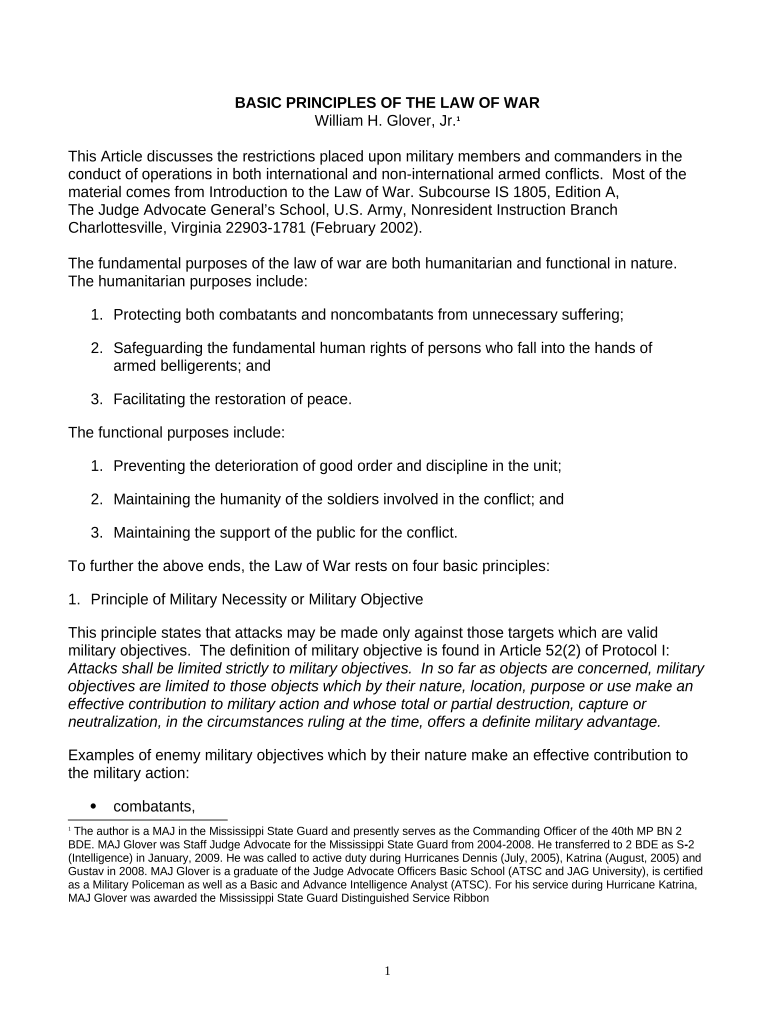
BASIC PRINCIPLES OF THE LAW OF WAR William H. Glover, Jr. 1 This Article discusses the restrictions placed upon military members and commanders in the conduct of operations in both international and non-international armed conflicts. Most of the material comes from Introduction to the Law of War. Subcourse IS 1805, Edition A, The Judge Advocate General’s School, U.S. Army, Nonresident Instruction Branch Charlottesville, Virginia 22903-1781 (February 2002). The fundamental purposes of the law of war are both humanitarian and functional in nature. The humanitarian purposes include: 1. Protecting both combatants and noncombatants from unnecessary suffering; 2. Safeguarding the fundamental human rights of persons who fall into the hands of armed belligerents; and 3. Facilitating the restoration of peace. The functional purposes include: 1. Preventing the deterioration of good order and discipline in the unit; 2. Maintaining the humanity of the soldiers involved in the conflict; and 3. Maintaining the support of the public for the conflict. To further the above ends, the Law of War rests on four basic principles: 1. Principle of Military Necessity or Military Objective This principle states that attacks may be made only against those targets which are valid military objectives. The definition of military objective is found in Article 52(2) of Protocol I: Attacks shall be limited strictly to military objectives. In so far as objects are concerned, military objectives are limited to those objects which by their nature, location, purpose or use make an effective contribution to military action and whose total or partial destruction, capture or neutralization, in the circumstances ruling at the time, offers a definite military advantage. Examples of enemy military objectives which by their nature make an effective contribution to the military action:  combatants, 1 The author is a MAJ in the Mississippi State Guard and presently serves as the Commanding Officer of the 40th MP BN 2 BDE. MAJ Glover was Staff Judge Advocate for the Mississippi State Guard from 2004-2008. He transferred to 2 BDE as S - 2 (Intelligence) in January, 2009. He was called to active duty during Hurricanes Dennis (July, 2005), Katrina (August, 2005) and Gustav in 2008. MAJ Glover is a graduate of the Judge Advocate Officers Basic School (ATSC and JAG University), is certified as a Military Policeman as well as a Basic and Advance Intelligence Analyst (ATSC). For his service during Hurricane Katrina, MAJ Glover was awarded the Mississippi State Guard Distinguished Service Ribbon 1  armored fighting vehicles,  weapons,  fortifications,  combat aircraft and helicopters,  supply depots of ammunition and petroleum, etc. Examples of enemy military objectives which by their location make an effective contribution to the military action:  A narrow mountain pass through which the enemy formation must pass,  bridge over which the enemy’s main supply route (MSR) crosses,  a key road intersection through which the enemy’s reserve will pass, etc. Examples of enemy military objectives which by their purpose make an effective contribution to the military action:  Civilian buses or trucks which are being transported to the front to move soldiers from point A to B,  a factory which is producing ball bearings for the military. Examples of enemy military objectives which by their use make an effective contribution to the military action:  An enemy headquarters located in a school,  an enemy supply dump located in a residence, a hotel which is used as billets for enemy troops. The criterion of use is concerned with the present function of the object. Criminal Defense. Military necessity has been urged as a defense to law of war violations, but generally has been rejected as a defense for acts forbidden by customary and conventional laws of war. Rationale: laws of war were crafted to include consideration of military necessity. Look to whether international law allows targeting of a person or property: Protected Persons. The law of war generally prohibits the intentional targeting of protected persons under any circumstances. Protected Places - The Rendulic Rule . The law of war typically allows destruction of civilian property if military circumstances necessitate such destruction. The circumstances justifying destruction of protected property are those of “urgent military necessity” as they appear to the commander at the time of the decision. The Nuremberg Tribunal dismissed charges that General Lothar Rendulic unlawfully destroyed civilian property via a “scorched earth” policy 2 because “the conditions, as they appeared to the defendant at the time were sufficient upon which he could honestly conclude that urgent military necessity warranted the decision made.” Current norms for protection (and destruction) of civilian property : Do not destroy real or personal property of civilians “except where such destruction is rendered absolutely necessary by military operations. (GC, art. 53.) There may be situations where because of poor intelligence or the failure of the enemy to abide by the law of war, mistakes are made concerning the status of a site: Example: Al Firdus Bunker. During the Persian Gulf War, planners identified this bunker as a military objective. Barbed wire surrounded the complex, it was camouflaged, and armed sentries guarded its entrance and exit points. Unknown to coalition planners, however, Iraqi civilians used the shelter as nighttime sleeping quarters. The complex was bombed, resulting in 300 civilian casualties. Was there a violation of the law of war? No. Based on information gathered by coalition planners, the commander made a reasonable assessment that the target was a military. Although the attack unfortunately resulted in numerous civilian deaths, there was no international law violation because the attackers, at the time of the attack, acted reasonably. Principle of Unnecessary Suffering or Humanity - “It is especially forbidden . . . to employ arms, projectiles or material calculated to cause unnecessary suffering.” (HR, art. 23e.) This concept also extends to unnecessary destruction of property. Combatants may not use arms that are per se calculated to cause unnecessary suffering  projectiles filled with glass, irregularly shaped bullets,  dum-dum rounds, Principle of Proportionality - The anticipated loss of life and damage to property incidental to attacks must not be excessive in relation to the concrete and direct military advantage expected to be gained. (FM 27-10, para. 41, change 1.)  Protocol I . Protection of the civilian population), paragraph 5(b) prohibits “indiscriminate attacks,” defined in part as an attack where incidental injury to civilians or incidental damage to civilian objects would be “excessive in relation to the concrete and direct military advantage anticipated.” The U.S. considers these provisions customary international law. Example: During Operation Allied Force, Serbian civilians painted red targets on themselves and congregated on key bridges over the Danube River. These bridges were military objectives because they enabled the Serbs to quickly transfer military forces. The Commander making the targeting decision had to balance the concrete and direct military advantage gained by destruction of the bridge against the anticipated number of civilian deaths resulting from the attack. Incidental Injury and Collateral Damage. Collateral damage consists of unavoidable and unplanned damage to civilian personnel and property incurred while attacking a military objective. Incidental (a/k/a collateral) damage is not a violation of international law. However, 3 GP -1 describes indiscriminate attacks as those causing “ incidental loss of civilian life excessive to the military advantage anticipated.” Judging Commanders. It may be a grave breach of GP I to launch an attack that a commander knows will cause excessive incidental damage in relation to the military advantage gained. The requirement is for a commander to act reasonably. Those who plan or decide upon an attack, therefore, must take all reasonable steps to ensure not only that the objectives are identified as military objectives or defended places . . . but also that these objectives may be attacked without probable losses in lives and damage to property disproportionate to the military advantage anticipated. (FM 27-10, para. 41.) In judging a commander's actions one must look at the situation a s the commander saw it in light of all circumstances. But based on case law and modern applications, the test is not entirely subjective—“reasonableness” implies an objective element as well. In this regard, two questions seem relevant.  First, did the commander reasonably gather information to determine whether the target was a military objective and that the incidental damage would not be disproportionate?  Second, did the commander act reasonably based on the gathered information? Of course, factors such as time, available staff, and combat conditions affecting the commander must also weigh in the analysis. Principle of Discrimination or Distinction. This principle requires that combatants be distinguished from non-combatants, and that military objectives be distinguished from protected property or protected places. Parties to a conflict shall direct their operations only against combatants and military objectives. (GP I, Art. 48) GP I prohibits “ indiscriminate attacks .” Under Article 51, paragraph 4, these are attacks that: are “not directed against a specific military objective,” (e.g., Iraqi SCUD missile attacks on Israeli and Saudi cities during the Persian Gulf War);  might prohibit area bombing in certain populous areas, such as a bombardment “which treats as a single military objective a number of clearly separated and distinct military objectives in a city, town, or village  employ a method or means of combat the effects of which cannot be limited as required”  collateral damage excessive in relation to concrete and direct military advantage APPLICATION OF THE LAW OF WAR  The Law of War applies to all cases of declared war or any other armed conflicts that arise between the U.S. and other nations,  applies to cases of partial or total occupation. (codified in common article 2 of the Geneva Conventions). 4 Armed conflicts such as the Falklands War, the Iran-Iraq War, and Desert Storm were clearly international armed conflicts to which the Law of War applied. In peace operations, such as those in Somalia, Haiti, and Bosnia, the question frequently arises whether the Law of War applies to those operations. The issue hinges on whether the peace operations forces undertake a combatant role. It has thus far been the U.S., UN, and NATO opinion that their forces have not become combatants, despite carrying out some offensive- type operations (e.g. Task Force Ranger in Somalia, Operations Deny Flight and Deliberate Force in Bosnia). Despite the legal inapplicability of the Law of War to these operations, it is, nonetheless, the position of the U.S., UN, and NATO that their forces will apply the “principles and spirit” of the Law of War in these operations. This approach is consistent with DoD policy to comply with the Law of War “in the conduct of military operations and related activities in armed conflict, however such conflicts are characterized.” In applying the DoD policy, however, allowance must be made for the fact that during these operations U .S. Forces often do not have the resources to comply with the Law of War to the letter. It has been U.S. practice to comply with the Law of War to the extent “practicable and feasible.” SOURCES OF THE LAW OF WAR. The Law of The Hague (ref. (1) and (2)).  Regulates “methods and means” of warfare  prohibitions against using certain weapons such as poison; and humanitarian concerns such as warning the civilian population before a bombardment. Geneva Conventions of 1949 (ref. (3) - (6)). The Conventions protect “victims” of war such as wounded and sick, shipwrecked at sea, prisoners of war, and civilians. 1977 Geneva Protocols Although the U.S. has not ratified GP I and II, judge advocates must be aware that approximately 150 nations have ratified the Protocols (thus most of the 185 member states of the UN). The Protocols will come into play in most international operations. U.S. Commanders must be aware that many allied forces are under a legal obligation to comply with the Protocols. Furthermore, the U.S. considers many of the provisions of the Protocols to be applicable as customary international law. The impetus for drafting the Protocols was the International Committee of the Red Cross’ belief that the four Geneva Conventions and the Hague Regulations insufficiently covered certain areas of warfare in the conflicts following WWII, specifically  aerial bombardments,  protection of civilians,  and wars of national liberation. 5 New or expanded areas of definition and protection contained in Protocols include 1. provisions for: medical aircraft, wounded and sick, prisoners of war, 2. protections of the natural environment, 3. protections of civilians from indiscriminate attack, and l 4. Legal review of weapons. The U.S. views some of the GP I articles as either legally binding as customary international law or acceptable practice though not legally binding: The U.S. specifically objects to certain articles:  applicability to certain types of armed conflicts  environmental limitations on means and methods of warfare);  limits on the use of enemy flags and insignia);  expansion of definition of combatants,  relaxing of requirement to wear fixed distinctive insignia recognizable at a distance;  (non-protection of mercenaries Other Treaties. The following treaties restrict specific aspects of warfare:  Geneva Protocol of 1925 prohibits use in war of asphyxiating, poisonous, or other gases U.S. reserved the right to respond with chemical weapons to a chemical attack by the enemy.  The Chemical Weapons Convention (CWC), article I(1), prohibits production, stockpiling, and use (even in retaliation). The U.S. ratified the CWC in April 1997. The 1954 Hague Cultural Property Convention  prohibits targeting cultural property,  sets forth conditions when cultural property may be used by a defender or attacked. Although the United States has not ratified the treaty, it does regard its provisions as relevant to the targeting process: United States policy and the conduct of operations are entirely consistent with the Convention’s provisions. In large measure, the practices required by the convention to protect cultural property were based upon the practices of US military forces during World War II.” 6 Conventional Weapons (ref. (12)). The 1980 Conventional Weapons Treaty restricts or prohibits the use of certain weapons deemed to cause unnecessary suffering or to be indiscriminate:  Protocol I – non-detectable fragments;  Protocol II - mines, booby traps and other devices;  Protocol III - incendiaries; and  Protocol IV - laser weapons. T The U.S. has ratified the treaty by ratifying Protocols I and II. The Senate is currently reviewing Protocols III and IV and amendments to Protocol II for its advice and consent to ratification. The treaty is often referred to as the United Nations Convention on Certain Conventional Weapons. Regulations . Implementing LOW guidance for U.S. Armed Forces is found in respective service regulations. (FM 27-10 (Army), NWP 1-14M/FMFM 1-10 (Navy and Marine Corps), and AFP AFPD 51-4 (Air Force).) THE CONDUCT OF HOSTILTIES Lawful Combatants and Unprivileged Belligerents Combatants. Anyone engaging in hostilities in an armed conflict on behalf of a party to the conflict. Combatants are lawful targets unless “out of combat.” Lawful Combatants. Receive protections of Geneva Conventions, - -gain ”combatant immunity” for their warlike acts; and become prisoners of war if captured. Geneva Convention of 1949 Definition. (GPW, art. 4; GWS, art. 13.)  Combatants include: armed forces of a Party to the conflict;  militia,  volunteer corps, and  organized resistance movements belonging to a Party to the conflict that are under responsible command, wear a fixed distinctive sign recognizable at a distance, carry their arms openly, and abide by the laws of war; and members of armed forces of a government not recognized by a detaining authority or occupying power. Protocol I Definition. Article 43 states that members of the armed forces of a party to the conflict, except medical personnel and chaplains, are combatants. 7 Article 44(3) of GP I allows that a belligerent attains combatant status by merely carrying his arms openly during each military engagement, and when visible to an adversary while deploying for an attack. Unprivileged belligerents. May be treated as criminals under the domestic law of the captor. Unprivileged belligerents may include spies, saboteurs, or civilians who are participating in the hostilities. Forbidden Conduct with Respect to Enemy Combatants and Nationals  It is especially forbidden to declare that no quarter will be given, or to kill or injure enemy personnel who have surrendered. H. IV Reg. Art. 23.  It is also forbidden to kill or wound treacherously individuals belonging to the hostile nation or armed forces.  Belligerents are likewise prohibited to compel nationals of the enemy state to take part in hostilities against their own country. H. IV art. 23. Assassination. Hiring assassins, putting a price on the enemy’s head, and offering rewards for an enemy “dead or alive” is prohibited. (FM 27-10, para 31; E.O. 12333.) Targeting military leadership, however, is not assassination. Non-combatants. The law of war prohibits attacks on non-combatants. Among others, non- combatants include civilians, medical personnel, chaplains, and those out of combat – including prisoners of war and the wounded and sick. METHODS AND MEANS OF WARFARE AND WEAPONS “The rights of belligerents to adopt means of injuring the enemy is not unlimited.” (HR, art. 22.) Legal Review. All U.S. weapons, weapons systems, and munitions must be reviewed by the service TJAG for legality under the law of war. A review occurs before the award of the engineering and manufacturing development contract and again before the award of the initial production contract. (DoD Instr. 5000.2) Legal review of new weapons is also required under Article 36 of GP I. The Test. In the TJAG reviews, the discussion will often focus on whether the suffering occasioned by the use of the weapon is needless, superfluous, or grossly disproportionate to the advantage gained by its use. Weapons may be illegal:  Those weapons calculated to cause unnecessary suffering, determined by the “usage of states.” Examples: lances with barbed heads, irregularly shaped bullets, projectiles filled with glass. (FM 27-10, para. 34.) 8 By improper use. Using an otherwise legal weapon in a manner to cause unnecessary suffering. Example: a conventional air strike against a military objective where civilians are nearby vs. use of a more precise targeting method that is equally available By agreement or prohibited by specific treaties. Example: certain land mines, booby traps, and laser weapons are prohibited under the Protocols to the 1980 Conventional Weapons Treaty. Small Arms Projectiles. Must not be exploding or expanding projectiles.  he Declaration of St. Petersburg of 1868 prohibits exploding rounds of less than 400 grams (14 ounces).  Expanding rounds were prohibited by an 1899 Hague Declaration (of which U.S. was never a party). U.S. practice, however, accedes to this prohibition as being customary international law.  Hollow point ammunition. Typically, this is semi-jacketed ammunition that is designed to expand dramatically upon impact. This ammunition is prohibited for use in armed conflict by customary international law and the treaties mentioned above. There are situations, however, outside of international armed conflict, where use of this ammunition is lawful because its use will significantly reduce collateral damage to noncombatants and protected property (hostage rescue, aircraft security).  High Velocity Small Caliber Arms. Early controversy about M-16 causing unnecessary suffering due to movement of the high velocity round upon impact. Tests concluded the rounds did not cause unnecessary suffering.  Sniper rifles, .50 caliber machine guns, and shotguns. Much “mythology” exists about the lawfulness of these weapon systems. Bottom line: they are lawful weapons, although rules of engagement (policy and tactics) may limit their use. Fragmentation. Legal unless used in an illegal manner (on a protected target or in a manner calculated to cause unnecessary suffering). Land Mines and Booby Traps. Lawful if properly used, however, international process underway to outlaw all antipersonnel land mines. Indiscriminate. Primary legal concern: indiscriminate use that endangers civilian population. Articles 4 and 5, Protocol II of the 1980 Conventional Weapons Treaty, restrict placement of mines and booby traps in areas of “civilian concentration.” Remotely delivered mines (those planted by air, artillery, etc.): Only used against military objectives; and then only if their location can be accurately recorded and if they are self- neutralizing or self-destructing. Non-remotely delivered mines, booby traps, and other devices: May not be used in towns or cities or other places where concentrations of civilians are present unless: they are placed in 9 the vicinity of a military objective under the control of an adverse party; or measures are in place to protect civilians from their effects (posting of signs etc.). Booby Traps: Amended Protocol II of the 1980 Conventional Weapons Treaty also prohibits use of booby traps  on the dead,  wounded,  Children’s toys,  medical supplies, and  religious objects, among other objects (art. 6). Requires that all remotely delivered anti-personnel land mines (APL) be equipped with self- destruct devices and backup self-deactivation features; (1) Requires that all APL be detectable using available technology; (2) Requires that the party laying mines assume responsibility to ensure against their irresponsible or indiscriminate use; and (3) Provides for means to enforce compliance U.S. policy on anti-personnel land mines. U.S. forces may no longer employ APL that do not self-destruct or self-neutralize, (sometimes called “dumb” anti-personnel land mines) according to a 16 May 1996 policy statement issued by the President. Exceptions to this policy: the use of non-self-destructing APL on the Korean Peninsula and for training purposes. U.S. Developments. On 17 September 1997, the President announced the following U.S. initiatives in regards to anti-personnel land mines:  Develop alternatives to APL by the year 2003;  field them in South Korea by 2006.  Appointed a Presidential advisor on land mines.  Pursue a ban on APL through the UN Conference on Disarmament.  Increase de-mining programs. Incendiaries. (FM 27-10, para. 36.) Examples:  Napalm, f  lame-throwers, 10  tracer rounds, and  white phosphorous. None of these are illegal per se or illegal by treaty. The only U.S. policy guidance is found in paragraph 36 of FM 27-10 which warns that they should “not be used in such a way as to cause unnecessary suffering.” Napalm and Flame-throwers. Designed for use against armored vehicles, bunkers, and built- up emplacements. White phosphorous. Designed for igniting flammable targets such as fuel, supplies, and ammunition and for use as a smoke agent. Protocol III of the 1980 Conventional Weapons Convention. Prohibits use of air-delivered incendiary weapons on military objectives located within concentrations of civilians. Has not been ratified by the U.S. The U.S. is currently considering ratifying the protocol - with a reservation that incendiary weapons may be used within areas of civilian concentrations, if their use will result in fewer civilian casualties. For example: the use of incendiary weapons against a chemical munitions factory in a city could cause fewer incidental civilian casualties. Conventional explosives would probably disperse the chemicals, where incendiary munitions would burn up the chemicals. Lasers. U.S. Policy (announced by SECDEF in Sep. 95) prohibits use of lasers specifically designed, as their sole combat function or as one of their combat functions, to cause permanent blindness to unenhanced vision. Chemical Weapons . (FM 27-10, para. 37.) Poison has been outlawed for thousands of years. Considered a treacherous means of warfare. The 1925 Geneva Protocol. (FM 27-10, para 38, change 1.) Applies to all international armed conflicts.  Prohibits use of lethal, incapacitating, and biological agents.  Protocol prohibits use of “asphyxiating, poisonous, or other gases and all analogous liquids, materials or devices. . . .” The U.S. considers the 1925 Geneva Protocol as applying to both lethal and incapacitating chemical agents. Incapacitating Agents: Those chemical agents producing symptoms that persist for hours or even days after exposure to the agent has terminated. U.S. views riot control agents as having a “transient” effect—and thus are NOT incapacitating agents. Therefore, the treaty does not prohibit their use in war. (Other nations disagree with interpretation.) 11 Under the Geneva Protocol of 1925 the U.S. reserved right to use lethal or incapacitating gases if the other side uses them first Control Agents: U.S. has an understanding to the Treaty that these are not prohibited. Riot Control Agents (RCA). U.S. RCA Policy is found in Executive Order 11850. Applies to use of Riot Control Agents and Herbicides ; requires presidential approval before first use in an armed conflict. EO 11850: renounces first use in armed conflicts except in defensive military modes to save lives such as:  controlling riots in areas under direct and distinct U.S. military control, to include rioting prisoners of war;  dispersing civilians where the enemy uses them to mask or screen an attack;  rescue missions for downed pilots/passengers and escaping Paws n remotely isolated areas; and in our rear echelon areas outside the zone of immediate combat to protect convoys from civil disturbances, terrorists and paramilitary 1993 Chemical Weapons Convention (CWC) (ref. 9). The CWC was ratified by U.S. and came into force in April 1997. Provisions (twenty-four articles).  Article I. Parties agree to never develop, produce, stockpile, transfer, use, or engage in military preparations to use chemical weapons.  Retaliatory use (second use) not allowed; significant departure from 1925 Geneva Protocol.  Requires destruction of chemical stockpiles.  Each party agrees not to use Riot Control Agents (RCAs) as a “method of warfare.” Article II.  Definitions of chemical weapons, toxic chemical, RCA, and purposes not prohibited by the convention. Article III. Requires parties to declare stocks of chemical weapons and facilities they possess.  Articles IV and V. Procedures for destruction and verification, including routine on-site inspections. RCA Controversy . The Chemical Weapons Convention prohibits RCA use as “method of warfare.” “Method of warfare” is undefined, however some argue the phrase includes any actions that involve “combatants” - including traditional hostage rescue/ The rationale for the 12 prohibition - we do not want to give states the opportunity for subterfuge. Keep all chemical equipment off the battlefield, even if it is supposedly only for use with RCA. The President’s certification document of 25 April 1997 states that “the United States is not restricted by the convention in its use of riot control agents in various peacetime and peacekeeping operations. These are situations in which the U.S. is not engaged in the use of force of a scope, duration, and intensity that would trigger the laws of war with respect to U.S. forces.” Thus, during peacekeeping missions (such as Bosnia, Somalia, Rwanda, and Haiti) it appears U.S. policy will maintain that we are not a party to the conflict for as long as possible. Therefore RCA would be available for all purposes under E.O. 11850. However, in armed conflicts (such as Desert Storm, Panama, and Grenada) it is unlikely that the NCA will approve the use of RCA in situations where “combatants” are involved due to the CWC’s prohibition on the use of RCA as a “method of warfare.” Herbicides. E.O. 11850 renounces first use in armed conflicts, except for domestic uses and to control vegetation around defensive areas. (e.g., Agent Orange in Vietnam.) Nuclear Weapons. (FM 27-10, para. 35.) Not prohibited by international law. BOMBARDMENTS, ASSAULTS, AND PROTECTED AREAS AND PROPERTY Military Objectives. Objects that, by their nature, use, location, or purpose, make an effective contribution to military action are legitimate military objectives. Their destruction, capture or neutralization is justified if it offers a definite military advantage. There must be a nexus between the object and a “definite” advantage toward military operations. Examples: enemy equipment, munitions factories, roads, bridges, railroads, or electrical powers stations. Warning Requirement . General requirement to warn before a bombardment . Only applies if civilians are present. Exception : if it is an assault (any surprise attack or an attack where surprise is a key element Defended Places. (FM 27-10, paras. 39 & 40, change 1.) As a general rule, any place the enemy chooses to defend makes it subject to attack. Defended places include:  a fort or fortified place;  a place occupied by a combatant force or through which a force is passing; and  a city or town that is surrounded by defensive positions under circumstances that the city or town is indivisible from the defensive positions. Undefended places. The attack or bombardment of towns, villages, dwellings, or buildings, which are undefended, is prohibited Natural environment. The environment cannot be the object of reprisals. In the course of normal military operations, care must be taken to protect the natural environment against “long- term, widespread, and severe damage.” 13 Protected Areas. Hospital or safety zones may be established for the protection of the wounded and sick or civilians. (FM 27-10, para. 45.) Articles 8 and 11 of the 1954 Hague Cultural Property Convention provide that certain cultural sites may be designated in an “International Register of Cultural Property under Special Protections.” The Vatican and art storage areas in Europe have been designated under the convention as “specially protected.” Protected Property . Civilians. Prohibition against attacking civilians or civilian property. ( Presumption of civilian property attaches to objects traditionally associated with civilian use (dwellings, school, etc.) (GP I, art. 52(3)), as contrasted with military objectives such as industrial facilities such as munitions factories, which remain legitimate military objectives even if manned by civilian workers. Protection of Medical Units and Establishments – Hospitals  Fixed or mobile medical units shall be respected and protected. They shall not be intentionally attacked. Protection shall not cease, unless they are used to commit “acts harmful to the enemy.”  Warning requirement before attacking a hospital in which individuals are committing “acts harmful to the enemy.” The hospital is given a reasonable time to comply with warning before attack. When receiving fire from a hospital, there is no duty to warn before returning fire in self-defense. . Captured Medical Facilities and Supplies of the Armed Forces.  Fixed facilities - May be used by captors for other than medical care, in cases of urgent military necessity, provided proper arrangements are made for the wounded and sick who are present.  Mobile facilities - Captors may keep mobile medical facilities, provided they are reserved for care of the wounded and sick.  Medical Supplies - May not be destroyed. Medical Transport. Transports of the wounded and sick or medical equipment shall not be attacked Cultural Property. Prohibition against attacking cultural property. The convention has not been ratified by the U.S. Cultural property includes buildings dedicated to religion, art, science, charitable purposes, historic monuments, hospitals, and places where the sick and wounded are collected. Misuse will subject them to attack. Enemy has duty to indicate presence of such buildings with visible and distinctive signs. 14 Works and Installations Containing Dangerous Forces. The rules are not U.S. law but should be considered because of the pervasive international acceptance of GP I and II. Under the Protocol, dams, dikes, and nuclear electrical generating stations shall not be attacked - even if they are military objectives - if the attack will cause the release of dangerous forces and cause “ severe losses ” among the civilian population. (U.S. objects to “severe loss” language as creating a different standard than customary Objects Indispensable to the Survival of the Civilian Population. Article 54 of GP I prohibits starvation as a method of warfare. It is prohibited to attack, destroy, remove, or render useless objects indispensable for survival of the civilian population - such as foodstuffs, crops, livestock, water installations, and irrigation works. Protective Emblems . (FM 27-10, para. 238.) Objects and personnel displaying emblems are presumed to be protected under Conventions. (GWS, art. 38.) Medical and Religious Emblems . Red Cross, Red Crescent, Lion and Sun. Red Star of David: Not mentioned in the 1949 Geneva Convention, but is protected as a matter of practice. Cultural Property Emblems: “A shield, consisting of a royal blue square, one of the angles of which forms the point of the shield and of a royal blue triangle above the square, the space on either side being taken up by a white triangle.” (1954 Cultural Property Convention, art. 16 and 17). Stratagems and Tactic Ruses. (FM 27-10, para. 48). Injuring the enemy by legitimate deception (abiding by the law of war—actions are in good faith). Examples of ruses:  Naval Tactics. A common naval tactic is to rig disguised vessels or dummy ships, e.g., to make warships appear as merchant vessels. Land Warfare. Creation of fictitious units by planting false information, putting up dummy installations, false radio transmissions, using a small force to simulate a large unit. (FM 27-10, para. 51.) Gulf War - Coalition: Coalition forces, specifically XVIII Airborne Corps and VII Corps, used deception cells to create the impression that they were going to attack near the Kuwaiti boot heel, as opposed to the “left hook” strategy actually implemented. Use of Enemy Property. Enemy property may be used to deceive under the following conditions:  Uniforms. Combatants may wear enemy uniforms but cannot fight in them. Note, however, that military personnel not wearing their own uniform lose their PW status if captured and risk being treated as spies. 15  Colors. The U.S. position regarding the use of enemy flags is consistent with its practice regarding uniforms, i.e., the U.S. interprets the “improper use” of a national flag (HR, art. 23(f).) to permit the use of national colors and insignia of enemy as a ruse Equipment. Must remove all enemy insignia in order to fight with it. Use of Property . ( See Elyce Santere, From Confiscation to Contingency Contracting: Property Acquisition on or Near the Battlefield , 124 Mil. L. Rev. 111 (1989).) Confiscation - permanent taking without compensation; Seizure - taking with payment or return after the armed conflict; Requisition - appropriation of private property by occupying force with compensation as soon as possible; Contribution - a form of taxation under occupation law. Psychological Operations. Gulf War - U.S. PSYOPS leaflet program - PSYOPS units distributed over 29 million leaflets to Iraqi forces. The themes of the leaflets were the “futility of resistance; inevitability of defeat; surrender; desertion and defection; abandonment of equipment; and blaming the war on Saddam Hussein.” It was estimated that nearly 98% of all Iraqi prisoners acknowledged having seen a leaflet; 88% said they believed the message; and 70% said the leaflets affected their decision to surrender. Misuse of Red Cross, Red Crescent, and cultural property symbol. Designed to reinforce/reaffirm HR, Article 23f. GWS requires that wounded & sick, hospitals, medical vehicles, and in some cases, medical aircraft be respected and protected. Protection lost if committing acts harmful to enemy. Cultural property symbols include 1954 Hague Cultural Property Convention, Roerich Pact, and 1907 Hague Conventions symbol. Espionage. clandestinely (or on false pretenses) to obtain information for transmission back to their side. Gathering intelligence while in uniform is not espionage. Espionage is not a law of war violation. No protection, however, under Geneva Conventions for acts of espionage. Reprisals. (FM 27-10, para 497.) An otherwise illegal act done in response to a prior illegal act by the enemy. The purpose of a reprisal is to get the enemy to adhere to the law of war. Reprisals are authorized if the following requirements are met:  it’s timely;  it’s responsive to enemy’s act;  must first attempt a lesser form of redress; and The U.S. position is that reprisals are prohibited only when directed against protected persons as defined in the Geneva Conventions. U.S. policy is that a reprisal may be ordered only at the highest levels (NCA). War Trophies. The law of war authorizes the confiscation of enemy military property. War trophies, as long as taken from enemy military property, are legal under the law of war. The problem with war trophies arises under U.S. domestic law, rather than under the law of war. Confiscated enemy military property is property of the U.S. The property becomes a war trophy —and capable of legal retention by an individual soldier—only if the U.S. so designates the property IAW law and regulation. 16 The key to a clear and workable war trophy policy is to publicize it before deployment , work it into all exercises and plans, and train with it! When drafting a war trophy policy, consider the “6 Cs”: 1. COMMON SENSE—does the policy make sense? 2. CLARITY—can it be understood at the lowest level? 3. CI—is the word out through all command information means available? (Post on unit bulletin boards, post in mess facilities, put in post newspaper, put in PSA on radio, etc.) 4. CONSISTENCY—are we applying the policy across all layers and levels of command? (A policy promulgated for an entire Corps is better than diverse policies within subordinate divisions; a policy that is promulgated by the unified command and applies to all of its components is better still.) 5. CUSTOMS—prepare for customs inspections, “courtesy” inspections prior to redeployment, and amnesty procedures. 6. CAUTION—Remember one of the prime purposes of a war trophy policy: to limit soldiers from exposing themselves to danger (in both Panama and the Gulf, soldiers were killed or seriously injured by exploding ordnance encountered when they were looking for souvenirs). Consider prohibitions on unauthorized “bunkering, “souvenir hunting,” “climbing in or on enemy vehicles and equipment.” A good maxim for areas where unexploded ordnance or booby-traps are problems: “If you didn’t drop it, don’t pick it up.” Rules of Engagement. Defined: Directives issued by competent superior authority that delineate the circumstances and limitations under which U.S. forces will initiate and/or continue engagement with other forces. ROE are drafted in consideration of the Law of War, national policy, public opinion, and military operational constraints. ROE are often more restrictive than what the Law of War would allow. PROTECTED PERSONS Hors de Combat. Prohibition against attacking enemy personnel who are “ out of combat .” Prisoners of War. (GPW, art. 4, HR, art. 23c, d.) Surrender may be made by any means that communicates the intent to give up. No clear-cut rule as to what constitutes surrender. However, most agree surrender constitutes a cessation of resistance and placement of one’s self at the discretion of the captor. The onus is on the person or force surrendering to communicate intent to surrender. Captors must respect (not attack) and protect (care for) those who surrender—no reprisals. GP I art. 44 expands the definition of prisoners of war to include any combatant "who falls into the power of an adverse Party" Combatants include those who do not distinguish themselves from the civilian population except when carrying arms openly during an engagement and in the deployment immediately preceding the engagement; e.g., national liberation movements. (GP I, art. 44.) 17 U.S. asserts this definition does not reflect customary international law. Captured civilians accompanying the force also receive PW status (GPW, art. 4(a)(4)). Identification and Status. The initial combat phase will likely result in the capture of a wide array of individuals. 2 The U.S. applies a broad interpretation to the term “international armed conflict” set forth in common Article 2 of the Conventions. Furthermore, DoD Directive 5100.77, the DoD Law of War Program, states that U.S. Forces will comply with the LOW regardless of how the conflict is characterized. Judge advocates, therefore, should advise commanders that, regardless of the nature of the conflict, all enemy personnel should initially be accorded the protections of the GPW Convention (GPW), at least until their status may be determined. In that regard, recall that “status” is a legal term, while “treatment” is descriptive. When drafting or reviewing guidance to soldiers, ensure that the guidance mandates treatment, not status. For example, a TACSOP should state that persons who have fallen into the power of U.S. Forces will be “treated as PW,” not that such persons “will have the status of PW.” When doubt exists as to whether captured enemy personnel warrant continued PW status, Art. 5 (GPW) Tribunals must be convened. It is important that judge advocates be prepared for such tribunals. During the Vietnam conflict, a Directive established procedures for the conduct of Art. 5 Tribunals; however, no comparable Directive is presently in effect. 3 Treatment. There is a legal obligation to provide adequate food, facilities, and medical aid to all PWs. This obligation poses significant logistical problems in fast-moving tactical situations; thus, judge advocates must be aware of how to meet this obligation while placing a minimum burden on operational assets. 4 PWs must be protected from physical and mental harm. They must be transported from the combat zone as quickly as circumstances permit. Subject to valid security reasons, PWs must be allowed to retain possession of their personal property, protective gear, valuables, and money. These items must not be taken unless properly receipted for and recorded as required by the GPW. In no event can a PW’s rank insignia or 2 For example, in two days of fighting in Grenada, Army forces captured approximately 450 Cubans and 500 hostile Grenadians. Panama provided large numbers of detainees, both civilian and "PDF" (Panamanian Defense Force/police force) for the Army to sort out. The surrender of almost overwhelming numbers of Iraqi forces in the Gulf War was well publicized. 3 No Article 5 Tribunals were conducted in Grenada or Panama, as all captured enemy personnel were repatriated as soon as possible. In the Gulf War, Operation DESERT STORM netted a large number of persons thought to be EPWs, who were actually displaced civilians. Subsequent interrogations determined that they had taken no hostile action against Coalition Forces. In some cases, they had surrendered to Coalition Forces to receive food and water. Tribunals were conducted to verify the status of the detainees. Upon determination that they were civilians who had taken no part in hostilities, they were transferred to detainment camps. Whether the tribunals were necessary as a matter of law is open to debate -- the civilians had not "committed a belligerent act," nor was their status "in doubt." 4 The following examples are illustrative. When U.S. Forces landed in Grenada, they did not possess the food necessary to feed the large number of PWs and detainees who would come under our control. Thus, we used captured foodstuffs to feed them. Similar situations occurred in Panama. Thus, by using captured food, the U.S. met its obligation under the GPW, and the ground commanders were able to conserve valuable assets. Initially, PW facilities on Grenada, in Panama, and in the Gulf were each inadequate in their own ways. They consisted of dilapidated buildings, with no sanitation facilities or electricity, or were simply non-existent (in the desert). The ground commanders could not afford to use critically needed combat personnel (the personnel necessary to handle PWs were not initially available) to construct PW camps. Because the LOW does not require combatants to use their own assets to construct PW camps, the U.S. used captured property and PWs to construct adequate camps. (In fact, in Grenada the PWs were Cuban construction workers.). Medical assets also tend to be in high demand and short supply during combat. The LOW, however, prohibits the willful denial of needed medical assistance to PWs, and priority of treatment must be based on medical reasons. While the Capturing Party has the obligation to ensure adequate medical care for enemy wounded, the GWS Convention encourages the use of "retained persons" to treat enemy wounded. The U.S. has made use of this provision as well. As these examples indicate, the JA must be familiar with and apply the LOW in a practical manner. In doing so, he enables the commander to comply with legal requirements, without jeopardizing the mission. 18 identification cards be taken. These protections continue through all stages of captivity, including interrogation. Detainees. Particularly in Military Operations Other Than War, where there are no lawful enemy combatants (e.g., Somalia, Haiti, Bosnia, as discussed above), persons who commit hostile acts against U.S. forces or serious criminal acts and are captured do not meet the legal criteria of PW under the GPW. These persons may be termed “detainees” instead of PW. Wounded and Sick in the Field and at Sea. (GWS, art. 12; GWS Sea, art. 12.) The first and second Geneva Conventions as well as the 1977 Protocol I to the Geneva Conventions deal with protections for the wounded and sick, to include the shipwrecked. All wounded and sick in the hands of the enemy must be respected and protected ( See para. 208, FM 27-10, GWS Art 13, and GC, Art 16). “Each belligerent must treat his fallen adversaries as he would the wounded of his own army” (Pictet’s Commentary, GWS, p. 137). The order of treatment is determined solely by urgent medical reasons (triage). No adverse distinctions in treatment may be established because of sex, race, nationality, religion, political opinions, or any other similar criteria (GWS, Art 12). If compelled to abandon the wounded and sick to the enemy, commanders must leave medical personnel and material to assist in their care, “as far as military considerations permit” (GWS, Art 12). At all times, and particularly after an engagement parties are obligated to search for the wounded and sick - as conditions permit (GWS, Art 15). Permanent medical personnel “exclusively engaged” in medical duties (GWS, Art 24), chaplains (GWS, Art 24), personnel of national Red Cross Societies, and other recognized relief organizations (GWS, Art 26), shall not be intentionally attacked. Upon capture they are “retained personnel,” not PWs; however, at a minimum they receive PW protections. They are to perform only medical or religious duties. They are to be retained as long as required to treat the health and spiritual needs of PWs. If not required they are to be repatriated (GWS, Art 28). Personnel of aid societies of neutral countries cannot be retained, and must be returned as soon as possible. Medical units and establishments may not be attacked. ( GWS, Art 19). However, incidental damage to medical facilities situated near military objectives is not a violation of the law of war. Medical units and facilities lose their protection if committing “acts harmful to the enemy,” and, if after a reasonable time, they fail to heed a warning to desist. No warning requirement if taking fire from the medical unit or establishment; e.g., Richmond Hills Hospital, Grenada (GWS, Art 21, Pictet’s Commentary on GWS, pp. 200-201). Those soldiers who have fallen by reason of sickness or wounds and who cease to fight are to be respected and protected. Under GP I, civilians are included in the definition of wounded and sick (who because of trauma, disease, . . . are in need of medical assistance and care and who refrain from any act of hostility). (GP I, art. 8.) As a practical matter, care should be provided to civilians if medical resources are available. Otherwise, civilian care remains the primary responsibility of the civilian authorities. 19 Shipwrecked members of the armed forces at sea are to be respected and protected . (GWS Sea, art. 12, NWP 1-14M, para. 11.6). Shipwrecked includes downed passengers/crews on aircraft, ships in peril, castaways. Parachutists (FM 27-10, supra , para. 30). Descending paratroopers are presumed to be on a military mission and therefore may be targeted. Parachutists are crewmen of a disabled aircraft. They are presumed to be out of combat and may not be targeted unless it is apparent they are engaged on a hostile mission. Parachutists, according to GP I, Article 42, “shall be given the opportunity to surrender before being made the object of attack.” Civilians. General Rule . Civilians and civilian property may not be the subject or sole object of a military attack. Civilians are persons who are not members of the enemy’s armed forces, and who do not take part in the hostilities (GP I, art. 50 and 51). Indiscriminate Attacks. GP I provides for expanded protections of the civilian population from “indiscriminate” attacks. Indiscriminate attacks include those where the incidental loss of civilian life, or damage to civilian objects, would be excessive in relation to the concrete and direct military advantage anticipated. (GP I, art. 51(4).) Civilian Medical and Religious Personnel. Article 15 of GP I requires that civilian medical and religious personnel shall be respected and protected. They receive the benefits of the provisions of the Geneva Conventions and the Protocols concerning the protection and identification of medical personnel. All available help shall be given to civilian medical personnel when civilian services are disrupted due to combat. Personnel Engaged in the Protection of Cultural Property. Article 17 of the 1954 Hague Cultural Property Convention established a duty to respect (not directly attack) persons engaged in the protection of cultural property. The regulations attached to the Convention provide for specific positions as cultural protectors and for their identification. Journalists. Given protection as “civilians” provided they take no action adversely affecting their status as civilians. (GP I, art. 79 - considered customary international law by U.S.). MILITARY OCCUPATION The Nature of Military Occupation Territory is considered occupied when it is actually placed under the authority of the hostile armed forces. The occupation extends only to territory where such authority has been established and can effectively be exercised. H. IV Regs. Art. 42. Thus, occupation is a question of fact based on the invader's ability to render the invaded government incapable of exercising public authority. Simply put, occupation must be both actual and effective. (FM 27- 10, para. 352) However, military occupation (also termed belligerent occupation) is not conquest; it does not involve a transfer of sovereignty to the occupying force. Indeed, it is unlawful for a belligerent occupant to annex occupied territory or to create a new state therein while hostilities are still in progress. See GC, art. 47. It is also forbidden to compel the 20 inhabitants of occupied territory to swear allegiance to the hostile occupying power. H IV. Regs. Art. 45. Occupation is thus provisional in nature, and is terminated if the occupying power is driven out. Administration of Occupied Territory Occupied territory is administered by military government, due to the inability of the legitimate government to exercise its functions, or the undesirability of allowing it to do so. The occupying power therefore bears a legal duty to restore and maintain public order and safety, while respecting, "unless absolutely prevented," the laws of the occupied nation. H. IV. Regs Art. 43. The occupying power may allow the local authorities to exercise some or all of their normal governmental functions, subject to the paramount authority of the occupant. The source of the occupant's authority is its imposition of government by force, and the legality of its actions is determined by the Law of War. In restoring public order and safety, the occupant is required to continue in force the normal civil and criminal laws of the occupied nation, unless they would jeopardize the security of the occupying force or create obstacles to application of the GC. See GC Art. 64. However, the military and civilian personnel of the occupying power remain immune from the jurisdiction of local law enforcement. Articles 46-63 of the GC establish important fundamental protections and benefits for the civilian population in occupied territory. Family honor, life and property, and religious convictions must be respected. Individual or mass forcible deportations of protected persons from the occupied territory to the territory of the occupying power or to a third state are prohibited. GC Art. 49. The occupying power has the duty of ensuring that the population is provided with adequate food, medical supplies and treatment facilities, hygiene, and public health measures. GC Art. 55. In addition, children are subject to special protection and care, particularly with respect to their education, food, medical care, and protection against the effects of war. GC Art. 50. The occupying power is forbidden from destroying or seizing enemy property unless such action is "imperatively demanded by the necessities of war," H. IV. Regs. Art. 23, or "rendered absolutely necessary by military operations." GC Art. 53. "Pillage is formally forbidden." H. IV. Regs. Art. 47. However, the occupying power may requisition goods and services from the local populace to sustain the needs of the occupying force, "in proportion to the resources of the country, and of such a nature as not to involve the population in the obligation of taking part in operations of the war against their country." The occupying power is obliged to pay cash for such requisitions or provide a receipt and make payment as soon as possible. H. IV. Regs. Art. 52. The occupying power may not compel protected persons to serve in its armed forces, nor may it compel them to work unless they are over eighteen years old, and then only on work that: (1) is necessary for the needs of the occupying force; (2) is necessary for public utility services; or (3) for the feeding, sheltering, clothing, transportation or health of the populace of the occupied country. The occupied country's labor laws regarding such matters as wages, hours, and 21 compensation for occupational accidents and diseases remain applicable to the protected persons assigned to work by the occupant. GC Art. 51; see H. IV. Regs. Art. 23. The occupying power is specifically prohibited from forcing the inhabitants to take part in military operations against their own country, and this precludes requiring their services in work directly promoting the military efforts of the occupying force, such as construction of fortifications, entrenchments, and military airfields. See GC Art. 51. However, the inhabitants may be employed voluntarily in such activities. Security of the Occupying Force: Penal Law and Procedure The occupant is authorized to demand and enforce the populace's obedience as necessary for the security of the occupying forces, the maintenance of law and order, and the proper administration of the country. The inhabitants are obliged to behave peaceably and take no part in hostilities. If the occupant considers it necessary, as a matter of imperative security needs, it may assign protected persons to specific residences or internment camps. GC Art. 78. The occupying power may also enact penal law provisions, but these may not come into force until they have been published and otherwise brought to the knowledge of the inhabitants in their own language. Penal provisions shall not have retroactive effect. GC Art. 65. The occupying power's tribunals may not impose sentences for violation of penal laws until after a regular trial. The accused person must be informed in writing in his own language of the charges against him, and is entitled to the assistance of counsel at trial, to present evidence and call witnesses, and to be assisted by an interpreter. The occupying power shall notify the protecting power of all penal proceedings it institutes in occupied territory. Sentences shall be proportionate to the offense committed. The accused, if convicted, shall have a right to appeal under the provisions of the tribunal's procedures or, if no appeal is provided for, he is entitled to petition against his conviction and sentence to the competent authority of the occupying power. GC, Arts. 72, 73. Under the provisions of the GC, the occupying power may impose the death penalty on a protected person only if found guilty of espionage or serious acts of sabotage directed against the occupying power, or of intentional offenses causing the death of one or more persons, provided that such offenses were punishable by death under the law of the occupied territory in force before the occupation began. GC Art. 68. However, the United States has reserved the right to impose the death penalty for such offenses resulting in homicide irrespective of whether such offenses were previously capital offenses under the law of the occupied state. In any case, the death penalty may not be imposed by the occupying power on any protected person who was under the age of eighteen years at the time of the offense. GC Art. 68. The occupying power must promptly notify the protecting power of any sentence of death or imprisonment for two years or more, and no death sentence may be carried out until at least six months after such notification. GC Arts. 74, 75. The occupying power is prohibited from imposing mass punishments on the populace for the offenses of individuals. That is, "No general penalty, pecuniary or otherwise, shall be inflicted 22 upon the populations on account of the acts of individuals for which they cannot be regarded as jointly and severally responsible." H. IV. Regs Art. 50; see GC, Art. 33. In areas occupied by United States forces, military jurisdiction over individuals, other than members of the U.S. armed forces, is exercised by courts of the military government. Although sometimes designated by other names, these military tribunals are actually military commissions. They preside in and for the occupied territory and thus exercise their jurisdiction on a territorial basis. NEUTRALITY Customary Law Reflected in Hague Convention No. V Under customary international law, as reflected in Hague Convention No. V, neutrality on the part of a state not a party to an armed conflict consists in refraining from all participation in the conflict, and in preventing, tolerating, and regulating certain acts on its own part, by its nationals, and by the belligerents. In response, it is the duty of the belligerents to respect the territory and rights of neutral states. Those neutrality rights include the following: The territory of the neutral state is inviolable. H. V. Art. 1. This prohibits any unauthorized entry into the territory of the neutral state, its territorial waters, or the airspace over such areas by troops or instrumentalities of war. Thus, belligerents are also specifically prohibited from moving troops or convoys of war munitions or supplies across the territory of a neutral state. H. V. Art. 2. In consequence, the efforts of the neutral to resist, even by force, attempts to violate its territory cannot be regarded as hostile acts by the offending belligerents. H. V. Art. 10. However, if the neutral is unable, or fails to prevent such violations of its neutrality by the troops of one belligerent, that belligerent's enemy may be justified in attacking those troops in neutral territory. Belligerents are also prohibited from establishing radio communications stations in neutral territory to communicate with their armed forces, or from using such facilities previously established before the outbreak of hostilities for that purpose. H. V. Art. 3. However, a neutral state may permit the use of its own communications facilities to transmit messages on behalf of the belligerents, so long as such usage does not lend assistance to the forces of only one side of the conflict. Indeed, the neutral must ensure that the measure it takes in its status as a neutral state are impartial as applied to all belligerents. H.V. Art. 9. While a neutral state is under no obligation to allow passage of convoys or aircraft carrying the sick and wounded of belligerents through its territory or airspace, it may do so without forfeiting its neutral status. However, the neutral must exercise necessary control or restrictive measures concerning the convoys or medical aircraft, must ensure that neither personnel nor material other than that necessary for the care of the sick and wounded is carried, and must accord the belligerents impartial treatment. H. V. Art. 14; see GWS Art. 37. In particular, if the wounded and sick or prisoners of war are brought into neutral territory by their captor, they must be detained and interned by the neutral state so as to prevent them from taking part in further hostilities. GWS Art. 37. 23 The nationals of a neutral state are also considered as neutrals. H. V. Art. 16. However, if such neutrals reside in occupied territory during the conflict, they are not entitled to claims different treatment, in general, from that accorded the other inhabitants. They are likewise obliged to refrain from participation in hostilities, and must observe the rules of the occupying power. Moreover, such neutral residents of occupied territory may be punished by the occupying power for penal offenses to the same extent as nationals of the occupied nation. See GC Art. 4. A national of a neutral state forfeits his neutral status if he commits hostile acts against a belligerent, or commits acts in favor of a belligerent, such as enlisting in its armed forces. However, he is not to be more severely treated by the belligerent against whom he has abandoned his neutrality than would be a national of the enemy state for the same acts. H. V. Art. 17. The United States has supplemented the ab

Valuable instructions on finishing your ‘Principles Law’ digitally

Are you fed up with the complications of dealing with paperwork? Look no further than airSlate SignNow, the leading electronic signature solution for individuals and businesses. Bid farewell to the lengthy process of printing and scanning documents. With airSlate SignNow, you can effortlessly finalize and sign paperwork online. Take advantage of the powerful features integrated into this user-friendly and cost-effective platform and transform your paperwork management approach. Whether you need to approve forms or obtain electronic signatures, airSlate SignNow manages everything effortlessly, with just a few clicks.

Follow this comprehensive guide:

  1. Log into your account or register for a complimentary trial with our service.
  2. Click +Create to upload a document from your device, cloud storage, or our template library.
  3. Open your ‘Principles Law’ in the editor.
  4. Click Me (Fill Out Now) to complete the form on your end.
  5. Include and assign fillable fields for additional participants (if necessary).
  6. Proceed with the Send Invite options to request eSignatures from others.
  7. Download, print your version, or convert it into a reusable template.

Don’t fret if you need to work with your colleagues on your Principles Law or send it for notarization—our platform equips you with everything required to accomplish such tasks. Create an account with airSlate SignNow today and boost your document management to new levels!

Here is a list of the most common customer questions. If you can’t find an answer to your question, please don’t hesitate to reach out to us.

Need help? Contact Support

The best way to complete and sign your principles law form

Save time on document management with airSlate SignNow and get your principles law form eSigned quickly from anywhere with our fully compliant eSignature tool.

How to Sign a PDF Online How to Sign a PDF Online

How to complete and sign forms online

Previously, coping with paperwork required pretty much time and effort. But with airSlate SignNow, document management is easy and fast. Our powerful and user-friendly eSignature solution lets you easily complete and electronically sign your principles law form online from any internet-connected device.

Follow the step-by-step guidelines to eSign your principles law form template online:

  • 1.Sign up for a free trial with airSlate SignNow or log in to your account with password credentials or SSO authentication.
  • 2.Click Upload or Create and import a form for eSigning from your device, the cloud, or our form catalogue.
  • 3.Click on the document name to open it in the editor and utilize the left-side menu to fill out all the blank fields accordingly.
  • 4.Place the My Signature field where you need to eSign your sample. Type your name, draw, or upload a photo of your regular signature.
  • 5.Click Save and Close to finish editing your completed document.

As soon as your principles law form template is ready, download it to your device, export it to the cloud, or invite other individuals to eSign it. With airSlate SignNow, the eSigning process only takes several clicks. Use our robust eSignature tool wherever you are to manage your paperwork productively!

How to Sign a PDF Using Google Chrome How to Sign a PDF Using Google Chrome

How to complete and sign forms in Google Chrome

Completing and signing documents is simple with the airSlate SignNow extension for Google Chrome. Installing it to your browser is a quick and effective way to manage your forms online. Sign your principles law form template with a legally-binding electronic signature in just a few clicks without switching between tools and tabs.

Follow the step-by-step guide to eSign your principles law form template in Google Chrome:

  • 1.Go to the Chrome Web Store, search for the airSlate SignNow extension for Chrome, and add it to your browser.
  • 2.Right-click on the link to a document you need to eSign and choose Open in airSlate SignNow.
  • 3.Log in to your account using your credentials or Google/Facebook sign-in buttons. If you don’t have one, sign up for a free trial.
  • 4.Utilize the Edit & Sign toolbar on the left to complete your template, then drag and drop the My Signature field.
  • 5.Add an image of your handwritten signature, draw it, or simply enter your full name to eSign.
  • 6.Make sure all data is correct and click Save and Close to finish editing your form.

Now, you can save your principles law form sample to your device or cloud storage, send the copy to other people, or invite them to eSign your form with an email request or a protected Signing Link. The airSlate SignNow extension for Google Chrome enhances your document processes with minimum time and effort. Start using airSlate SignNow today!

How to Sign a PDF in Gmail How to Sign a PDF in Gmail How to Sign a PDF in Gmail

How to complete and sign forms in Gmail

Every time you get an email containing the principles law form for approval, there’s no need to print and scan a file or save and re-upload it to another tool. There’s a better solution if you use Gmail. Try the airSlate SignNow add-on to promptly eSign any paperwork right from your inbox.

Follow the step-by-step guide to eSign your principles law form in Gmail:

  • 1.Go to the Google Workplace Marketplace and locate a airSlate SignNow add-on for Gmail.
  • 2.Install the tool with a corresponding button and grant the tool access to your Google account.
  • 3.Open an email with an attached file that needs approval and utilize the S symbol on the right sidebar to launch the add-on.
  • 4.Log in to your airSlate SignNow account. Choose Send to Sign to forward the file to other people for approval or click Upload to open it in the editor.
  • 5.Put the My Signature option where you need to eSign: type, draw, or import your signature.

This eSigning process saves time and only requires a couple of clicks. Utilize the airSlate SignNow add-on for Gmail to adjust your principles law form with fillable fields, sign forms legally, and invite other parties to eSign them al without leaving your mailbox. Improve your signature workflows now!

How to Sign a PDF on a Mobile Device How to Sign a PDF on a Mobile Device How to Sign a PDF on a Mobile Device

How to fill out and sign paperwork in a mobile browser

Need to rapidly fill out and sign your principles law form on a mobile phone while working on the go? airSlate SignNow can help without the need to install extra software applications. Open our airSlate SignNow solution from any browser on your mobile device and add legally-binding electronic signatures on the go, 24/7.

Follow the step-by-step guide to eSign your principles law form in a browser:

  • 1.Open any browser on your device and go to the www.signnow.com
  • 2.Register for an account with a free trial or log in with your password credentials or SSO authentication.
  • 3.Click Upload or Create and pick a file that needs to be completed from a cloud, your device, or our form catalogue with ready-to go templates.
  • 4.Open the form and complete the empty fields with tools from Edit & Sign menu on the left.
  • 5.Place the My Signature area to the sample, then type in your name, draw, or upload your signature.

In a few easy clicks, your principles law form is completed from wherever you are. When you're finished editing, you can save the document on your device, generate a reusable template for it, email it to other people, or invite them eSign it. Make your documents on the go prompt and efficient with airSlate SignNow!

How to Sign a PDF on iPhone How to Sign a PDF on iPhone

How to fill out and sign documents on iOS

In today’s business world, tasks must be completed rapidly even when you’re away from your computer. With the airSlate SignNow mobile app, you can organize your paperwork and sign your principles law form with a legally-binding eSignature right on your iPhone or iPad. Set it up on your device to conclude contracts and manage forms from anywhere 24/7.

Follow the step-by-step guidelines to eSign your principles law form on iOS devices:

  • 1.Go to the App Store, find the airSlate SignNow app by airSlate, and install it on your device.
  • 2.Open the application, tap Create to import a form, and choose Myself.
  • 3.Select Signature at the bottom toolbar and simply draw your signature with a finger or stylus to eSign the sample.
  • 4.Tap Done -> Save after signing the sample.
  • 5.Tap Save or take advantage of the Make Template option to re-use this document later on.

This method is so simple your principles law form is completed and signed within a couple of taps. The airSlate SignNow application works in the cloud so all the forms on your mobile device remain in your account and are available whenever you need them. Use airSlate SignNow for iOS to improve your document management and eSignature workflows!

How to Sign a PDF on Android How to Sign a PDF on Android

How to fill out and sign documents on Android

With airSlate SignNow, it’s simple to sign your principles law form on the go. Install its mobile application for Android OS on your device and start enhancing eSignature workflows right on your smartphone or tablet.

Follow the step-by-step guidelines to eSign your principles law form on Android:

  • 1.Open Google Play, search for the airSlate SignNow app from airSlate, and install it on your device.
  • 2.Log in to your account or register it with a free trial, then upload a file with a ➕ button on the bottom of you screen.
  • 3.Tap on the imported file and choose Open in Editor from the dropdown menu.
  • 4.Tap on Tools tab -> Signature, then draw or type your name to eSign the template. Fill out empty fields with other tools on the bottom if needed.
  • 5.Utilize the ✔ key, then tap on the Save option to finish editing.

With an intuitive interface and full compliance with primary eSignature laws and regulations, the airSlate SignNow app is the best tool for signing your principles law form. It even works without internet and updates all form adjustments when your internet connection is restored and the tool is synced. Fill out and eSign documents, send them for approval, and generate re-usable templates anytime and from anywhere with airSlate SignNow.

Sign up and try Principles law form
  • Close deals faster
  • Improve productivity
  • Delight customers
  • Increase revenue
  • Save time & money
  • Reduce payment cycles