Establishing secure connection…Loading editor…Preparing document…

Resignation Trustee Form

This template is fully customizable. Edit the text, fill out the fields, and send it for signature. Give it a try!
Resignation Trustee Form

What a Resignation Trustee Form Is and Why It Matters

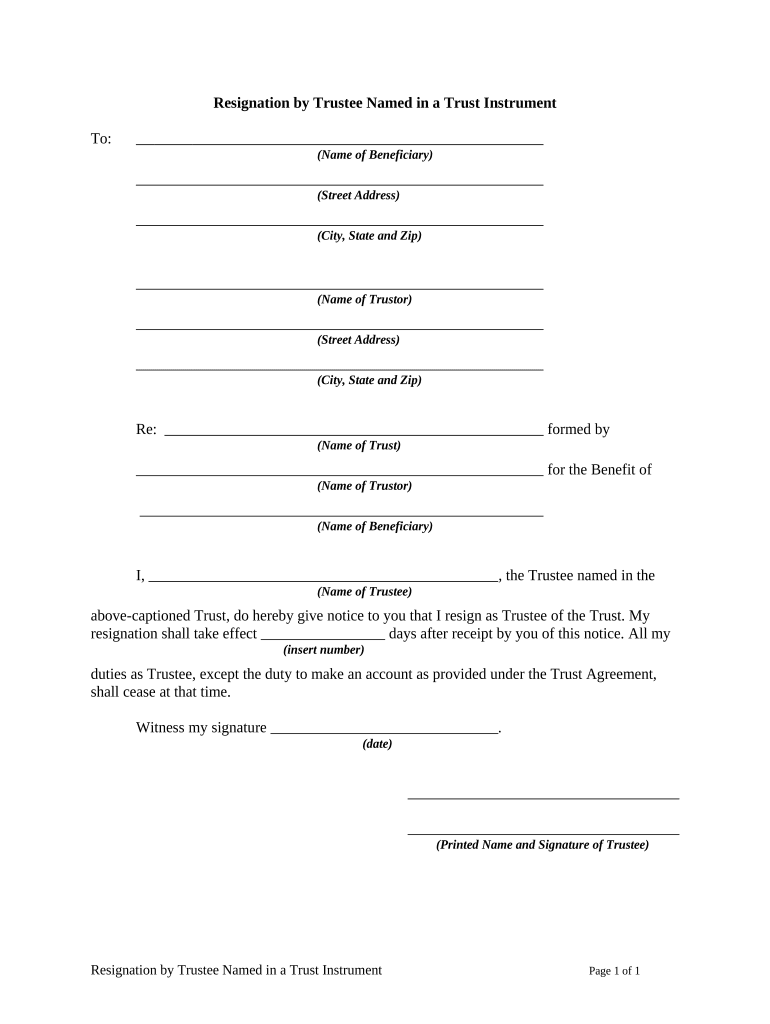
The Resignation Trustee Form is a formal written notice used when a trustee resigns and transfers duties to a successor or the trust’s remaining trustees. It records the resigning trustee’s effective date, the reason for resignation if required, and the acceptance of any successor trustee. The document provides a clear chain of authority for trust administration, reduces disputes about authority, and creates an auditable record for beneficiaries, financial institutions, and courts. Parties often file a recorded resignation with the trust’s service providers and, when required, present notarized or witnessed resignation statements.

Why a Clear, Executed Resignation Protects Trustees and Beneficiaries

A Resignation Trustee Form clarifies who controls trust assets, documents the effective resignation date, and helps prevent contested actions by beneficiaries or third parties. It supports administrative continuity, enables institutions to update account signatories, and creates a provable record for legal or tax purposes.

Why a Clear, Executed Resignation Protects Trustees and Beneficiaries

Step-by-Step: From Draft to Institution Acceptance

Follow these steps to complete and finalize a Resignation Trustee Form correctly before submitting to institutions.

  • 01
    Prepare: Gather trust document and identification for trustee.
  • 02
    Complete: Enter names, effective date, and successor details.
  • 03
    Notarize: Sign before notary; follow state RON rules if used.
  • 04
    Distribute: Send copies to beneficiaries, banks, and counsel.

Who Commonly Completes or Receives a Resignation Trustee Form

Common users who complete or receive a Resignation Trustee Form include trustees, beneficiaries, and trust attorneys.

  • Current trustee resigning and documenting transfer of duties to a successor trustee or co-trustees.
  • Successor trustees accepting appointment and confirming authority to act on trust matters.
  • Trust counsel and estate administrators preparing records for banks, brokers, and probate courts.

Typical Signatories and Their Roles

Trustee (Resigning)

A resigning trustee signs the form to relinquish authority, state effective date, and provide contact information. They may need to deliver the signed and notarized document to co-trustees, beneficiaries, banks, and title companies to update accounts and records.

Successor Trustee

A successor trustee who accepts appointment signs or acknowledges acceptance, collects the resignation record, and presents it to financial institutions. Acceptance confirms authority to manage trust assets and is often required before banks or brokers will permit transactions.

Essential Data Elements to Include

Trust Name: Full legal trust name exactly
Trustee Name: Full legal name as ID
Effective Date: Enter date as MM/DD/YYYY
Reason (optional): Provide brief explanation or code
Successor Details: Successor name, address, and phone
Notary Block: Include signature, seal, and date

Consequences of an Incorrect or Incomplete Resignation

Invalid Transfer: May cause unauthorized asset movement
Bank Refusal: Institutions may block account changes
Beneficiary Dispute: Increased litigation risk and costs
Tax Reporting Issue: Incorrect trustee records affect filings
Notary Noncompliance: Rejection for improper notarization
Fraud Allegations: Possible civil and criminal exposure

Common Pitfalls to Avoid When Preparing the Form

  • Omitting the effective date creates uncertainty about when authority shifts and can delay bank or title acceptance when executing transactions.
  • Using abbreviations or initials instead of full legal names leads to mismatches with IDs and triggers requests for corrected documentation.
  • Failing to include successor contact details requires institutions to seek further verification, prolonging access to accounts and trust assets.
  • Delivering an unsigned or improperly witnessed form can void the resignation and necessitate notarized re-execution, increasing administrative delay.

How the Resignation Process Flows from Signing to Record Update

A Resignation Trustee Form progresses from execution and notarization to institutional acceptance and updated account permissions, creating an auditable record for administrators.

  • Execution: Trustee signs and dates the form.
  • Notarization: Notary verifies identity and applies seal.
  • Acceptance: Successor or co-trustees acknowledge and accept.
  • Update Records: Banks and brokers update authorized signers.

Key Components of a Professional Resignation Trustee Form

A professional Resignation Trustee Form is concise, includes formal acceptance, complies with notarization rules, and presents information in a way that institutions and courts can verify quickly.

Trust Identification

Include the full trust name, date of trust instrument, and taxpayer identification if available. Precise identification prevents ambiguity when institutions match the resignation to trust accounts and records.
Resigning Statement

A clear declaration that the trustee resigns, the scope of powers relinquished, and any limitations. Use unambiguous language to avoid disputes about whether resignation applies to all trust powers.

Successor Acceptance

A signed acceptance by the successor trustee or co-trustees acknowledging appointment and consent to act. Acceptance may be required by financial institutions before access to accounts is granted.

Effective Date

Specify the exact effective date of resignation in MM/DD/YYYY format. The effective date determines when signing authority and fiduciary duties transfer to successors. Include time of day if needed.

Notary Acknowledgement

Provide a notary block with state-specific language, signature, seal, and date. For remote notarization, include the RON session record and comply with state identity-proofing rules.

Attachments

Attach trustee resignation letters, appointment documents, amended trust instruments, or court orders that affect trustee authority. Supporting documents streamline verification and reduce requests for supplemental evidence.

Formats and Supporting Files to Keep with the Signed Form

Make final signed copies available in multiple formats and attach supporting documents; properly labeled files help institutions and counsel locate the resignation quickly.

PDF/A Archive

Save a PDF/A copy for long-term archival. PDF/A preserves document structure and metadata, ensuring future accessibility and reducing format incompatibility with institutional record systems effectively.

Signed Copy

Distribute a certified signed PDF that includes the audit trail or certificate of completion. Financial institutions commonly require the signed file for acceptance and account changes.

Editable Record

Keep an unflattened, editable copy in document management systems for internal review. Mark it as 'draft' or 'executed' to avoid confusion when multiple versions exist.

Physical Storage

Maintain one original signed paper copy in a secure, fire-resistant location. Note the storage location in trust records and trustee handover checklists for reference only.

Best Practices to Complete and Deliver a Clean Resignation

Adopt consistent formatting, use clear legal names, and confirm notarization and successor acceptance before distributing the resignation.

Use full legal names and IDs
Enter names exactly as they appear on government-issued identification and on the trust instrument. Mismatches often cause banks or brokers to refuse changes and require corrected, notarized resignations, adding delay and cost.
Confirm successor acceptance in writing
Obtain a signed acceptance from the successor trustee that explicitly acknowledges appointment and willingness to serve. Without written acceptance, institutions may not grant authority, leading to operational interruptions when accessing trust funds.
Follow state notarization and RON rules
Verify whether your state allows remote online notarization and whether the resignation requires in-person witnessing. Comply with identity-proofing, audio-video retention, and notarial language to avoid rejection by courts or institutions.
Provide supporting trust documentation with resignation
Attach the trust instrument, any amendment showing successor appointment, and trustee resignation letters. These exhibits help banks and title companies confirm authority and reduce requests for additional documentation or legal opinions.

Timing Expectations: Notarization, Institutional Processing, and Notices

Timelines vary by institution and state; plan for notarization, institutional processing, and notice to beneficiaries when resigning as trustee.

Effective Date:

Use the date specified on the form.

Bank Processing Time:

Typically 1 to 10 business days for account updates.

RON Record Retention:

Audio-video records retained 5 to 10 years per many states.

Notice to Beneficiaries:

Provide notice within a reasonable time; check state law.

Record Filing:

File with banks or title companies as institutions require.

Short Use Cases: How Organizations Use Resignation Forms

Real examples show how different organizations streamline trustee resignations and reduce administrative friction.

Martin Properties — Tim Martin

A regional real estate firm used an electronic resignation workflow for trustee changes to speed closings and reduce in-person signings.

  • Reduced turnaround time for account changes.
  • I can process and execute all of these documents online with 100% compliance and built-in security. Whether on mobile or working offline, I can get forms back to their necessary parties efficiently.

Fertility Centers — John Butler

A healthcare practice replaced paper resignations to secure patient-related account authority and meet HIPAA retention rules.

  • Maintained HIPAA-compliant records and audit trails.
  • Their implementation reduced administrative burden and ensured secure handling of patient-authority changes. 'The airSlate SignNow team has been exceptional, responsive, the API has been great, and we're extremely happy that we chose airSlate SignNow as a company.'

Recommended eSignature Workflow Settings for This Form

Typical eSignature workflow settings for customizing a Resignation Trustee Form before sending or storing in your platform.

Field Configuration
Authentication Email link, SMS code, or KBA
RON Enabled Yes if state permits with identity-proofing
Template Name Resignation Trustee Form template version number
Signer Order Trustee first, successor next, then witnesses/notary

Platform Capabilities to Check Before eSigning

Choose a platform that supports PDF and Word formats, integrates with document storage, and meets required authentication for trustee resignations.

  • File Formats: PDF, DOCX, HTML, or Excel supported
  • Integrations: Salesforce, NetSuite, Google Workspace, Box, Procore
  • Authentication: Email, SMS, KBA, SSO options available

Electronic Resignation vs Paper/Notarized Resignation

Compare electronic resignation filings with traditional paper resignations to weigh acceptance, speed, and authentication requirements across institutions.

Criteria Electronic Resignation Paper/Notarized Resignation
Legal Validity
Notarization ron if required notary acknowledgement
Institution Acceptance varies by institution widely accepted
Processing Time hours–days days–weeks

Pricing and Feature Comparison for eSignature Platforms

Common eSignature pricing and features compared for executing and storing a Resignation Trustee Form; signNow is listed first in the table.

signNow DocuSign Adobe Sign PandaDoc HelloSign
Starting Price $8/user/mo $15/user/mo $14/user/mo $19/user/mo $15/user/mo
Free Trial 7-day free trial Varies by plan Varies by plan Varies by plan Varies by plan
Bulk Send Available Available Available Available Available
Audit Trail Yes Yes Yes Yes Yes
HIPAA Compliant Yes Yes Yes No No
Envelope Cap No envelope cap 100 envelopes/user/year Varies by plan Varies by plan Varies by plan

Key Milestones from Execution to Institutional Update

Key milestones for processing a trustee resignation from execution through institutional acceptance and record updating.

01

Prepare Documents

Assemble trust instrument, resignation form, and ID.

02

Execute and Notarize

Sign with notary or RON session as applicable.

03

Notify Beneficiaries

Send copies to beneficiaries and counsel.

04

Institutional Update

Banks update signers and grant successor access.

Frequently Asked Questions and Troubleshooting

Answers to common questions about completing, notarizing, and submitting a Resignation Trustee Form in the United States.


Need help? Contact support

be ready to get more
Join over 28 million airSlate SignNow users