Establishing secure connection…Loading editor…Preparing document…

New Jersey Right-of-Way Use Agreement

This template is fully customizable. Edit the text, fill out the fields, and send it for signature. Give it a try!
New Jersey Right-of-Way Use Agreement

What the New Jersey Right-of-Way Use Agreement Is

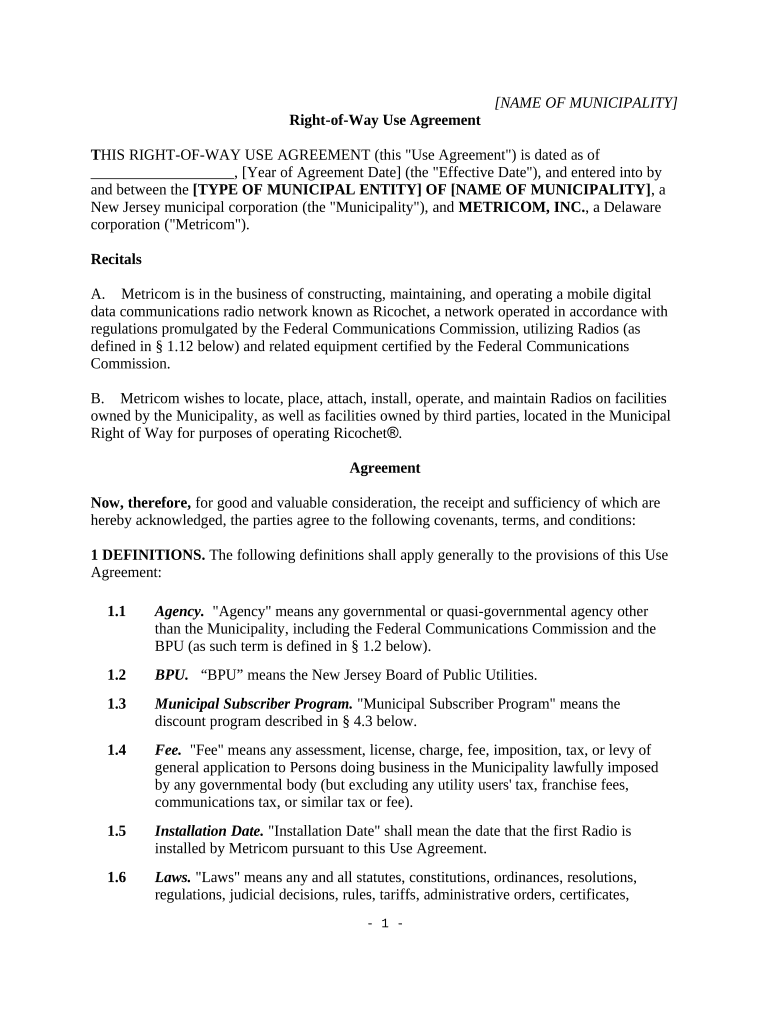
A New Jersey Right-of-Way Use Agreement is a legal contract that authorizes a private party, utility, or contractor to occupy, install equipment in, or perform work within a public right-of-way under municipal or county control. The agreement typically specifies the permitted use, exact location and legal description, required permits, insurance and indemnity obligations, restoration and maintenance responsibilities, duration and renewal terms, inspection rights, compensation or permit fees, and procedures for termination or removal. It coordinates municipal oversight with any state or federal approvals required for work in roadways or public easements.

Why a Formal Agreement Matters

A written Right-of-Way Use Agreement clarifies legal responsibility, reduces dispute risk, and documents municipal consent. Properly executed agreements support compliance with local ordinances and provide an auditable record; e-signature and records tools that comply with ESIGN and UETA can accelerate execution and retention.

Why a Formal Agreement Matters

Who Typically Completes This Agreement

Multiple parties prepare and sign right-of-way agreements depending on project type and jurisdiction.

  • Municipal officials and public works directors who approve access and set permit conditions.
  • Utilities and telecommunications firms seeking to install or maintain poles, conduit, or fiber.
  • General contractors and specialty contractors performing excavation, paving, or utility relocations.

Core Sections to Expect in a Professional Agreement

A complete Right-of-Way Use Agreement organizes obligations, risk allocation, and administrative steps so both the public agency and the permittee can rely on a clear, enforceable record.

Parties

Full legal names and entity types for the municipality and permittee, including contact and billing information to ensure proper legal attribution and service of notices.
Location Detail

Precise legal description, map or plan references, and GPS coordinates where appropriate so work limits and restoration obligations are unambiguous and enforceable.

Term

Effective date, expiration, renewal provisions, and early termination rights to define when rights begin and how long obligations remain in force.

Permits and Approvals

Reference to required municipal permits, traffic control plans, and any state or federal authorizations needed before work starts to avoid regulatory violations.

Insurance & Indemnity

Minimum insurance limits, additional insured endorsements, and indemnity language allocating third-party claims and restoration costs to the responsible party.

Restoration & Maintenance

Standards for restoration after work, maintenance responsibilities, inspection rights, and remedies for defective work or failure to restore public property.

Step-by-Step: Preparing and Executing the Agreement

Follow a consistent sequence to assemble the package, obtain approvals, and complete execution to minimize back-and-forth with the municipality.

  • 01
    Gather documents: Include plans, insurance, and legal descriptions before submission.
  • 02
    Submit application: File the agreement with required permits and processing fee.
  • 03
    Municipal review: Respond to comments and provide any requested clarifications.
  • 04
    Execute and archive: Sign all parties and retain a dated, reproducible copy.

Configure an Efficient Digital Workflow

Set up the electronic routing, authentication, and storage settings before sending to reduce signer friction and audit issues.

Field Configuration
Authentication Method Email link with optional SMS code or KBA for higher assurance
Signing Order Sequential or parallel signing depending on municipal requirements
Notification Settings Automatic reminders and completion notices to all parties
File Format PDF/A for long-term retention and compatibility

Where to File, Send, and Record the Agreement

Know the correct recipients and recording steps to ensure the agreement is effective and publicly accessible where required.

  • Submit to municipality: Send the signed agreement and permit application to the local public works or engineering office.
  • Obtain review: Municipal staff reviews plans, insurance, and bond requirements before approval.
  • Perform work: Complete installation following approved traffic control and inspection protocols.
  • Record or archive: File any required encumbrance or permit with county records or municipal clerk.

Digital Signing and Technical Requirements

Use platforms that produce auditable, tamper-evident records and export standard PDF/A files for long-term storage.

  • File formats: PDF/A, DOCX, and exported audit reports
  • Integrations: Connectors for cloud storage and ERP systems
  • Authentication: Email, SMS code, or KBA options

Typical eSignature Pricing and Feature Comparison

Select a platform that meets compliance and workflow needs; the table summarizes common vendor pricing and feature availability for document signing.

signNow DocuSign Adobe Sign PandaDoc HelloSign
Starting Price $8/user/mo $15/user/mo $14/user/mo $19/user/mo $15/user/mo
Free Trial 7-day free trial Varies by vendor Varies by vendor Varies by vendor Varies by vendor
Bulk Send Yes Yes Yes Yes No
Audit Trail Yes Yes Yes Yes Yes
HIPAA Compliant Yes Yes Yes No No
Envelope Cap No cap 100 envelopes/user/year Varies Varies Varies

Security and Compliance Controls to Verify

Encryption in transit: TLS 1.2 / 1.3
Encryption at rest: AES-256 authenticated
Certifications: SOC 2 Type II and ISO 27001
HIPAA readiness: BAA available when required
Audit trail: Tamper-evident signing history
Access controls: Role-based access and 2FA

Common Risks and Potential Penalties

Permit denial: Application rejected for incomplete submissions
Restoration liability: Contractor pays to restore public property
Administrative fines: Local ordinance fines may apply
Project delays: Work halted pending corrected approvals
Insurance gaps: Claims not covered for insufficient limits
Enforceability risk: Improper execution can invalidate provisions

Typical Timelines and Processing Expectations

Processing times vary widely by municipality; plan for review, bonding, and scheduling in advance to avoid project delays.

Application submission:

File complete package with plans, insurance, and fees

Municipal review period:

Varies by jurisdiction; 30–90 days typical for complex permits

Bond posting:

If required, post bond or escrow before permit issuance

Construction window:

Work scheduled after permit issuance and any required inspections

Recordation or closure:

File final as-built or completion certificate where required

Real-World Examples of Digital Execution

Organizations use electronic workflows to shorten approval cycles and maintain auditable records while complying with applicable standards and certifications.

Martin Properties — Tim Martin

Martin Properties moved municipal agreements online to remove in-person delays and physical routing.

  • Signed and returned documents from mobile devices.
  • "I can process and execute all of these documents online with 100% compliance and built-in security. Whether on mobile or working offline, I can get forms back to their necessary parties efficiently."

BIS — Dan Rotelli

A compliance-focused operator prioritized secure, auditable signatures for municipal contracts.

  • Chose a platform with SOC 2 controls.
  • "We felt most comfortable with airSlate SignNow given their SOC 2 certification and strict focus on ESIGN and UETA act compliance."

Frequently Asked Questions and Practical Answers

Answers to common execution, recordation, and e-signature questions for New Jersey right-of-way agreements.


Need help? Contact support

be ready to get more
Join over 28 million airSlate SignNow users