Establishing secure connection…Loading editor…Preparing document…

Smoking Policy Letter

This template is fully customizable. Edit the text, fill out the fields, and send it for signature. Give it a try!
Smoking Policy Letter

What a Smoking Policy Letter Is and When It’s Used

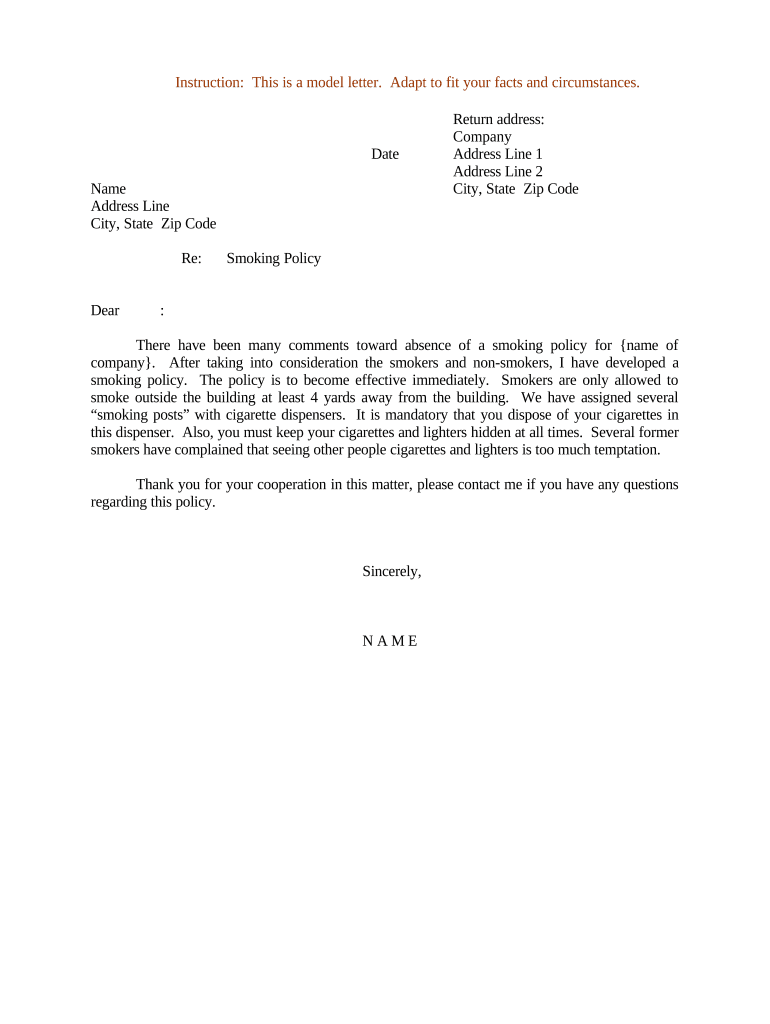
A Smoking Policy Letter is a formal written notice issued by an employer, landlord, school, or property manager that explains where, when, and how smoking or vaping is permitted or prohibited on the premises. The letter typically identifies the scope (building, campus, vehicle), effective date, designated smoking areas or full bans, enforcement measures, and any required employee or occupant acknowledgment. It may reference applicable local or state smoke-free laws and is compatible with electronic delivery and signatures governed by ESIGN (15 U.S.C. §7001) and UETA where adopted.

Why a Clear, Written Notice Matters

A concise Smoking Policy Letter clarifies expectations, supports consistent enforcement, documents notice to affected parties, and reduces disputes by creating a contemporaneous record of policy terms and the date of issuance.

Why a Clear, Written Notice Matters

Who Typically Issues or Receives This Letter

Typical senders and recipients are grouped below to help you determine whether to use this template.

  • Employers — HR or risk management issuing workplace smoking rules and seeking employee acknowledgments.
  • Property managers/landlords — notifying tenants about building-wide or unit-level smoking restrictions.
  • Educational institutions — colleges, universities, and K–12 administrators implementing campus smoke-free zones.

Essential Elements to Include in a Professional Letter

Include clearly labeled sections so recipients can review obligations quickly; use plain language, effective dates, and a signature or acknowledgment area to document acceptance.

Policy Scope

Describe specific locations covered (indoor areas, outdoor patios, common areas, vehicles) and whether personal devices such as e-cigarettes are included.
Effective Date

State the date the policy becomes enforceable and whether there is a transition or grace period for compliance.

Designated Areas

Identify any approved smoking zones, including distance from entrances and any shelter or containment rules.

Exceptions

List lawful exceptions such as private residences, authorized research, or exemptions required by statute or accommodation.

Enforcement

Explain progressive enforcement steps (warnings, fines, lease remedies, disciplinary actions) and the party responsible for enforcement.

Acknowledgment

Provide a place for recipient signature, date, and printed name to document receipt and acceptance of the policy.

Required Information to Make the Letter Actionable

Sender Name: Organization or landlord legal name
Recipient Name: Individual or tenant full legal name
Premises Address: Street, city, state, ZIP
Effective Date: MM/DD/YYYY format
Signature Block: Signer name, title, date
Contact Info: Phone or email for questions

Step-by-Step: Prepare and Issue a Smoking Policy Letter

Follow these sequential steps to draft, approve, distribute, and record recipient acknowledgments efficiently.

  • 01
    Draft Policy: Write clear scope, rules, exceptions, and enforcement language.
  • 02
    Legal Review: Have counsel confirm compliance with local and state laws.
  • 03
    Approve Internally: Obtain sign-off from HR, property management, or executive leadership.
  • 04
    Distribute and Collect: Send letters, obtain signed acknowledgments, and archive copies.

Where to File, Send, and Store the Signed Letter

Designate routing and retention at the point you issue the letter so recipients and administrators know where to send signed copies.

  • HR Records: Store employee acknowledgments in personnel files.
  • Tenant Files: Keep signed letters with lease records.
  • Digital Archive: Save signed PDFs in a secure document repository.
  • Compliance Folder: Retain copies for inspections or legal inquiries.

How to Configure an Online Distribution and Collection Workflow

Configure fields and routing so the letter is delivered, signed, and filed automatically with minimal manual work.

Field Configuration
Notification method Email delivery plus posted intranet notice
Acknowledgment field Required signature and date
Reminder schedule Automatic reminders at 7 and 30 days
Access control HR admin role only

Digital Signing and Submission: Technical Considerations

Electronic delivery and e-signature simplify distribution but require configuration for authentication, formats, and integrations.

  • File formats: PDF and DOCX supported
  • Integrations: Connects to HR or document storage systems
  • Authentication: Email, SMS code, or stronger KBA

Typical Timeline and Notice Deadlines

Set clear internal deadlines so staff know when to distribute, when recipients must respond, and when enforcement begins.

Policy finalized:

Draft and obtain internal approval before distribution

Advance notice period:

Provide at least 14 days' notice when possible

Acknowledgment deadline:

Require signed return within 30 days of receipt

Enforcement start:

Begin enforcement on the stated effective date

Annual review:

Review policy language and compliance annually

Common Mistakes to Avoid When Preparing the Letter

  • Using vague location language such as 'common areas' without precisely defining boundaries and distances from entrances can create enforcement disputes.
  • Failing to reference applicable local or state smoke-free laws and exemptions leads to unenforceable or inconsistent provisions.
  • Not collecting signed acknowledgments or failing to retain proof of delivery weakens the organization's ability to demonstrate notice.
  • Applying the policy unevenly across similarly situated employees or tenants risks discrimination or wrongful enforcement claims.

Potential Consequences of an Inadequate Letter

Administrative fines: Local agency penalties possible
Liability exposure: Civil claims for nuisance or negligence
Workers' comp risk: Claims related to secondhand smoke
Discrimination claims: Unequal enforcement may trigger complaints
Invalid enforcement: Improper notice undermines remedies
Recordkeeping failures: Loss of evidence for disputes

eSignature Vendor Comparison for Distributing a Smoking Policy Letter

Common eSignature providers offer audit trails, bulk send, and varying plans; signNow appears first for direct feature and price comparison.

signNow DocuSign Adobe Sign PandaDoc HelloSign
Starting Price $8/user/mo $15/user/mo $14/user/mo $19/user/mo $15/user/mo
Free Trial 7-day free trial No No Yes, limited Yes, limited
Bulk Send Yes Yes Yes Yes No
Audit Trail Yes Yes Yes Yes Yes
HIPAA Compliant Yes Yes Yes No No
Envelope Cap No cap 100 envelopes/user/year Varies Varies Varies

Frequently Asked Questions About the Smoking Policy Letter

Answers to common questions on legality, e-signing, notarization, enforcement, and updating the letter to reduce uncertainty.


Need help? Contact support

be ready to get more
Join over 28 million airSlate SignNow users