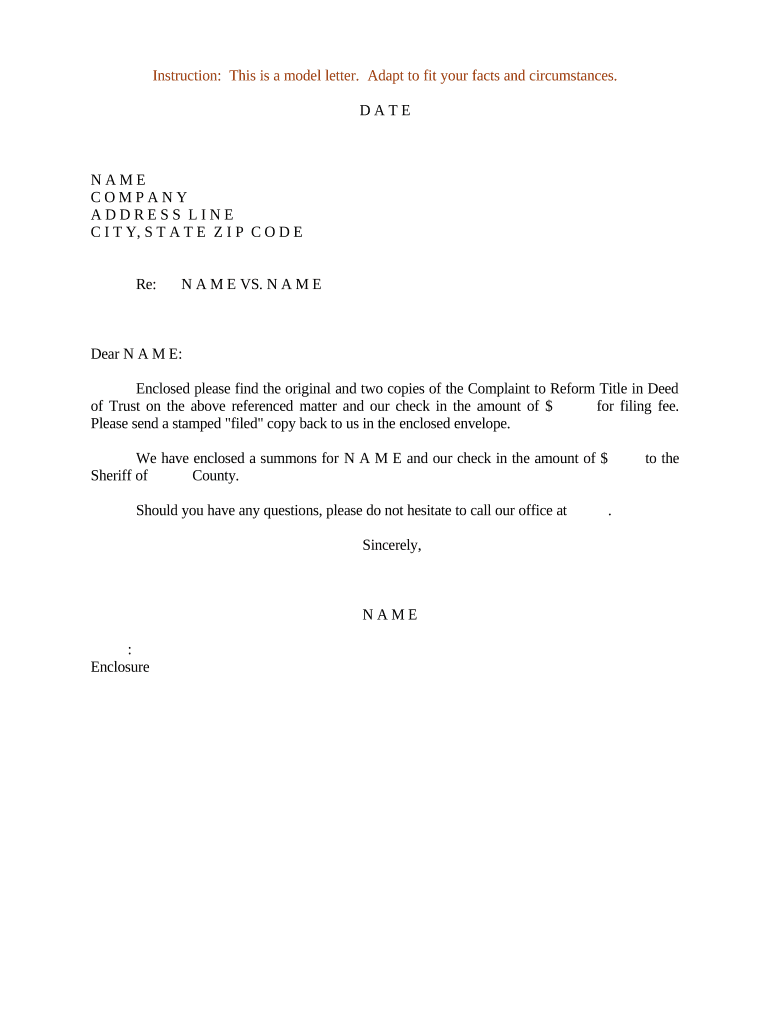
Quiet Title Complaint
What a Quiet Title Complaint Is and when it is used
Why filing a Quiet Title Complaint may be necessary
Filing clarifies ownership, removes clouds on title, and enables clear marketable title for sale, refinancing, or development. It is often required when title insurance will not insure an unresolved claim or when competing interests cannot be resolved by negotiation.
Who typically initiates or uses a Quiet Title Complaint
The complaint is used by parties who need a court decree to establish or confirm ownership and clear defects.
- Property owners asserting superior title against recorded or unrecorded claims.
- Lenders or purchasers requiring a judicial determination to insure or accept title.
- Real estate investors or developers resolving boundary or title cloud risks.
Typical signers and their roles
Plaintiff (Owner)
An individual or entity claiming superior legal title who signs under penalty of perjury; often provides supporting deeds, affidavits, and exhibits to prove chain of title.
Authorized Attorney
An attorney of record prepares and files the complaint, signs court filings, and represents the plaintiff at hearings; attorney involvement reduces procedural risk and addresses service and jurisdiction issues.
Step-by-step: preparing and filing a Quiet Title Complaint
-
01Draft Complaint: Describe parties, legal description, and grounds for relief.
-
02Attach Records: Include deeds, chain of title, affidavits, and lien notices.
-
03Serve Defendants: Use statutory service methods (personal, certified, publication).
-
04Court Hearing: Request decree after judgment or default; obtain order quieting title.
Recommended digital workflow settings for preparing the complaint
| Field | Configuration |
|---|---|
| Case Caption | Use court-required format: Plaintiff v. Defendant |
| Filing Method | Choose eFile if supported or paper filing per county rule |
| Service Method | Select certified mail, personal service, or publication as needed |
| Attachments | Attach recorded deeds, title reports, and affidavits |
Technical considerations for digital completion and submission
Use platforms that accept PDF/DOCX, produce an audit trail, and support signer authentication.
- File Formats: PDF and DOCX accepted
- Integrations: Salesforce, NetSuite, Google Workspace
- Authentication: Email, SMS, or two-factor
Overview: digital signing and case submission flow
-
Prepare Documents: Upload complaint and exhibits to the platform.
-
Add Signers: Assign signature fields and authentication methods.
-
Capture Signatures: Signers complete e-signature steps and receive copies.
-
File with Court: Submit signed complaint via eFile or courthouse clerk.
Key risks and penalties from errors in the complaint
Common preparation mistakes to avoid
- Listing incorrect defendants or omitting known lienholders, which can result in incomplete relief and later challenges.
- Using an insufficient legal description (street address only) rather than the recorded metes-and-bounds or lot-block reference.
- Failing to attach or reference the primary recorded instruments that form the chain of title and support allegations.
- Choosing improper service methods or not following publication requirements when defendants cannot be located.
Typical timelines and deadlines during a quiet title action
Service Deadline:
Serve defendants promptly per local rules; timetable varies by jurisdiction
Answer Period:
Defendant usually has 20–30 days to respond after service
Default Judgment:
May be requested if defendant fails to appear
Hearing Scheduling:
Court hearing dates depend on calendar and complexity
Appeal Window:
Statutory appeal period typically 30 days post-judgment
eSignature vendor pricing and capability snapshot relevant to Quiet Title documents
| signNow | DocuSign | Adobe Sign | PandaDoc | HelloSign | |
|---|---|---|---|---|---|
| Starting Price | $8/user/mo | $15/user/mo | $14/user/mo | $19/user/mo | $15/user/mo |
| Free Trial | 7-day free trial | Varies by vendor | Varies by vendor | Varies by vendor | Varies by vendor |
| Bulk Send | Yes | Yes | Yes | Yes | Varies by plan |
| Audit Trail | Yes | Yes | Yes | Yes | Yes |
| HIPAA Compliant | Yes | Yes | Yes | No | No |
Representative scenarios where a Quiet Title Complaint resolved a dispute
Boundary Dispute Resolved
A homeowner discovered a decades-old fence line dispute and filed suit to quiet title.
- Plaintiff presented decades of occupancy records.
- The court issued a decree clarifying the boundary and enabling the homeowner to obtain title insurance and proceed with a sale.
Forged Deed Removed
An owner found a forged conveyance in the chain of title and sued to cancel the instrument.
- Forensic document evidence supported the claim.
- The court cancelled the forged deed, restored title to the rightful owner, and permitted recording a corrective deed.
Frequently asked questions about Quiet Title Complaints
-
Who must be named as a defendant
Name all parties with a recorded or asserted interest in the property, including mortgagees, lienholders, unknown heirs, and anyone claiming adverse possession; omitting a necessary party can leave a cloud on title despite a judgment.
-
Is notarization required for the complaint
Court pleadings themselves typically do not require notarization, but deeds, affidavits, and acknowledgements attached as exhibits usually must be notarized according to local recording rules.
-
Can the complaint be e-signed and e-filed
Many jurisdictions accept electronically signed documents consistent with ESIGN and UETA; verify e-filing rules with the county clerk or court and ensure the eSignature method meets authentication requirements.
-
What supporting documents are essential
Provide recorded deeds, title reports, tax records, affidavits of possession or forgery, and any lien instruments; clear exhibits strengthen the factual showing at hearing.
-
How long does the process take
Timing depends on service, contested responses, and court calendars; uncontested matters may resolve in weeks, contested suits often take months to years depending on complexity.
-
When should I consult an attorney
Consult counsel before filing if defendants are numerous, claims include fraud or complex chain issues, or when significant monetary or title interests are at stake; attorney review reduces procedural and substantive risk.