Scope of Support
Describe covered software, supported versions, and excluded features or third-party components. Specify whether support includes bug fixes, security patches, enhancements, and whether on-premises or cloud components are covered.
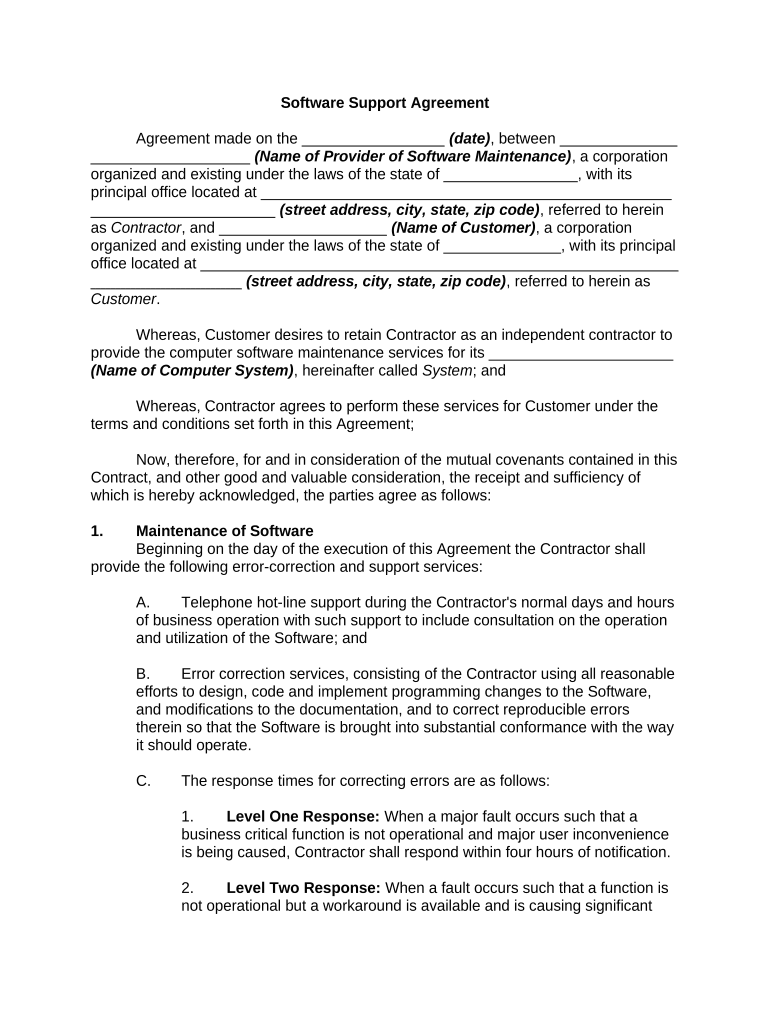
A precise Software Support Agreement reduces downtime, aligns expectations about response times and deliverables, and limits financial and legal exposure by defining fees, termination rights, and liability caps. It also documents procedures for change requests and escalation, which helps both vendor and customer manage ongoing operations without frequent disputes.

Organizations and individuals from both vendor and customer sides fill, review, and approve Software Support Agreements before support services begin.
The authorized vendor signatory (CEO, VP Sales, or Contracts Manager) confirms the vendor’s capacity to deliver services, accepts commercial terms, and binds the vendor to SLAs. This person must have authority to commit resources and agree to indemnities and liability limits on behalf of the provider.
The customer signatory (IT Director, Procurement Officer, or General Counsel) confirms budget approval and operational acceptance. Signing indicates the customer agrees to payment terms, support scope, data handling clauses, and termination provisions and has authority to bind the purchasing organization.
Describe covered software, supported versions, and excluded features or third-party components. Specify whether support includes bug fixes, security patches, enhancements, and whether on-premises or cloud components are covered.
Define response and resolution timeframes for different severity levels, business hours coverage, and on-call/after-hours commitments. Tie service credits or remedies to missed SLAs where appropriate.
State fee structure (monthly, annual, per-incident), invoicing cadence, late-payment consequences, and whether fees escalate on renewal. Clarify one-time onboarding or transition charges.
Specify initial term, automatic renewal, notice periods for nonrenewal or termination for convenience, and grounds for termination for cause, including material breach procedures.
Include process for change requests, prioritization, impact assessment, cost estimates, and approval workflow. State how changes affect SLAs and delivery timelines.
Address handling of customer data, encryption and access controls, breach notification timelines, and required addenda such as a HIPAA BAA where protected health information is involved.
Optica needed consistent, simple execution of post-sale support agreements to reduce turnaround time and customer friction.
A healthcare provider required secure, auditable signatures on support and service forms while meeting privacy rules.
| Field | Configuration |
|---|---|
| Authentication Method | Email link, SMS code, or advanced signer verification |
| Template Reuse | Save standard agreement templates for consistent issuance |
| Bulk Send | Enable bulk distribution for mass renewals or notices |
| Notifications | Automated reminders for pending signatures and renewals |
Choose a platform that supports required integrations, document formats, and authentication methods for your organization.