License Grant
Describe precisely what is licensed (software, source code, patents, data), whether the grant is exclusive, the permitted uses, and any restrictions such as no reverse engineering or geographic limits.
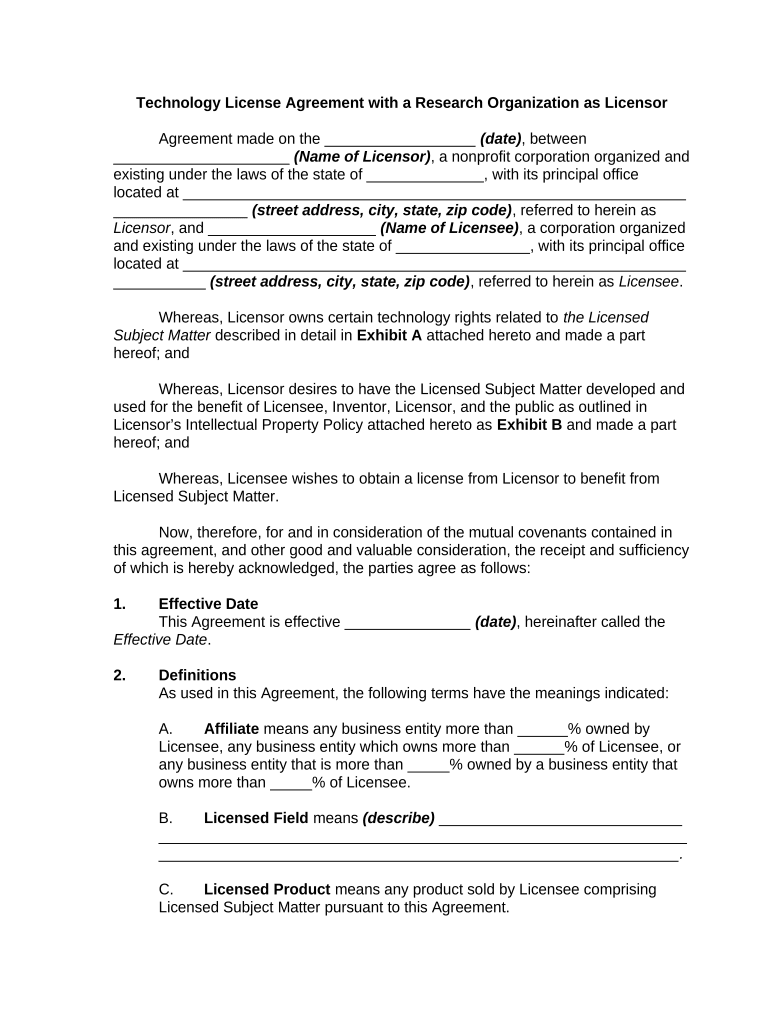
A well-drafted agreement allocates commercial rights, protects intellectual property, and reduces the risk of future disputes by defining scope, payments, and liability in measurable terms.

Technology License Agreements are used by creators, businesses that license technology, and legal or commercial teams who manage IP commercialization.
Parties often involve in-house counsel, procurement, CTOs, or external IP attorneys to finalize technical, commercial, and compliance terms.
The licensor’s authorized executive or corporate counsel should confirm ownership of the licensed technology and sign to grant rights. The signing individual must have corporate authority to bind the licensor and accept any continuing obligations, such as indemnities or warranty disclaimers.
The licensee’s representative (often a CTO, CFO, or contracting officer) should sign after confirming scope, fees, and operational obligations. Financial signers validate payment terms and ensure integrations or sublicensing rights meet internal controls.
Describe precisely what is licensed (software, source code, patents, data), whether the grant is exclusive, the permitted uses, and any restrictions such as no reverse engineering or geographic limits.
Define the field of use, territory, and whether sublicenses are permitted. Limitations on use prevent unexpected exploitation or competitive licensing in the same market.
State the effective date, initial term, renewal mechanics, and termination rights for material breach, insolvency, or failure to pay royalties.
Set license fees, royalties, minimum guarantees, payment schedule, audit rights, and taxes. Specify invoicing procedure and currency to avoid disputes.
Clarify that ownership of preexisting IP remains with the original owner and set terms for any new IP arising from collaborative work or modifications.
Limit warranties to what the parties can reasonably control, include indemnities for third‑party IP claims, and set liability caps consistent with negotiations.
| Field | Configuration |
|---|---|
| Signature Field | Required | visible signature block | date auto-fill |
| Authentication Method | Email link, SMS code, or advanced methods like KBA |
| Conditional Logic | Show payment clauses only when fees are non-zero |
| Audit Trail | Capture timestamps, IP, and certificate of completion |
Choose a platform that supports required authentication, audit trails, and secure storage for executed agreements.
Confirm the platform’s encryption standards and compliance posture for HIPAA, SOC 2, and ESIGN/UETA before using it for regulated agreements.
| signNow | DocuSign | Adobe Sign | PandaDoc | HelloSign | |
|---|---|---|---|---|---|
| Starting Price | $8/user/mo | $15/user/mo | $14/user/mo | $19/user/mo | $15/user/mo |
| Free Trial | 7-day free trial, no credit card required | Varies by plan | Varies by plan | Varies by plan | Varies by plan |
| Bulk Send | Yes | Yes | Yes | Yes | No |
| Audit Trail | Yes | Yes | Yes | Yes | Yes |
| HIPAA Compliant | Yes | Yes | Yes | No | No |
| Envelope Cap | No cap | 100 envelopes/user/year | Varies by plan | Varies by plan | Varies by plan |
Enter as MM/DD/YYYY; starts all timing obligations
Specify years or months and renewal mechanics
Typically 30–90 days prior to expiration
Show invoice date and net payment terms
Require written notice and cure period for breach
Exchange redlines and resolve material commercial points
Obtain authorized signatures and audit trail
Deliver software, APIs, or technical documentation
Confirm payment, compliance, and support handoffs
Optica implemented an online signature workflow to speed customer acceptance and reduce turnaround time.
Xerox integrated signature workflows with NetSuite for operational efficiency.