Establishing secure connection…Loading editor…Preparing document…

Texas Expungement Form

This template is fully customizable. Edit the text, fill out the fields, and send it for signature. Give it a try!
Texas Expungement Form

What the Texas Expungement Form Is and When It Applies

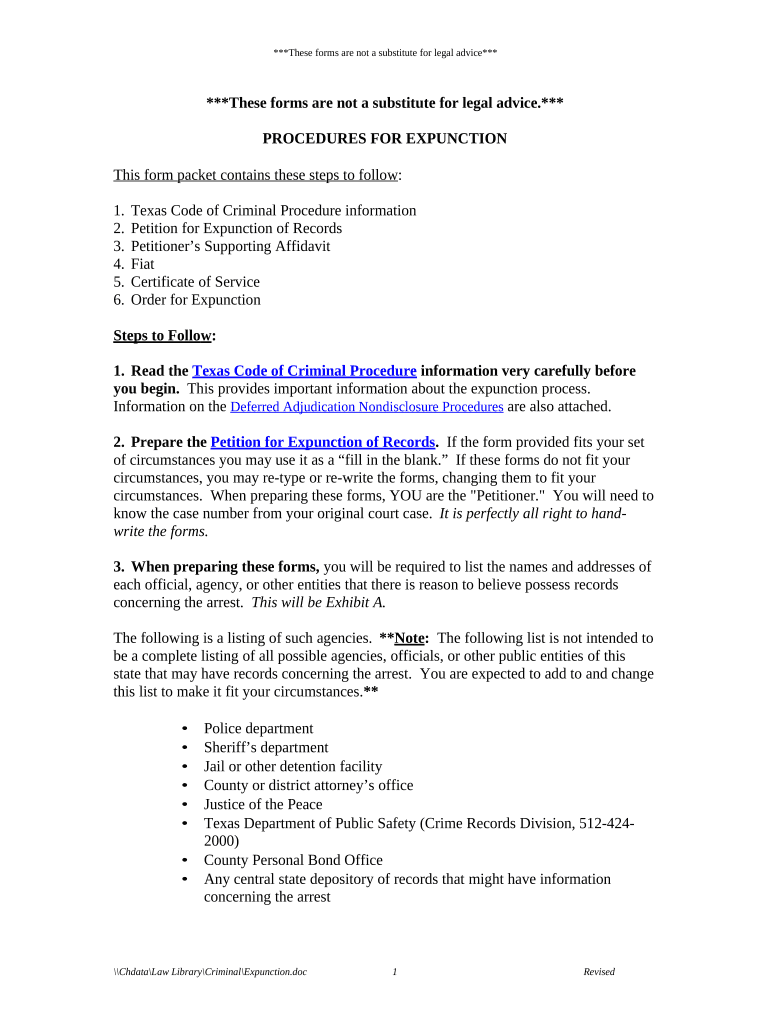
Texas Expungement Form is a court filing used to remove or seal certain criminal records under Texas law. The form initiates the statutory process for nondisclosure or expunction of arrests, convictions, deferred adjudication, or juvenile records when eligibility criteria are met. It includes petitioner information, case identifiers, offense descriptions, and requests for sealing or destruction of records. After filing, the court schedules hearings or issues orders; subsequent notifications are sent to law enforcement and record repositories. This page explains who qualifies, required fields, filing locations, timelines, and common pitfalls.

Why Completing the Texas Expungement Form Matters

Filing a Texas Expungement Form can clear public criminal records, improve employment and housing prospects, and remove barriers to professional licensing when eligibility exists. The court order limits public dissemination and directs agencies to update or destroy records under statutory authority.

Why Completing the Texas Expungement Form Matters

Who Typically Prepares and Files This Form

Typical filers include individuals with dismissed charges, acquitted defendants, and those eligible after completed deferred adjudication or juvenile adjudication.

  • Individuals with arrests that resulted in acquittal or dismissal record
  • People who completed deferred adjudication and meet statutory waiting periods
  • Victims of mistaken identity seeking court order for record destruction

Primary Sections and Attachments Courts Expect

Core sections of the Texas Expungement Form and essential attachments that courts expect when reviewing petitions, including citation table, supporting exhibits, service proof, and legal basis citations.

Caption

Court caption lists petitioner as plaintiff and state or county as defendant; include cause number, court name, judge if known, and complete party addresses for service.
Petitioner Info

Provide full legal name, aliases, date of birth, and contact information; include identifiers to match arrest records, like driver license or ID number.

Case Details

List case numbers, offense dates, disposition types, court orders, and any deferred adjudication entries; attach certified disposition when available to speed review.

Relief Sought

State whether you request expunction, nondisclosure, or sealing, and specify statutes or code sections that support your eligibility for the requested remedy.

Supporting Docs

Attach arrest reports, disposition records, court orders, birth certificates, or affidavits proving identity and disposition; mark exhibits and reference them in the petition.

Service Proof

Include stamped envelopes, return receipts, or signed acknowledgments showing service on prosecutors and agencies; courts require proof before finalizing orders.

Step-by-Step: Preparing and Filing the Form

Follow these steps to prepare and submit a Texas Expungement Form accurately and in compliance with local rules.

  • 01
    Gather Records: Collect charge dispositions, arrest records, and court case numbers.
  • 02
    Confirm Eligibility: Check statutory bars, waiting periods, and exceptions for your offense.
  • 03
    Complete Form: Enter petitioner details, case identifiers, offense dates, and relief requested.
  • 04
    File & Serve: Submit to clerk, pay fees, and serve prosecuting attorney as required.

Configuring an Online Filing and eSignature Workflow

Settings to configure when preparing an online Texas Expungement Form for e-filing and e-signature submission.

Field Configuration
Authentication Email verification plus SMS code for signer
Signature Type Typed, drawn, or uploaded image accepted
Document Format PDF preferred; preserve original court forms
Notification Auto-notify clerk and prosecuting attorney on filing

Filing Flow: From Upload to Court Order

Overview of filing and notification flow after submitting a Texas Expungement Form, including court review and agency updates.

  • Upload: Attach completed form and supporting exhibits.
  • Submit: File with county clerk and pay required fees.
  • Serve: Provide service copies to prosecutor and agencies as ordered.
  • Order: Court may hold hearing then issue order directing records update.

Penalties and Risks of Incorrect or Incomplete Filings

Filing Errors: Case delayed or dismissed
Incorrect Identity: Wrong records retained
Missed Deadlines: Statutory bars remain
Service Failures: Order may be vacated
False Statements: Perjury or sanctions possible
Unremoved Records: Agencies may not update

Common Preparation Challenges to Avoid

  • Incomplete case citations, incorrect county names, or missing cause numbers cause clerks to reject or misroute expunction petitions, adding weeks to processing.
  • Failing to serve the prosecutor or law enforcement agencies as required prevents orders from taking effect against third-party repositories.
  • Relying on non-certified records or uncertified web printouts for case outcomes can force additional discovery or affidavits to prove disposition.
  • Using inconsistent names, dates, or misspelled agency names increases identity mismatches and may trigger hearing continuances.

Practical Steps to Improve Acceptance and Speed

Practical tips to improve acceptance rates and shorten processing for Texas Expungement Form filings in most counties.

Verify statutory eligibility before filing petition
Confirm your eligibility under Texas Code provisions and ensure waiting periods and prior convictions are correctly accounted for; when in doubt, request certified dispositions from the clerk and consult counsel to prevent dismissal for ineligibility.
Attach certified dispositions and minute entries
Including certified court dispositions or minute entries reduces requests for supplemental records; clerks accept certified documents which expedites eligibility review, minimizes continuances, and shortens time to final orders substantially in many counties.
Serve all required parties using local methods
Follow local rules to serve the prosecuting attorney, arresting agencies, and repositories; include certificates of service in the filing to verify notice and prevent later challenges to the court's jurisdiction.
Provide consistent identity documentation across exhibits
Provide matching government-issued ID numbers, full names, and birthdates across all attachments; inconsistent identity details commonly cause hearings, require affidavits, and lengthen the timeline for final orders significantly in many counties.

Technical Requirements for eSubmission and eSignatures

Online submission and eSignature require certain platform capabilities and security measures to comply with ESIGN and local court rules.

  • Integrations: Supports Salesforce, Google Workspace, NetSuite
  • Formats: PDF, DOCX accepted and preserved forms
  • Auth: Email, SMS code, or KBA

Security and Compliance Considerations for Electronic Submissions

Encryption: TLS 1.2 and 1.3; AES-256 at rest
Certifications: SOC 2 Type II, ISO 27001, PCI DSS
Regulatory Compliance: ESIGN, UETA, HIPAA (BAA available), 21 CFR Part 11
Access Controls: SSO, role-based permissions, audit logs
Data Privacy: EU-U.S. Data Privacy Framework available
Accessibility: WCAG 2.0 Level AA support

Comparing eSignature Providers for Completing the Texas Expungement Form

Vendor pricing and feature comparison for eSignature solutions commonly used to complete Texas Expungement Form filings.

signNow DocuSign Adobe Sign PandaDoc HelloSign
Starting Price $8/user/mo $15/user/mo $14/user/mo $19/user/mo $15/user/mo
Free Trial 7-day free trial, no credit card required Free trial availability varies by plan and vendor Free trial availability varies by plan and vendor Free trial availability varies by plan and vendor Free trial availability varies by plan and vendor
Bulk Send Yes, included on Business Premium and up Yes, available on select tiers Yes, included on enterprise plans Yes, available on paid plans No, feature not available on plans
Audit Trail Yes, granular audit trail and certificate Yes, comprehensive audit logs provided Yes, audit trail and tamper evidence Yes, audit logs with timestamps Yes, basic audit trail included
HIPAA Compliant Yes, HIPAA compliant; BAA available Yes, HIPAA support and BAA options Yes, HIPAA configurations available by request No, HIPAA compliance not standard No, does not offer HIPAA BAA
Envelope Cap No envelope cap on paid plans Limit: 100 envelopes per user per year Limits vary by plan and contract Limits depend on plan; check terms Limits vary; consult vendor terms

Real-World Examples of Successful Expungement Filings

Two real-world examples showing typical Texas expungement scenarios and how correct form completion affected outcomes.

Case Example 1

A petitioner with a dismissed misdemeanor found outdated arrest records appearing on public background checks despite dismissal.

  • Filed expunction with certified disposition attached.
  • After providing the court with certified disposition and identification, the clerk issued an expunction order; repositories updated records within six weeks, and the petitioner reported improved hiring responses from employers.

Case Example 2

An individual who completed deferred adjudication for a nonviolent felony sought nondisclosure after waiting period ended and documentation assembled.

  • Clerk required service on multiple agencies.
  • The petitioner served prosecutors and several agencies, included certified orders, and addressed identity mismatches promptly; the court granted nondisclosure and agencies updated automated records within three months, avoiding further employment denials.

Frequently Asked Questions About the Texas Expungement Form

Answers to frequent questions about eligibility, filing, signatures, and common administrative hurdles for the Texas Expungement Form.


Need help? Contact support

be ready to get more
Join over 28 million airSlate SignNow users