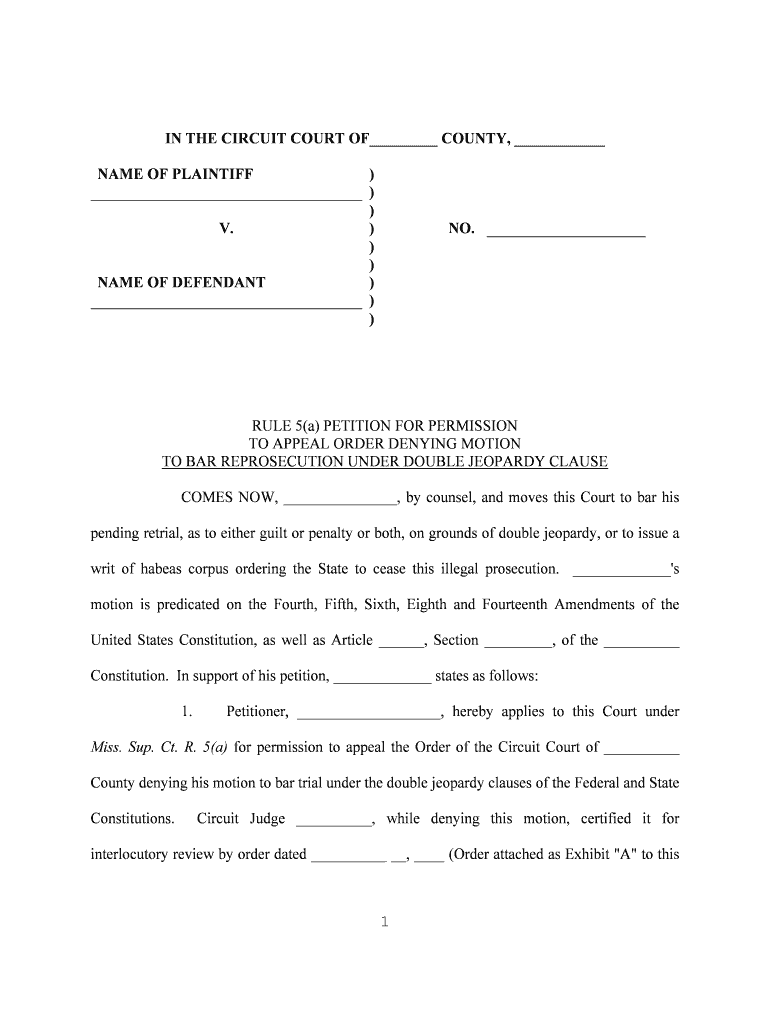
1 IN THE CIRCUIT COURT OF_________ COUNTY, ____________ NAME OF PLAINTIFF) )) V. )NO.))NAME OF DEFENDANT) )) RULE 5(a) PETITION FOR PERMISSION TO APPEAL ORDER DENYING MOTION TO BAR REPROSECUTION UNDER DOUBLE JEOPARDY CLAUSE COMES NOW, _______________, by counsel, and moves this Court to bar his
pending retrial, as to either guilt or penalty or both, on grounds of double jeopardy, or to issue a
writ of habeas corpus ordering the State to cease this illegal prosecution. _____________'s
motion is predicated on the Fourth, Fifth, Sixth, Eighth and Fourteenth Amendments of the
United States Constitution, as well as Article ______, Section _________, of the __________
Constitution. In support of his petition, _____________ states as follows:1. Petitioner, ___________________, hereby applies to this Court under
Miss. Sup. Ct. R. 5(a) for permission to appeal the Order of the Circuit Court of __________
County denying his motion to bar trial under the double jeopardy clauses of the Federal and State
Constitutions. Circuit Judge __________, while denying this motion, certified it for
interlocutory review by order dated __________ __, ____ (Order attached as Exhibit "A" to this
2 Petition). 2.As recognized by Judge Edmonds by his act of certification of this
question, only through interlocutory review can ____________________ be protected from the
substantial and irreparable injury of a second trial barred by the prohibition against double
jeopardy, Simon v. State , Order of __________ __, ____ at page 11; see Abney v. United States,
431 U.S. 651, 659, 97 S.Ct. 2034, 52 L.Ed.2d 651 (1977); Harden v. State, 460 So.2d 1194
(Miss. 1984). Circuit Judge __________ did not stay further proceedings pending this
interlocutory appeal, and the second, unconstitutional trial is currently set for __________ __,
____.
INTRODUCTION 3. "Double jeopardy . . . is the right to be free from a second prosecution, not
merely a second punishment . . . ." Fain v. Duff, 488 F.2d 218, 224 (5th Cir. 1973) (emphasis in
original); accord United States v. Sneed, 705 F.2d 745, 747 (5th Cir. 1983). A claim predicated
under the double jeopardy clause "contest[s] the very authority of the Government to hale him
into court to face trial on the charge against him." Abney v. United States, 431 U.S. 651, 659, 97
S. Ct. 2034, 52 L. Ed. 2d 651 (1977).
4. While it has long been clear that the double jeopardy clause may bar retrial on
the issue of culpability, it is now clear that the same principles apply to the penalty phase of a
capital trial: Once a sentence of life imprisonment has been imposed there may be no "second
bite at the apple" to try to secure a death sentence. See Bullington v. Missouri , 451 U.S. 430,
101 S. Ct. 1852, 68 L. Ed. 2d 270 (1980); Dycus v. State , 440 So. 2d 246 (Miss. 1983); Odom v.
State, 483 So. 2d 343 (Miss. 1986); Ex Parte Bell, 511 So. 2d 519 (Ala. Crim. App. 1987).
3 5. Applying these principles to the pending reprosecution of
___________________, it is apparent that he can be neither prosecuted on other charges arising
out of the same incident, nor can the state seek to impose a death sentence again in this case.A. THE FACTS.6. _____________________, has been previously tried and convicted of capital
murder predicated on acts taking place in __________ County. Four persons were killed in the
course of the crime charged, and the State indicted ____________________ separately for each
homicide. The State did this so that it could have four bites at the execution apple: If at first the
State did not succeed, they could try, try and try again. The long and the short of it is that the
State is now hoist on the petard of this unconstitutional strate gy.7. A review of the decisions taken by the prosecution in this case is critical to an
understanding of how the prosecu tion has brought themselves into their current procedural
logjam. The state initially sought and secured four separate indictments. The first charged him
with the Capital Murder (in the course of arson), Sexual Battery and Kidnapping of __________.
See State of Mississippi v. John CLIENT, No. _____ (_________ Co. __________ __, ____).
The second charged him with the Capital Murder (in the course of arson), Robbery and
Kidnapping of __________, and Burglary of Mr. __________ dwelling. See State of Mississippi
v. John CLIENT, Jr. , No. 5107 (__________ Co. __________ __, ____). The third charged him
with the Capital Murder (in the course of arson) and Kidnapping of __________. See State of
Mississippi v. John CLIENT, No. 5109 (__________ Co. __________ __, ____). Finally, the
fourth indictment charged ________________ with the Capital Murder (in the course of arson)
and robbery of __________. See State of Mississippi v. John CLIENT, No. 5111 (__________
4 Co. __________ __, ____). 8. All these indictments were multi-count indictments, as permitted by our law: (1) Two (2) or more offenses which are triable in the same court
may be charged in the same indictment with a separate count for
each offense if: (a) the offenses are based on the same act or
transaction; or (b) the offenses are based on two (2) or more acts or
transactions connected together or constituting parts of a common
scheme or plan. (2) Where two (2) or more offenses are properly charged in
separate counts of a single indictment, all such charges may be
tried in a single proceeding.Miss. Code Ann. 99-7-2 (Supp. 1989). Nothing prohibited all
the crimes from being charged in the same indictment. It was
simply the prosecution's decision to give themselves four separate
shots at conviction, and four separate shots at a death sentence.
Surely, the reasoning went, the defense would be sufficiently worn
down, and the odds multiplied by four rolls of the dice, to assure
_______________'s execution. This is, however, precisely the
kind of strategy, which the Double Jeopardy Clause was designed
to prohibit.9. The prosecution chose first to pursue the
indictment charging the capital murder of __________s. The
reasoning underlying this decision is fairly obvious: The tragedy
of young __________ death is enhanced by the emotional impact
of the evidence that she may have been sexually assaulted,
followed by her three-time shooting, and the evidence that she may
5 have died of asphyxiation.10. This case was set for trial on __________ __,
____. On __________ __, ____, the United States Supreme Court
decided Grady v. Corbin, ___ U.S. ___, 110 S. Ct. 2084, 109 L.
Ed. 2d 548 (1990), which expanded on the test for double jeopardy
first set forth Blockburger v. United States, 284 U.S. 299, 304
(1932). Grady v. Corbin made explicit what was already rather
obvious: That the prosecution's "wear-them-down" strategy in this
case was unconsti tutional.
11. On __________ __, ____, the prosecution filed
a Motion to Consolidate the four indictments against
____________. Revealingly, the prosecution argued as follows:
[I]n a United States Supreme Court case decided __________ __,
____, styled William V. Grady, District Attorney of Dutchess
County petitioner v. Thomas J. Corbin, No. 88-474, the court
under circumstances of that case [sic], held that that [sic] the
prosecution was barred from a subsequent prosecution if an
essential element of the first was required in proving conduct in the
second crime. * * * The prosecution in this case has only now
become aware of this recent decision of the Supreme Court and is
unsure of its consequences, but would be irreparably harmed in its
subsequent prosecutions after the first prosecution should the
above case be applicable to these cases.
Motion to Consolidate at paras. 2-3 (Motion attached as Exhibit
"B" to this Petition). This motion was heard shortly before the trial
date, and was denied by the trial court. The prosecution could
have sought immediate interlocutory review of this decision from
6 this Court, in light of their apparent certainty in the Motion to
Consolidate that they would be "irreparably harmed" by the
adverse ruling. See Miss. Sup. Ct. Rule 5. The prosecution chose
not to do so.
12. The case went to trial, and _______________
was convicted of Capital Murder, Sexual Battery and Kidnapping.
At the penalty phase, the prosecution failed to prove their case for
the death penalty, and the jury did not impose it. Therefore, as
required by law, the trial court imposed a sentence of life
imprisonment.13. Having failed in their first effort to obtain a
death sentence, the prosecution then sought to nolle prosequi the
three remaining indictments. Orders granting the motion as to
each indictment were entered on __________ __, ____. In the
meantime, two days after the initial life sentence, the prosecution
had sought another indictment charging three counts of capital
murder. See State of Mississippi v. John CLIENT, No. 5114
(__________ Co. __________ __, ____). This charged
__________________ with the Capital Murders of __________ (in
the course of an armed robbery), of __________ (in the course of a
kidnapping), and __________ (in the course of a burglary).
14. This case has now been set for trial on
________ __, ____, and the State apparently intends to seek the
7 death penalty anew. The planned proceedings fall squarely within
the proscription of the Double Jeopardy Clause.B. THE STATE IS BARRED BY PRINCIPLES
OF DOUBLE JEOPARDY FROM
REPROSECUTING __________, FOR
CAPITAL MURDER ARISING OUT OF THIS
SERIES OF EVENTS.15. When the prosecution read Grady v. Corbin,
there was good reason to wonder whether the Double Jeopardy
Clause would preclude successive prosecutions under the same
facts in an effort to wear down the indigent defendant and his
appointed counsel in this case. However, it is not as if Grady v.
Corbin stated anything new, for ten years before,
[i]n Illinois v. Vitale, 447 U.S. 410 (1980), [the United States
Supreme Court] suggested that even if two successive prosecutions
were not barred by the Blockburger test, the second prosecution
would be barred if the prosecution sought to establish an essential
element of the second crime by proving conduct for which the
defendant was convicted in the first prosecution.
Grady v. Corbin , 109 L. Ed. 2d 548, 557 (1990) (emphasis
supplied); see also Fugate v. New Mexico , 470 U.S. 904 (1985)
(affirming by equally-divided vote on Vitale issue); Thigpen v.
Roberts, 468 U.S. 27 (1984) (deciding case on alternative
grounds). In Grady, the Supreme Court explicitly adopted the rule
set forth in Illinois v. Vitale:
As we suggested in Vitale, the Double Jeopardy Clause bars any
subsequent prosecution in which the government, to establish an
8 essential element of an offense charged in that prosecution, will
prove conduct that constitutes an offense for which the defendant
has already been prosecuted.
Id., 109 L.Ed.2d 557 (emphasis supplied).17. In this case, the prosecution has already argued
__________________'s case for him in their Motion to
Consolidate:
There would be only minimal testimonial and evidentiary
differences in the trial or the trials of each case and the trial of the
cases consolidated. The defense in not [sic] way could be
prejudiced in the proof or in the preparation in this case.
Id. at para. 4. This was indeed true of the trial where the State's
theory was ___________________ killed all of the __________
family. The facts produced before the jury to support the initial
conviction were therefore identical to the facts which would be
introduced at the subsequent trials.
18. There are other independent reasons to dismiss
the current indictment on double jeopardy grounds.
____________ has already been convicted of kidnapping, arising
out of this event. It makes no difference that he was convicted of
the kidnapping of __________ rather than __________. Ashe v.
Swenson, 397 U.S. 436, 90 S. Ct. 1189, 25 L. Ed. 2d 469 (1970),
takes care of any notion that such a contention would be relevant.
9 19. In Ashe, the accused was charged in six
separate indictments with the armed robbery of six individuals at a
card game. The Supreme Court held that the first prosecution
barred any attempt to bring the other five cases because of the
doctrine of collateral estoppel "embodied in the Fifth Amendment
guarantee against double jeopardy," and concluded:
For whatever else that constitutional guarantee may embrace,
North Carolina v. Pearce, 395 U.S. 711, 89 S.Ct. 2072, 2076, it
surely protects a man who has been acquitted from having to 'run
the gauntlet' a second time. Green v. United States, 355 U.S. 184,
78 S.Ct. 221, 225.
Ashe v. Swenson, 90 S. Ct. at 1195. Therefore, Count II of the
new indictment is explicitly barred.
20. Similar defects taint Counts I and III. Count I
charges robbery, while Count III charges burglary--which is
defined as breaking into the dwelling with intent to steal goods
from within. Obviously, these two crimes are not distinct, for the
purposes of Grady v. Corbin .21. Grady v. Corbin made indisputable what was
already obvious: The State should not be allowed to take a single
criminal transaction and divide it up into several trials, to hone
down the eviden tiary presentation, and enhance the chances of
conviction and a sentence of death. As the Court held:
The underlying idea, one that is deeply ingrained in at least the
10 Anglo-American system of jurisprudence, is that the State with all
its resources and power should not be allowed to make repeated
attempts to convict an individual for an alleged offense, thereby
subjecting him to embarrassment, expense and ordeal and
compelling him to live in a continuing state of anxiety and
insecurity. . . .Id., 109 L. Ed. 2d at 562 (quoting Green v. United States, 355 U.S.
184, 187 (1957)). The Clause "prevents the State from honing its
trial strategies and perfecting its evidence through successive
attempts at conviction." Id. (quoting, Tibbs v. Florida , 457 U.S.
31, 41 (1982)). The same is true of multiple prosecutions even
after conviction. Id. at 561 (citing North Carolina v. Pearce , 395
U.S. 711, 717 (1969)). The same is true where the successive
efforts are aimed at securing a death sentence. Bullington v.
Missouri, 451 U.S. 430 (1980).
22. The rule in Grady v. Corbin is founded in
common sense, and is directly applicable to this case. If, as there,
the State could try [the accused] in four consecutive trials . . . [the
State could improve its presentation of proof with each trial,
assessing which witnesses gave the most persuasive testimony,
which documents had the greatest impact, which opening and
closing arguments most persuaded the jurors. [The accused] would
be forced either to contest each of these trials or to plead guilty to
avoid the harassment and expense.Id., 109 L. Ed. 2d at 564. In short, Grady v. Corbin left the
prosecution hoist on its own unprincipled plan for assuring a death
11 penalty. 23. And there is nothing unfair about that. Indeed,
in Grady v. Corbin the double jeopardy bar was erected because
the prosecution was "overworked and [did] not . . . have time to
monitor seemingly minor cases. . . ." Grady, 109 L. Ed. 2d at 566.
In this case, the prosecution knew very well what they were up to,
but simply misjudged by fabricating a basically unfair strategy to
secure ____________________'s execution. Under Article 3,
22, of the Mississippi Constitution, there is even more cause to
hold the second trial barred, since the provision provides that:
No person's life or liberty shall be twice placed in jeopardy for
the same offense: but there must be an actual acquittal or convic-
tion on the merits to bar another prosecution.
(emphasis supplied).24.The learned trial judge, however, failed to
apply Grady v. Corbin to the case at bar, despite the fact that the
defense explicitly argued same. Instead, the Circuit Court applied
a "same evidence" test, see Circuit Court Order at 4, which was
disavowed by the Supreme Court in Grady: "Commentators and
judges alike have referred to the Blockburger test as a 'same
evidence' test. . . . This is a misnomer." Grady , 109 L. Ed. 2d at
564 n.12. Additionally, the Court below focused exclusively on
the Blockberger test and its logical conclusions, see Order at 5,
12 whereas the Supreme Court in Grady expressly stated that "a
subsequent prosecution must do more than merely survive the
Blockburger test." Grady, 109 L. Ed. 2d at 564. Finally, the
Circuit Court objected several times to ______________'s position
on grounds that "'The words 'same offense' means same offense,
not the same transaction, not the same acts, not the same
circumstances or same situation,'" Circuit Court Order at 8-9
(quoting Burton v. State , 226 Miss. 31, 79 So.2d 242 (1955). This
was the position taken by the dissent in Grady. Indeed,
___________'s dissent makes clear that the Circuit Judge's logic
fails to survive Grady:
[The Double Jeopardy Clause] guarantees only the right not to be
put in jeopardy for the same offense, and has been interpreted
since its inception, as was its common-law antecedent, to permit a
prosecution based upon the same acts but for a different crime.
The Court today holds otherwise. . . .Grady, 109 L. Ed. 2d at 568 (Scalia, J., dissenting) (emphasis by
underlining supplied; boldface emphasis in original).
25.In short, the reprosecution of
_____________ is barred by the Double Jeopardy Clause as
interpreted by Grady v. Corbin . The Circuit Judge did not apply
Grady or its principles in his decision. ____________ should not
face a second reprosecution for capital murder, or run the gauntlet
of a second capital sentencing proceeding, without some Court
13 squarely facing the double jeopardy issue in light of Grady. If this
Court does so, ___________________ is convinced that the
reprosecution will be barred.
C. AT THE VERY LEAST, THE STATE IS
BARRED BY DOUBLE JEOPARDY FROM
SEEKING TO IMPOSE THE DEATH
PENALTY FOR ANY CRIME CONNECTED
WITH THIS SERIES OF EVENTS.26. Turning to the State's desire to continue to
pursue the death penalty in these cases, it is clear that that effort is
also barred. That this is a distinct question cannot be gainsaid.
See Bullington v. Missouri , 451 U.S. 430, 101 S. Ct. 1852, 68 L.
Ed. 2d 270 (1980); Dycus v. State, 440 So. 2d 246 (Miss. 1983);
Odom v. State, 483 So. 2d 343 (Miss. 1986); Ex Parte Bell, 511
So. 2d 519 (Ala. Crim. App. 1987).
27. As the prosecution has conceded in the Motion
to Consolidate, and as was apparent from the trial in this matter,
the jury was aware of all the four alleged murders, and did not feel
that the crimes deserved the death penalty. Indeed, the prosecution
chose to pursue the sexual battery, kidnapping and murder of little
__________ first because, if there was any distinction between the
cases, this emotional crime was the one most likely to tip the scales
towards death.
28. It was clear long before Grady v. Corbin that, in
reviewing the verdict from the first trial, this Court should look for
14 the general intent of the sentencer: The disposition of this case is controlled by the Ashe "rational
jury" test, which is what a rational jury could and could not have
decided based upon an examination of what was presented and
argued to the jury. As stated in Ashe,
Where a previous judgment . . . was based on a
general verdict, as is usually the case, this approach
requires a court to examine the record of a prior
proceeding, taking into account the pleadings,
evidence, charge, and other relevant matter, and
conclude whether a rational jury could have
grounded its verdict on an issue other than that
which the defendant seeks to foreclose from
consideration.
Griffin v. State, 545 So.2d 729, 734 (Miss. 1989) (quoting Ashe v.
Swenson, 397 U.S. at 444).
29. Here, the prosecution has conceded in its
Motion to Consolidate that the evidence presented to the jury was
effectively identical with respect to the cases tried together, and the
cases tried separately. Quod erat demonstrandum. The
prosecution failed to prove that _______________ deserved to die.
It is now collaterally estopped from trying to prove it anew. As
stated in Ashe v. Swenson,
"Collateral estoppel" is an awkward phrase, but it stands for an
extremely important principle in our adversary system of justice.
It means simply that when a issue of ultimate fact has once been
determined by a valid and final judgement, that issue cannot again
be litigated between the same parties in any future lawsuit.
15 Ashe, 90 S. Ct. at 1194. Thus, as a jury has already passed on the
issue of whether ________________ should be put to death or,
instead, serve a sentence of life imprisonment for the crime that
took place in __________ County, the State is collaterally
estopped from trying that issue over and possibly over again.
D. THE STATE BEARS THE BURDEN OF
PROVING THAT THE DOUBLE JEOPARDY
CLAUSE DOES NOT BAR RETRIAL ON
THESE MATTERS.30. When the accused places the question of double
jeopardy in issue, "the burden shifts to the government. . . ."
United States v. Ragins, 840 F.2d 1184, 1192 (4th Cir. 1988)
(citing cases). At this point, in order to show that reprosecution is
permitted, the State bears "the burden of proof] by a preponderance
of the evidence. . . ." United States v. Futch, 637 F.2d 386, 388
(5th Cir. Unit B, 1981); accord United States v. Strickl in, 591 F.2d
1112, 1118 (5th Cir. 1979), cert. denied , 444 U.S. 963, 100 S. Ct.
449, 62 L. Ed. 2d 375 (1979); United States v. Mallah , 503 F.2d
971, 985-86 (2d Cir. 1974), cert. denied , 420 U.S. 995, 95 S. Ct.
1425, 43 L. Ed. 2d 671 (1975); United States v. Inmon , 568 F.2d
326, 329-30 (3d Cir. 1977). In light of the constitutional
implications of the double jeopardy clause, this "burden rests
heavily upon the Government. . . ." United States v. Pinto , 486
F.Supp. 578, 580 (E.D. Pa. 1980).
16 31. As this Court considers the elements of the
double jeopardy bar discussed above, it should be borne in mind
that the prosecution bears the burden of proof.E. SINCE THE DOUBLE JEOPARDY
CLAUSE PROTECTS JOHN CLIENT FROM
BEING SUBJECTED TO ANY
PROCEEDINGS ON A RETRIAL, THE
SUPREME COURTS OF MISSISSIPPI AND
THE UNITED STATES HAVE HELD THAT
AUTOMATIC REVIEW MUST BE ALLOWED
PRE-TRIAL IF A PLEA IN BAR IS
OVERRULED.32. It is well-settled that the right to freedom from
double jeopardy protects the accused against multiple prosecutions,
as well as multiple convictions and punishments. The United
States Supreme Court explained this principle in Abney v. United
States, 431 U.S. 651 (1977):
[T]his Court has long recognized that the Double Jeopardy Clause
protects an individual against more than being subjected to double
punishments . . . it assures an individual that . . . he will not be
forced . . . to endure the personal strain, public embarrassment, and
expense of a criminal trial more than once the for same offense. It
thus protects interests wholly unrelated to the pro priety of any
subsequent conviction.Id. at 600-61; see also Justice of Boston Municipal Court v. Lydon,
466 U.S. 294, 303 (1984); Fain v. Duff, 488 F.2d 218, 224 (5th
Cir. 1973). The harm created by successive trials if heightened
when the accused faces the possibility of being executed at the end
of the trial. See Bullington v. Missouri, 451 U.S. 430, 445 (1981).
17 33. The double jeopardy clause therefore includes
the right to final disposition of any plea in bar before any other
litigation in the trial court, and before any trial proceedings. This
was made explicitly clear in Abney:
[T]he protections [of the Double Jeopardy Clause] would be lost
if the accused were forced to "run the gauntlet" a second time
before an appeal could be taken: even if the accused is acquitted,
or if convicted, has his conviction ultimately reversed on double
jeopardy grounds, he has still been forced to endure a trial that the
Double Jeopardy Clause was designed to prohibit. Consequently,
if a criminal defendant is to avoid exposure to double jeopardy and
thereby enjoy the full protection of the Clause, his double jeopardy
challenge to the indictment must be reviewable before that
subsequent exposure occurs.
Id. at 662 (emphasis supplied in part); accord United States v.
Hollywood Motor Car Co., 458 U.S. 263, 266 (1982); United
States v. Alessi, 536 F.2d 978, 980 (2d Cir. 1976); United States v.
McQuilken, 673 F.2d 681, 685 (3d Cir. 1982); United States v.
Jelsma, 630 F.2d 778, 779 (10th Cir. 1980).
34. An accused who has raised a double jeopardy
"claim would be irreparably harmed if the trial court were allowed
to proceed to trial prior to the appellate court's disposition of the
claim. . . ." United States v. Claiborne , 727 F.2d 842, 851 (9th Cir.
1984). Indeed, so important is this constitutional right that "federal
courts would have the power to enjoin state criminal proceedings
that would constitute double jeopardy. . . ." Davis v. Herring, 800
18 F.2d 513, 515-16 (5th Cir. 1986) (emphasis supplied); accord
Allen v. Johnstone, 575 F. Supp. 935, 938 (S.D. Iowa 1983)
("appropriate . . . relief is to stay temporarily the state court
criminal trial to give [the defendant] the opportunity to present the
issue to the [appellate court]").
35. The __________ Supreme Court has also
recognized the criminal defendant's right to immediate
interlocutory review of a double jeopardy claim, where it is denied
by the trial court. In Harden v. State, 460 So. 2d 1194 (Miss.
1984), the accused appealed the trial court's denial of his double
jeopardy claim. The Supreme Court stated in no uncertain terms:
[Where the defendant] has presented us with a double jeopardy
violation in his habeas corpus petition . . . it is our duty to interfere
and tell the state he cannot be prosecut ed. For, such a grave
constitutional violation would be one of those exceptional circum-
stances obligating this Court to abort trial proceedings.
Id. at 1200-01 (emphasis supplied); see also In the interest of
W.R.A., 481 So. 2d 280, 288 (Miss. 1985); State v. Caldwell, 492
So. 2d 575 (Miss. 1986); Griffin v. State, 545 So. 2d 729 (Miss.
1989). Relying on Abney v. United States, our sister states have
likewise uniformly ruled that a double jeopardy claim must be
subject to pre-trial appellate review: "the rights conferred by a
criminal accused by the Double Jeopardy clause would be signifi-
cantly undermined if appellate review of double jeopardy claims
19 were postponed. . . ." Patterson v. State , 248 Ga. 875, 287 S.E. 2d
7, 8 (1982); see also County Court of El Paso v. Ruth, 575 P. 2d 1,
3-4 (Colo. 1978); State v. Ambrose, 598 P. 2d 354, 357 (Utah
1979); State ex rel. Dowdy v. Robinson , 257 S.E. 2d 167, 168 (W.
Va. 1979); Application of Berkowitz , 602 P. 2d 99, 103 (Ky
1979); State v. Thomas, 400 N.E. 2d 897 (Pa. 1980); State v.
Mestas, 605 P. 2d 1164, 1166 (N.M. 1980); Wiley v. Altman, 420
N.E. 2d 371 (N.Y. 1981); State v. Cagle, 626 S.W. 2d 719 (Tenn.
1981); Ex Parte Robinson, 641 S.W. 2d 552, 555 (Tex. 1982);
State v. Sundel, 460 A. 2d 939, 942 (R.I. 1983); In the Interest of
R.R., 464 A. 2d 348, 353 (Pa. 1983); Sigma Reproductive Health
Center v. State, 467 A. 2d 483 (Md. 1983); Stamper v. State , 672
P. 2d 106 (Wyo. 1983); State v. Keel , 512 N.E. 2d 420 (Ind.
1987).
36. Therefore, the Circuit Judge's certification
of this issue for interlocutory review was correct. However, for
these same reasons, it is clear that any proceedings aimed at a
second trial in this cause should be stayed under Miss. Sup. Ct. R. 5
(e) pending resolution of the weighty issues raised in this interlocu -
tory appeal. The vindication of _________________'s right to be
free from multiple prosecutions will be hollow indeed if further
hearings, and a second trial, takes place while this Court decides
the question on the merits. A stay must be granted to preserve
20 ____________________'s right to be free from double jeopardy. _____________________ therefore prays this Court
to grant his motion for interlocutory review under Rule 5(a), to
stay further proceedings in the trial Court pursuant to Rule 5(e)
pending interlocutory review, and, upon such review, to bar the
State from retrying ________________ on these capital charges.Respectfully submitted,____________________By:_______________________________________ CERTIFICATE OF SERVICE I, ________________, attorney for _______________, do
hereby certify that I have on this day mailed, postage prepaid, a
true and correct copy of the foregoing Motion to This the ____ day of _____________, _____ ________________________________________